SEO vs AEO vs GEO vs AIO vs SXO: The Complete Guide
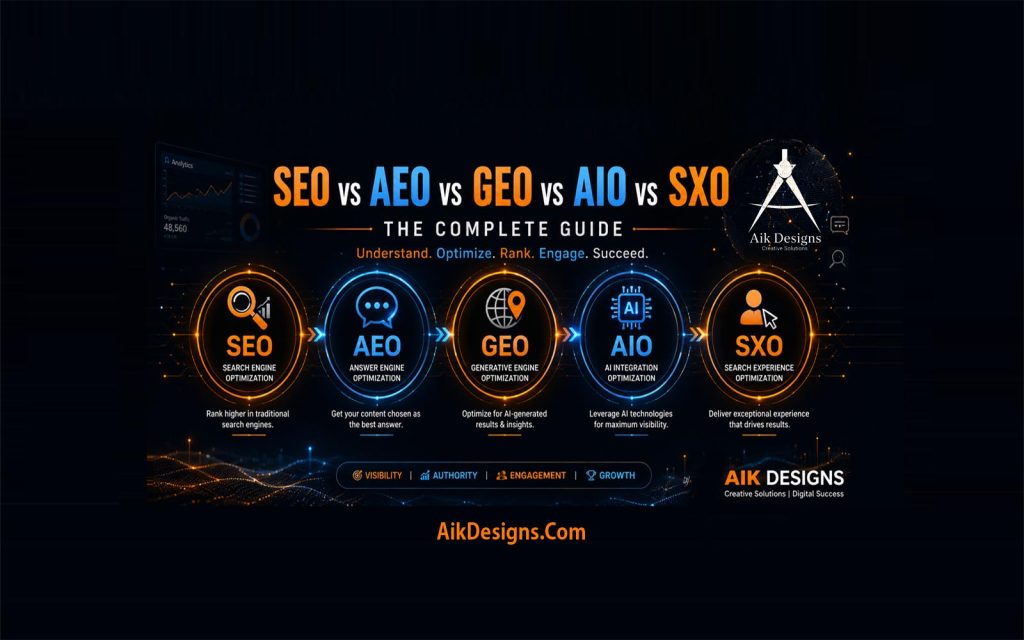
If you’ve been researching search marketing lately, you’ve probably run into a wall of acronyms: SEO, AEO, GEO, AIO, and SXO. They sound similar, they overlap in places, and most articles online throw them at you without ever explaining how they actually connect. This guide breaks down each term in plain language, shows you exactly how they differ, and gives you a practical framework for using all five together to stay visible whether someone is searching on Google, asking a voice assistant, or chatting with an AI tool.
⚡ Modern SEO Quick Facts
📌 SEO = Search Engine Optimization — ranking in traditional search results
🗣️ AEO = Answer Engine Optimization — winning voice and snippet answers
🤖 GEO = Generative Engine Optimization — getting cited in AI-generated answers
🧠 AIO = AI Optimization — the broader umbrella covering all AI-driven search surfaces
🎯 SXO = Search Experience Optimization — SEO combined with on-page UX and conversion
📋 Table of Contents
- What Is SEO (Search Engine Optimization)?
- What Is AEO (Answer Engine Optimization)?
- What Is GEO (Generative Engine Optimization)?
- What Is AIO (AI Optimization)?
- What Is SXO (Search Experience Optimization)?
- SEO vs AEO vs GEO vs AIO vs SXO: Side-by-Side Comparison
- How These Five Strategies Work Together
- How To Build A Modern Search Optimization Strategy
- Common Mistakes To Avoid
- Frequently Asked Questions
- Conclusion
1. What Is SEO (Search Engine Optimization)?
SEO is the practice of improving a website so it ranks higher in traditional search engine results pages, primarily Google. It’s the foundation everything else in this guide is built on.
Core Pillars of SEO
SEO is generally broken into three main areas:
- Technical SEO — site speed, crawlability, indexation, mobile-friendliness, structured data, and Core Web Vitals.
- On-page SEO — keyword targeting, title tags, headings, internal linking, and content quality.
- Off-page SEO — backlinks, brand mentions, and external signals of authority and trust.
💡 Tip: If your technical SEO foundation is weak, AEO and GEO efforts built on top of it will struggle too. Fix crawlability and page speed first.
Traditional SEO is still the base layer for everything else on this list. Even AI answer engines rely on well-indexed, well-structured web pages to source their answers from, so skipping SEO fundamentals to chase AI visibility usually backfires.
2. What Is AEO (Answer Engine Optimization)?
AEO focuses on getting your content selected as the direct answer to a question, whether that’s a Google featured snippet, a voice assistant response from Siri or Alexa, or a “People Also Ask” box.
How AEO Differs From Traditional SEO
Traditional SEO optimizes for rankings and clicks. AEO optimizes for being the answer, sometimes without a click happening at all. That means the writing style shifts: short, direct, quotable answers near the top of the page, followed by supporting detail.
AEO Best Practices
- Answer the core question in the first 1-2 sentences under a heading
- Use question-based H2s and H3s that mirror real search queries
- Add FAQPage schema so search engines can extract Q&A pairs cleanly
- Keep answers factual, specific, and free of fluff
⚠️ Warning: Winning a featured snippet or voice answer often means the searcher gets what they need without visiting your site. Balance AEO wins with content designed to still drive clicks for commercial intent queries.
3. What Is GEO (Generative Engine Optimization)?
GEO is the practice of optimizing content so it gets referenced, summarized, or cited inside AI-generated answers from tools like ChatGPT, Google AI Overviews, Gemini, and Perplexity.
Why GEO Is Different From SEO and AEO
SEO ranks a page. AEO wins a snippet. GEO gets your brand or content mentioned inside a synthesized answer that an AI model generates by pulling from multiple sources at once. There’s no single “ranking position” to chase, you’re competing to be one of the sources the model trusts enough to cite.
GEO Best Practices
- Publish original data, statistics, or first-hand experience AI models can’t get elsewhere
- Write clear, well-structured explanations that are easy for a model to summarize accurately
- Build topical authority across a full content cluster, not just one page
- Keep information factually consistent across your site so AI systems trust it
ℹ️ Info: GEO is closely tied to E-E-A-T. Generative engines favor sources that demonstrate real experience, expertise, authoritativeness, and trust.
4. What Is AIO (AI Optimization)?
AIO is the umbrella term for optimizing visibility across every AI-driven search and discovery surface, not just generative answer engines. It includes GEO, but also covers AI shopping assistants, AI browser copilots, and AI agents that take actions on a user’s behalf.
Where AIO Fits
Think of AIO as the widest circle: it contains GEO (getting cited in generated answers) and overlaps with AEO (being selected as a direct answer), but also stretches into newer territory like AI agents comparing products, prices, or services on a user’s behalf without a traditional search happening at all.
AIO Best Practices
- Keep structured product, pricing, and service data accurate and machine-readable
- Use schema markup consistently across the whole site, not just blog posts
- Monitor how AI tools describe your brand and correct inaccuracies where possible
- Treat AI crawlers (like GPTBot and Google-Extended) the same way you’d treat Googlebot: don’t block them if you want AI visibility
5. What Is SXO (Search Experience Optimization)?
SXO merges SEO with user experience design. The goal isn’t just to rank or get cited, it’s to make sure that once someone lands on your page, the experience is fast, clear, and leads them toward a meaningful next step.
Why SXO Matters More As AI Search Grows
As AEO and GEO reduce the number of clicks search engines send you, the clicks you do get become more valuable. SXO makes sure those visitors convert instead of bouncing.
SXO Best Practices
- Optimize Core Web Vitals and mobile page speed
- Match page content precisely to search intent so visitors don’t bounce back to the results page
- Use clear layout, readable typography, and obvious calls to action
- Reduce friction in forms, checkout flows, and navigation
🚫 Caution: Ranking #1 with a slow, cluttered, or confusing page still loses to a well-optimized #3 result in terms of actual business results. Don’t optimize rankings while ignoring the page visitors actually land on.
6. SEO vs AEO vs GEO vs AIO vs SXO: Side-by-Side Comparison
| Term | Full Name | Primary Goal | Where It Shows Up |
|---|---|---|---|
| SEO | Search Engine Optimization | Rank pages in organic search results | Google, Bing search results pages |
| AEO | Answer Engine Optimization | Become the direct answer to a query | Featured snippets, voice assistants, PAA boxes |
| GEO | Generative Engine Optimization | Get cited inside AI-generated answers | Google AI Overviews, ChatGPT, Gemini, Perplexity, Microsoft Copilot |
| AIO | AI Optimization | Stay visible across all AI-driven surfaces | AI chat tools, AI agents, AI browser copilots |
| SXO | Search Experience Optimization | Turn search visitors into conversions | On-page experience after the click |
7. How These Five Strategies Work Together
None of these five approaches replace the others. They stack:
- SEO gets your page indexed, technically sound, and eligible to rank at all.
- AEO shapes how that content is structured so it can win direct-answer placements.
- GEO makes sure that same well-structured, authoritative content gets pulled into AI-generated summaries.
- AIO extends that visibility across the full range of AI tools and agents beyond just chat-style answer engines.
- SXO makes sure that whichever channel sends the visitor, the page itself converts them once they land.
8. How To Build A Modern Search Optimization Strategy
Step 1: Audit Your Current SEO Foundation
Before layering on AEO or GEO tactics, confirm your technical SEO is solid: fast load times, clean crawlability, and proper indexation. Tools like Core Web Vitals fixes are a good starting point.
Step 2: Map Content To Real User Questions
Use a proper keyword research process to find the exact questions your audience is asking, then structure your headings around those questions for AEO.
Step 3: Add Structured Data
Implement FAQPage, HowTo, and Article schema consistently so both traditional search engines and AI systems can parse your content accurately.
Step 4: Write For Citation, Not Just Ranking
Add original data, first-hand experience, and clear definitions. This is the same foundation covered in our guide to writing for E-E-A-T, and it directly supports GEO and AIO visibility.
Step 5: Optimize The Full On-Page Experience
Improve speed, layout, and mobile usability so the visitors who do click through actually convert. This is the SXO layer on top of everything else.
Step 6: Track Visibility Across All Five Channels
Monitor traditional rankings, featured snippet wins, appearances in Google AI Overviews, citations in AI chat tools, and on-site engagement metrics together, not in isolation.
9. Common Mistakes To Avoid
- Chasing GEO or AIO tactics while ignoring basic technical SEO
- Writing vague, marketing-heavy copy that AI models can’t confidently summarize or cite (Suggested: AI Writing Tools)
- Blocking AI crawlers entirely and then wondering why the brand never appears in AI answers
- Winning snippets and AI citations but sending traffic to a slow, cluttered page that fails at SXO
- Treating these five terms as separate departments instead of one connected strategy
💡 Tip: Related reading: our AI SEO Tips 2026 guide to Search Generative Experience (SGE) and AI search visibility guide go deeper into the GEO and AIO side of this strategy.
10. Frequently Asked Questions
What does AEO stand for in SEO?
AEO stands for Answer Engine Optimization. It means structuring content so voice assistants, featured snippets, and answer engines can pull out a direct, correct answer to a user’s question.
What is the difference between SEO and GEO?
SEO focuses on ranking web pages in traditional blue-link results. GEO focuses on getting a brand cited or summarized inside AI-generated answers from tools like ChatGPT, Gemini, and Google AI Overviews.
Is AIO the same as GEO?
They overlap but aren’t identical. GEO refers narrowly to optimizing for generative answer engines, while AIO is the broader umbrella covering GEO plus AI chatbots, AI-powered search features, and AI agents in general.
What does SXO mean in digital marketing?
SXO stands for Search Experience Optimization. It combines SEO with UX principles, focusing on how satisfying and usable a page feels after a visitor lands on it, not just whether it ranks.
Do I need to choose between SEO, AEO, GEO, AIO, and SXO?
No. These aren’t competing strategies, they’re layers of the same modern search optimization approach. A strong SEO foundation supports AEO and GEO, and SXO ensures the traffic that arrives actually converts.
Which is more important in 2026, SEO or GEO?
SEO remains the foundation because AI answer engines still rely heavily on indexed, well-structured web content. GEO is increasingly important on top of that foundation as more searches resolve directly inside AI answers.
How do I optimize content for Google AI Overviews?
Write clear, direct answers near the top of the page, use structured headings, add FAQ and HowTo schema, cite credible data, and demonstrate first-hand experience so Google’s AI systems can confidently extract and cite the content.
Does schema markup help with AEO and GEO?
Yes. FAQPage, HowTo, and Article schema make it easier for answer engines and AI models to parse the structure and meaning of a page, increasing the chance of being selected as a source for a direct answer.
What is an example of SXO in practice?
A page that not only ranks for a keyword but also loads quickly, is easy to navigate on mobile, answers the searcher’s intent immediately, and guides the visitor toward a clear next step or conversion.
Will AEO and GEO replace traditional SEO?
Unlikely in the near term. AEO and GEO are built on top of the same technical and content fundamentals as SEO. Rather than replacing it, they extend SEO to cover voice assistants and AI-generated answers.
How can a small business start with AI search optimization?
Start by fixing core SEO fundamentals, then add clear question-and-answer sections, structured data, and concise summaries near the top of key pages so both traditional search engines and AI systems can easily understand and cite the content.
11. Conclusion
SEO, AEO, GEO, AIO, and SXO aren’t rival strategies fighting for your attention, they’re five layers of one connected approach to staying visible as search evolves from blue links to AI-generated answers. Start with a solid SEO foundation, structure content for direct answers with AEO, earn citations in AI summaries with GEO and AIO, and close the loop with SXO so every visitor who arrives actually converts.
If you’d rather have this handled for you, Aik Designs builds full-funnel search visibility strategies covering SEO, AEO, GEO, AIO, and SXO for clients across 13+ countries. Get in touch to audit your current search visibility →
About Author