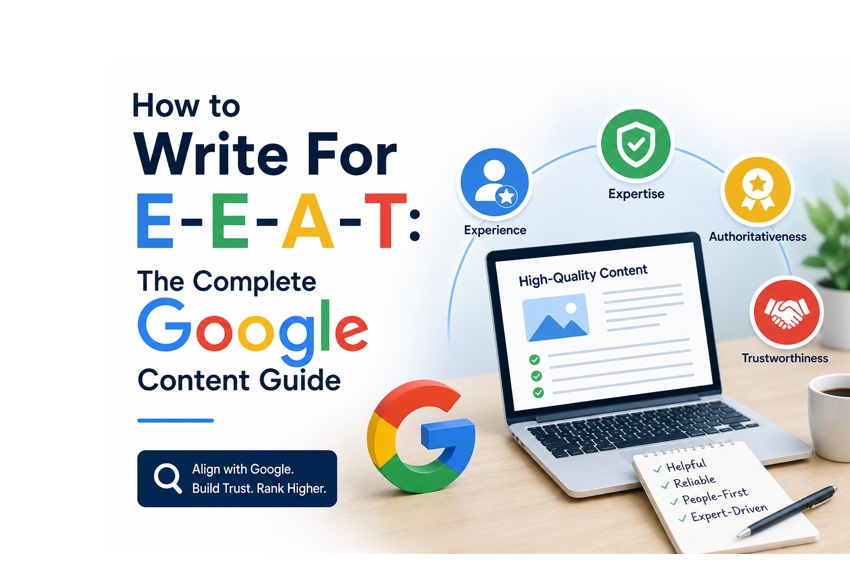
How to Write For E-E-A-T: The Complete Google Content Guide
By Ali Irfan Khan | Founder & CEO, Aik Designs | Updated: May 2026 | Reading Time: ~14 Minutes
You have probably heard the advice: ‘just create quality content.’ But in 2026, that phrase means nothing without a framework — and Google’s framework has a name: E-E-A-T.
If your website is losing rankings, getting passed over for AI Overview citations, or simply not growing despite publishing regularly, the most likely reason is not your keyword strategy or your backlink count. It is that your content is not demonstrating enough Experience, Expertise, Authoritativeness, and Trustworthiness — the four signals Google now uses as a gatekeeper for ranking.
This guide will teach you exactly what E-E-A-T means in 2026, why it matters more than ever before, and — most importantly — how to write content that earns Google’s trust from the very first paragraph. No fluff. No vague advice. Just a clear, step-by-step content writing framework you can apply to every blog post you publish.
Quick Answer: What Is E-E-A-T?
E-E-A-T stands for Experience, Expertise, Authoritativeness, and Trustworthiness. It is the quality framework embedded in Google’s Search Quality Rater Guidelines that shapes how Google’s algorithms evaluate and rank content. It is not a single ranking score — it is a collection of signals across your entire website, your author profiles, your reputation online, and the way your content is written and structured.
In simple terms: Google wants to know who wrote your content, why they are qualified to write it, whether others trust them, and whether your website is safe and honest. Content that answers all four questions confidently gets ranked. Content that does not, gets pushed down — or ignored entirely.
Why E-E-A-T Matters More Than Ever in 2026
E-E-A-T is not new — Google has used versions of this framework since 2014. But in 2026, it has become the most decisive quality signal in search.
The AI Content Flood
Billions of pages of AI-generated content have hit the web since 2023. Most of it is grammatically correct, keyword-optimised, and completely hollow — no real author, no real experience, no original insight. Google’s systems have become significantly better at detecting this content and downranking it.
The March 2026 Core Update Amplified Experience
Google’s most recent major update elevated the first E — Experience — beyond all other signals, including traditional authority indicators like link equity. Sites with named, credentialed authors, verifiable credentials, and first-person case studies gained the most ground. Content without a real author, a verifiable perspective, or original data was actively devalued.
AI Overviews Reward E-E-A-T
When Google’s Gemini model selects sources to cite inside AI Overview boxes, it disproportionately favours content tied to recognised entities and reliable sources. Strong E-E-A-T is not just a ranking signal — it is an AIO citation signal. The two are now inseparable.
| “In 2026, E-E-A-T is not a guideline — it is a gatekeeper. Content without visible experience, ownership, and trust signals will increasingly struggle to compete, no matter how well it is optimised.” |
The Four Pillars of E-E-A-T — Explained Clearly
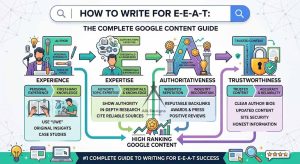
1. Experience (The First E)
Experience asks one question: Has the person who wrote this content actually done the thing they are writing about? This is the newest and now the most heavily weighted of the four pillars.
A financial advisor has Expertise. Someone who has personally invested through multiple market cycles and documented their losses and wins has Experience. A web designer with certifications has Expertise. A web designer who has built 200+ client websites and can share real results has Experience. Google wants the latter — and so do your readers.
What experience looks like in content:
- Specific numbers and outcomes (‘We reduced page load time from 8 seconds to 1.4 seconds on this client’s WordPress site’)
- Named tools, platforms, and methods you actually used
- Documented failures, pivots, and lessons — not just successes
- Original screenshots, photos, or videos from real work
- First-person language grounded in lived involvement, not just research
2. Expertise
Expertise asks: Does the author have genuine knowledge, credentials, or demonstrated competence in this topic area? It is about depth — the difference between a surface-level overview anyone could write after an afternoon of research versus content that reveals deep, earned understanding.
What expertise looks like in content:
- Technical accuracy and depth that goes beyond what a layperson could write
- Correct use of industry-specific terminology without unnecessary jargon
- References to methodologies, frameworks, and processes used by professionals
- Content that covers edge cases, exceptions, and nuances — not just the basics
- A recognisable author who publishes consistently in their field
3. Authoritativeness
Authoritativeness asks: Do others — other websites, publications, industries, communities — recognise you or your site as a trusted source? While Experience and Expertise are about what is on your page, Authoritativeness is about your reputation across the web.
What authoritativeness looks like off-page:
- Backlinks from recognised industry publications
- Guest posts and interviews on respected platforms
- Brand mentions on high-authority websites — even without hyperlinks
- Industry awards, certifications, and recognitions
- Consistent NAP (Name, Address, Phone) across directories and business listings
- Active, credible Google Business Profile with genuine reviews
4. Trustworthiness
Trustworthiness is the most important pillar. Google’s own Quality Rater Guidelines state it clearly: ‘Trustworthiness is the most important member of the E-E-A-T family because untrustworthy pages have low E-E-A-T no matter how Experienced, Expert, or Authoritative they may seem.’
What trustworthiness looks like on your website:
- HTTPS security — non-negotiable baseline in 2026
- A detailed, real About page with the people behind the work
- Clear, accurate author bios with photos, credentials, and external profile links
- Transparent sourcing — linking out to data, studies, and references you cite
- Proper privacy policy, contact page, and legal information
- Customer reviews and testimonials with verifiable attribution
- ‘Last updated’ dates on all time-sensitive content
How to Write for E-E-A-T: A Step-by-Step Content Framework
Step 1: Start With a Named, Credentialed Author — Always
This is the single most impactful change you can make right now. Every blog post must have a real, named author — not ‘Admin,’ not ‘Aik Designs Team,’ not an anonymous byline. Google now uses Author Entity profiles. It tracks who wrote the content and where else they appear on the web.
Action steps:
- Create a dedicated author page for every person who writes on your blog
- Include a professional photo, name, title, credentials, years of experience, and links to LinkedIn
- Add an author bio box at the bottom of every published post
- Link the author name in the byline to the author page
- Keep the author’s publishing record consistent across platforms
Step 2: Open Every Article With a Direct, Expert Answer
Burying your main insight 1,000 words into a post is a legacy SEO habit that actively hurts you in 2026. The first 2–3 sentences of any post should deliver a clear, expert-level answer to the query the post is targeting.
| Weak opener: ‘In today’s digital world, having a fast website is more important than ever. Many businesses struggle with technical SEO and…’
Strong E-E-A-T opener: ‘Core Web Vitals are three specific technical metrics — LCP, INP, and CLS — that Google uses to measure the real-world user experience of a web page. A page that scores well on Core Web Vitals loads fast, responds instantly to interaction, and does not shift layout unexpectedly. As of 2026, these metrics directly influence your Google rankings.’ |
Step 3: Add Original Experience Signals Throughout the Content
This is what separates E-E-A-T content from generic content. After your direct answer, you need to demonstrate that you have actually lived the topic you are writing about.
- Case studies from real client work: ‘When we redesigned a Karachi-based retail website in early 2025, we increased organic traffic by 140% in four months by doing three specific things…’
- Real data from your own tests: ‘We tested three different meta description formats across 40 blog posts and found that question-based meta descriptions had a 23% higher CTR.’
- Named tools with honest assessments: ‘We use Ahrefs for keyword research and Search Console for performance tracking — here is exactly how we use them together.’
- Documented lessons and mistakes: ‘One mistake we see constantly with Pakistani business websites is prioritising desktop design over mobile performance.’
- Original screenshots and visuals from real work and real dashboards
Step 4: Cite Sources and Link Out to Credible References
Citing credible external sources — Google’s own documentation, peer-reviewed research, established industry studies, official data — is a trust signal. It shows that your content is grounded in verifiable information, not opinion presented as fact.
- Link to primary sources rather than secondary summaries
- Include the publication date of cited sources
- Never cite a source you have not actually read and verified
- Update your citations when data becomes outdated
Step 5: Structure Content for Depth, Not Length
E-E-A-T is not about word count. A 600-word article written by a genuine expert with original examples outperforms a 3,000-word piece of padded, generic content. Genuine depth usually does produce longer content naturally — because real expertise has more to say.
- Cover the main topic fully, including edge cases and nuances
- Anticipate follow-up questions and answer them in the same piece
- Use concrete, specific examples rather than vague generalisations
- Avoid filler phrases — they add length without adding value
Step 6: Build a Topic Cluster Around Every Core Subject
E-E-A-T is evaluated at the site level. A website that has published 30 well-researched, interconnected articles on SEO sends a far stronger topical authority signal than a site with one excellent SEO article and 29 unrelated posts.
For Aik Designs, the SEO content cluster currently being built includes:
- What Is Google AI Overview (AIO) — Published
- How to Write for E-E-A-T — This post
- Core Web Vitals Checklist 2026 — Coming soon
- Local SEO Guide for Pakistan 2026 — Coming soon
- How Much Does a Website Cost in Pakistan — Coming soon
Step 7: Maintain and Update Content Regularly
Outdated content is a trust problem. An article with statistics from 2022 published on a 2026 blog sends a clear signal: this website is not actively maintained.
- Add a visible ‘Last Updated’ date to every post and actually update the content when you update the date
- Set a review cycle — at minimum once per year; for SEO and AI topics, every 3–6 months
- Replace outdated statistics with current data
- Remove or consolidate posts that are no longer accurate or relevant
The E-E-A-T Content Writing Checklist
Author Signals
- Named, real author on every post (not ‘Admin’ or ‘Team’)
- Author bio box at the bottom of the post with photo, credentials, and links
- Author name linked to a dedicated author page
- Author has consistent presence on LinkedIn and other relevant platforms
Experience Signals
- At least one real case study, example, or first-person experience in the post
- Original data, screenshots, or visuals from actual work
- Specific numbers and outcomes — not vague claims
- Honest acknowledgement of limitations, edge cases, or exceptions
Expertise Signals
- Direct, expert-level answer in the first 2–3 sentences
- Technical accuracy reviewed before publishing
- Content covers the topic with genuine depth, not surface-level generalisations
- Industry-specific language used correctly and naturally
Authoritativeness Signals
- External links to credible, primary sources
- Internal links to related cluster content
- Mention of credentials, certifications, or industry recognition where relevant
Trustworthiness Signals
- All facts and statistics cited with source and date
- ‘Last Updated’ date visible and accurate
- No broken links or outdated references
- HTTPS and technical performance basics confirmed
Common E-E-A-T Mistakes to Avoid
- Publishing without a named author — the most common and most damaging mistake
- Writing from research alone without personal experience — aggregation is not E-E-A-T content
- Treating E-E-A-T as a one-time project — it is an ongoing commitment to quality
- Ignoring off-page signals — your content can be excellent but authoritativeness is low without external recognition
- Mass-producing AI content without human expertise or oversight
Frequently Asked Questions About E-E-A-T
Is E-E-A-T a direct Google ranking factor?
No — Google does not assign an E-E-A-T score to individual pages or websites. It is a quality framework that shapes the signals Google’s algorithms measure and weight. In practical terms, strong E-E-A-T = stronger underlying ranking signals. The effect on rankings is very real, even if the mechanism is indirect.
Does E-E-A-T apply to every type of website?
Yes, but the standards vary by topic. YMYL topics (health, finance, law, safety) require the highest possible E-E-A-T signals. Non-YMYL topics like web design or digital marketing also require E-E-A-T, but the bar for expertise is more accessible for demonstrated practitioners.
Can AI-written content have good E-E-A-T?
It depends entirely on how it is used. AI content that expands on genuinely experienced input — real case studies, original data, expert review and editing — can perform well. AI content generated without human oversight, real experience, or original insight is what Google’s systems actively devalue.
How long does it take for E-E-A-T improvements to show in rankings?
Most websites see measurable improvements within 2–4 months of consistent E-E-A-T implementation. Full compounding benefits typically take 6–12 months, as Google needs time to reassess your site’s overall quality signals.
Does E-E-A-T matter for local businesses in Pakistan?
Absolutely. A Karachi-based business with a credible About page, real customer reviews, consistent NAP information, and a named expert author on its blog will outperform a competitor with a generic website and no trust signals — even at the local search level.
Final Thoughts
E-E-A-T is not something you can implement overnight. It is not a plugin you install or a setting you switch on. It is a commitment to publishing content that is genuinely useful, written by real people with real experience, supported by transparent sourcing, and consistently maintained over time.
The businesses and websites that started building E-E-A-T signals in 2023 are the ones holding their rankings through the turbulent 2025 and 2026 updates. The ones that treated SEO as a shortcut are the ones checking their Ahrefs dashboards and wondering what happened.
For Aik Designs and every business we work with, this is the foundation of our content strategy: Experience first. Expertise always. Authoritativeness over time. Trust in everything.
Start with your top five blog posts. Apply every point in this checklist. Add your real author bio. Cite your sources. Share something only you can share — a real result, a real client story, a real lesson from 19 years in Pakistan’s digital industry. That is how you write for E-E-A-T. And that is how you build a website that Google trusts for years to come.
Tags: E-E-A-T, EEAT SEO, Google E-E-A-T 2026, How to Write for EEAT, Content Quality, Google Rankings, SEO Pakistan, Author Authority, Trustworthiness SEO, Content Strategy 2026
Published by Aik Designs — A Multi-Award-Winning Digital Marketing & Web Design Company in Karachi, Pakistan. Established 2006. Ali Irfan Khan is the Founder & CEO of Aik Designs and a Google Analytics Certified Professional with over 19 years of hands-on experience in web design, SEO, and digital marketing in Pakistan.
About Author