AEO Guide: How To Optimize For Answer Engines Today
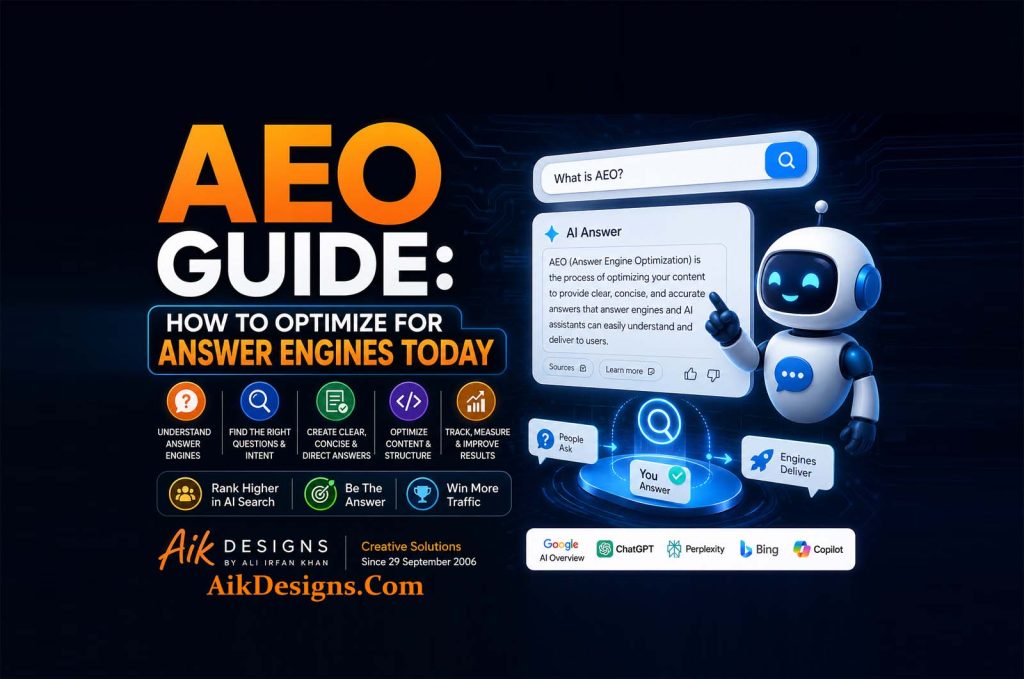
Type a question into Google, ChatGPT, or a voice assistant today, and there’s a good chance you’ll get a direct answer before you ever see a list of blue links. Answer Engine Optimization (AEO) is the discipline built around that shift — structuring content so AI systems can extract it, trust it, and cite it as the answer. This guide breaks down exactly what AEO is, how it works, and how to optimize your content to get chosen as the source.
📊 Quick Facts: AEO
🤖 Answer Engines — AI chatbots, voice assistants, and AI Overviews that give direct answers
✂️ Extraction over ranking — AEO optimizes for being quoted, not just listed
📝 Format matters — short, self-contained answers extract more easily
🏷️ Schema markup — structured data helps AI systems parse direct answers
🔗 Built on SEO — AEO doesn’t replace SEO, it extends it
Table of Contents
- What Is AEO (Answer Engine Optimization)?
- AEO vs Traditional SEO
- What Are Answer Engines?
- How Answer Engines Choose What To Cite
- Structuring Content For AEO
- Structured Data and Schema Markup for AEO
- Authority and Trust Signals
- Question-Based Keyword Research
- Measuring AEO Performance
- Common AEO Mistakes
- AEO Checklist
- Frequently Asked Questions
- Conclusion
1. What Is AEO (Answer Engine Optimization)?
Answer Engine Optimization is the practice of structuring and writing content so it can be directly extracted, summarized, and cited as an answer by AI-driven systems — chatbots, voice assistants, and AI-generated search summaries. Instead of optimizing purely to rank a page in a list of results, AEO optimizes for a much narrower goal: being the exact sentence or paragraph an AI system pulls out and presents as the answer.
2. AEO vs Traditional SEO
Traditional SEO is about earning a high position in a results list that a user then clicks through. AEO is about being extracted directly into an answer, often with no click at all. The two aren’t in competition — AEO sits on top of solid SEO. A page still needs to be crawlable, relevant, and trustworthy before any answer engine will consider quoting it.
| Aspect | Traditional SEO | AEO |
|---|---|---|
| Goal | Rank in a list of results | Get extracted as the direct answer |
| Success metric | Position and click-through rate | Citation and brand mention visibility |
| Content format | Long-form, keyword-optimized pages | Short, self-contained, directly answerable sections |
3. What Are Answer Engines?
Answer engines are any system that gives a user a direct answer instead of a list of links to click through. This includes AI chatbots, voice search like Siri and Alexa, Google’s AI-generated overviews, and even traditional featured snippets, which were an early form of the same idea.
4. How Answer Engines Choose What To Cite
Answer engines generally favor content that is clear, well-structured, directly relevant to the question asked, and backed by credible signals of expertise and trust. They tend to pull from sources that already rank well organically, present information in an extractable format, and avoid burying the answer under unnecessary fluff.
5. Structuring Content For AEO
The core principle of AEO writing is simple: answer the question immediately, then explain. Bury the answer in the fourth paragraph, and an answer engine has to work harder to extract it — and often won’t bother.
Step 1: Use Question-Based Headings
Phrase headings the way a real person would ask them (“What is AEO?” rather than “Understanding AEO Concepts”), since this mirrors how questions are typed or spoken into answer engines.
Step 2: Lead With The Answer
Place a concise, one-to-three sentence answer directly beneath the heading, before diving into supporting detail, examples, or nuance.
Step 3: Keep Answers Self-Contained
Write each answer so it makes sense on its own, without requiring the reader to have absorbed three earlier paragraphs of context.
✅ Tip: Write your direct answer first, then your supporting explanation — not the other way around. Answer engines reward content that gets to the point immediately.
6. Structured Data and Schema Markup for AEO
Structured data such as FAQPage, HowTo, and Article schema explicitly labels which part of a page contains a question and which part contains its answer, making it easier for answer engines to parse and extract content accurately. It doesn’t guarantee citation, but it removes ambiguity that could otherwise cause a system to skip your content entirely.
7. Authority and Trust Signals
Answer engines lean heavily on trust signals before citing a source — author credentials, site reputation, factual accuracy, and consistency across the web. Content written by a credible, identifiable expert with a track record in the subject is far more likely to be cited than anonymous or thin content, even if the writing itself is technically well-structured.
⚠️ Warning: No amount of formatting will fix a lack of genuine expertise or accuracy. Answer engines are increasingly cautious about citing sources that appear thin, outdated, or unverifiable.
8. Question-Based Keyword Research
AEO-focused keyword research shifts the emphasis from short head terms to the actual questions people ask. Mine “People Also Ask” boxes, forum threads, and customer support tickets for real phrasing, then build content around those exact questions rather than a generic topic.
9. Measuring AEO Performance
AEO is harder to measure than traditional rankings since a citation inside an AI answer doesn’t always generate a trackable click. Useful proxies include monitoring featured snippet ownership, tracking referral traffic from AI platforms where available, watching for brand mentions, and manually testing target questions across major AI tools to see whether and how your content gets cited.
10. Common AEO Mistakes
- Burying the direct answer under long introductions
- Writing vague, generic headings instead of real questions
- Skipping structured data that would clarify question-and-answer pairs
- Optimizing purely for extraction while neglecting accuracy and depth
- Ignoring author credibility and trust signals
- Treating AEO as a replacement for SEO fundamentals instead of an extension of them
11. AEO Checklist
☑️ Phrase key headings as real, natural questions
☑️ Lead every section with a concise, direct answer
☑️ Add FAQPage or HowTo schema where relevant
☑️ Credit content to a real, credible author
☑️ Research actual questions people ask, not just keywords
☑️ Keep each answer self-contained and easy to extract
☑️ Test target questions manually across major AI tools
12. Frequently Asked Questions
What does AEO stand for?
AEO stands for Answer Engine Optimization, the practice of structuring content so it can be directly extracted and cited as an answer by AI chatbots, voice assistants, and AI-generated search results.
How is AEO different from traditional SEO?
Traditional SEO aims to rank a webpage in a list of results, while AEO aims to have content directly extracted, summarized, and cited as a spoken or written answer by an AI system, often without the user clicking through at all.
What are answer engines?
Answer engines are systems that provide direct answers instead of a list of links, including AI chatbots, voice assistants, Google AI Overview, and featured snippets.
How do I optimize content for AEO?
Optimize for AEO by answering questions directly and concisely near the top of a section, using clear headings phrased as questions, adding structured data, and backing claims with credible, well-organized information.
Does structured data help with AEO?
Yes, structured data such as FAQPage and HowTo schema helps answer engines parse and understand exactly which part of a page contains a direct answer, increasing the chance of extraction.
Can AEO and SEO work together?
Yes, AEO builds on strong SEO fundamentals rather than replacing them; a page still needs to be crawlable, relevant, and authoritative before it can be considered for extraction as a direct answer.
What content format works best for AEO?
Short, self-contained answers of one to three sentences placed directly under a clear question-based heading tend to perform best, since answer engines favor content that can be lifted cleanly without extra context.
Does AEO reduce website traffic?
AEO can reduce click-through traffic for simple factual queries since the answer is shown directly, but it can also increase brand visibility and trust by positioning a business as the cited source across AI-generated answers.
How do I measure AEO performance?
AEO performance is harder to track than traditional rankings, but can be estimated through brand mention tracking, referral traffic from AI platforms, featured snippet visibility, and manual testing of target queries in AI tools.
13. Conclusion
AEO isn’t a trend to bolt onto your content strategy — it’s a reflection of how people are actually getting answers now. The businesses that win here are the ones that answer questions clearly, structure content so machines can parse it, and back everything with real expertise. Get those fundamentals right, and you’re positioned to show up whether the answer comes from a search results page, a chatbot, or a voice assistant. SEO vs AEO vs GEO vs AIO vs SXO
Want your content built to get cited, not just ranked? Get in touch with Aik Designs and let’s make your site answer-engine ready.
About Author