Search Generative Experience (SGE): The Future of Google Search In 2026
By Ali Irfan Khan | Founder & CEO, Aik Designs | Updated: May 2026 | Reading Time: ~6 Minutes
The way people search the internet is undergoing its most dramatic transformation since Google first launched in 1998. Search Generative Experience — better known as SGE — is no longer a beta experiment or a distant future concept. In 2026, it is reshaping how millions of users find information, make purchasing decisions, and interact with brands online.
If you own a business, manage a website, or work in digital marketing, understanding SGE is no longer optional. It’s the difference between thriving in the new era of search — and becoming invisible to your target audience.
This guide breaks down everything you need to know about Search Generative Experience in 2026: what it is, how it works, how it affects your rankings, and what you can do right now to stay ahead of the curve.
What Is Search Generative Experience (SGE)?
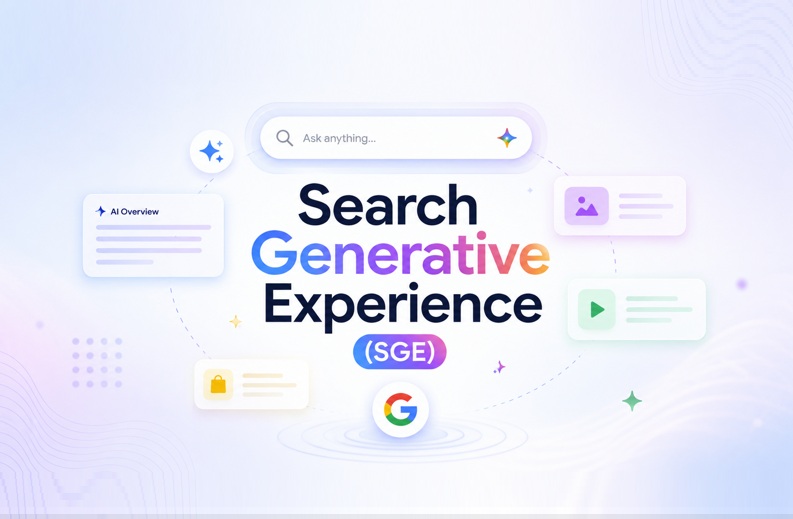
Search Generative Experience is Google AI Overview that generates direct, conversational answers at the top of search results pages — before any traditional organic links or paid ads appear. Instead of showing users a list of ten blue links and leaving them to click through multiple websites, SGE synthesizes information from across the web and presents a comprehensive, AI-generated summary in response to the user’s query.
Think of it as Google transforming from a search engine into a search answer engine. Rather than directing users to find answers elsewhere, Google now attempts to provide the answer itself — right there on the results page.
SGE draws on Google’s large language model technology (built on the Gemini AI family) to understand the intent behind a search query, gather relevant information from authoritative sources across the web, and generate a natural-language response that directly addresses what the user is looking for.
The AI-generated response typically appears in a prominent box at the very top of the search results page — above paid ads and above organic results. This placement alone has massive implications for website traffic, click-through rates, and how businesses need to think about their online visibility.
How SGE Works — A Step-by-Step Breakdown
Understanding the mechanics behind SGE helps you optimize your content to appear within AI-generated responses rather than being buried beneath them.
Step 1 — Query interpretation: When a user types or speaks a search query, Google’s AI doesn’t just match keywords. It interprets the full semantic intent of the question — understanding context, nuance, and what kind of answer would genuinely satisfy the user’s need.
Step 2 — Source evaluation: SGE scans and evaluates content from across the web, prioritizing sources that demonstrate strong E-E-A-T signals — Experience, Expertise, Authoritativeness, and Trustworthiness. Sites with high-quality, well-structured, factually accurate content are far more likely to be sourced in AI-generated answers.
Step 3 — Response generation: The AI synthesizes the most relevant information into a concise, readable answer. It may include key facts, a brief explanation, numbered steps, or a comparison — depending on the nature of the query.
Step 4 — Source citation: SGE typically displays a carousel of source links alongside the AI-generated answer. These citations are the websites that contributed content to the generated response. Appearing as a cited source in SGE is the new version of ranking on page one.
Step 5 — Follow-up suggestions: SGE often generates follow-up question prompts, encouraging users to continue the conversation within Google’s search interface rather than navigating away to external websites.
SGE vs Traditional Google Search — What Has Changed in 2026
The shift from traditional search to SGE-powered search represents one of the most significant behavioral changes in how people consume online information. Here’s how the two experiences compare:
Traditional Google Search: A user types a query, receives a list of ten blue links (with paid ads above), clicks through to a website, reads the content, and potentially returns to Google to visit more sites. The user controls their journey; websites get traffic from each click.
SGE-Powered Search in 2026: A user types or speaks a query (often in a longer, conversational format), receives a comprehensive AI-generated answer at the top of the page, may glance at the cited sources or click one for more depth, and often finds their question fully answered without ever leaving Google. Websites cited as sources benefit from visibility and credibility — but overall click-through rates for many query types have declined significantly.
This shift has created what industry analysts are calling the “zero-click search revolution”. For informational queries especially — things like “how to fix a leaky faucet,” “what is the capital of Brazil,” or “symptoms of vitamin D deficiency” — users increasingly get their answer directly from the SGE snapshot without clicking through to any external website.
The implications are enormous. Websites that once relied heavily on traffic from informational blog content are seeing significant organic traffic declines. Meanwhile, websites that are being cited as authoritative sources within SGE responses are seeing their brand authority and conversion rates climb — even without a corresponding increase in raw traffic.
How SGE Affects SEO and Organic Search Rankings in 2026
The arrival of SGE at scale has fundamentally changed the rules of SEO. Strategies that worked reliably in 2022 and 2023 are delivering diminishing returns, while a new set of optimization principles is emerging as the playbook for success in the SGE era.
Zero-click searches are increasing: Studies from leading SEO research firms in 2026 show that zero-click searches now account for the majority of Google searches across informational query types. This doesn’t mean SEO is dead — it means the nature of what constitutes SEO success has evolved.
Position zero is the new page one: Getting your content cited within an SGE snapshot — even without a direct click — delivers massive brand awareness and credibility signals. Users see your brand name associated with an authoritative answer. That visibility drives brand recognition, direct searches, and downstream conversions in ways that standard page-one rankings once did.
Long-tail conversational keywords are more valuable than ever: SGE is optimized for natural language queries. Searches are longer, more specific, and more question-based than they were in the keyword-stuffing era. Businesses that create content addressing very specific, intent-driven questions are far more likely to be surfaced by SGE than those targeting broad, generic terms.
E-E-A-T signals are now critical ranking factors: Google’s AI is trained to favor content from sources that demonstrably have real-world experience and expertise in their subject matter. Author bios, first-person experience, cited data, and up-to-date information are all signals that increase the likelihood of your content being selected for SGE responses.
Content structure matters more than keyword density: SGE pulls from well-structured content. Clear headings, concise answers to specific questions, FAQ sections, numbered lists, and structured data markup (schema) all make your content easier for the AI to extract and incorporate into generated responses.
What Types of Searches Does SGE Affect Most?
SGE doesn’t impact all types of searches equally. Understanding which query categories are most affected helps you prioritize where to adapt your strategy.
Informational queries: These are the most dramatically affected. Questions like “how does X work,” “what is Y,” or “why does Z happen” are now almost always answered directly by SGE. If your traffic relied heavily on this type of content, expect significant changes and adapt accordingly.
Commercial investigation queries: Searches like “best laptops under $1000” or “top SEO companies for small businesses” are increasingly surfaced through SGE, which synthesizes comparisons and recommendations. Getting your brand mentioned in these AI responses is extremely valuable.
Navigational queries: Searches where users are looking for a specific brand or website (e.g., “Amazon,” “WebMD login”) are largely unaffected by SGE, as the intent is clear and direct.
Transactional queries: High-intent purchase queries like “buy running shoes size 10” or “book a hotel in Miami” still frequently surface traditional product listings, Google Shopping results, and paid ads alongside or instead of SGE snapshots. These are among the safest areas for e-commerce SEO in the SGE era.
Local searches: “Near me” searches and local intent queries continue to be served largely through Google’s local pack and Google Maps results, with SGE playing a supporting rather than dominant role. Local SEO remains highly valuable for brick-and-mortar businesses.
How to Optimize Your Content for SGE in 2026
The businesses and websites that are winning in the SGE era share a common approach: they’ve shifted their focus from ranking for keywords to becoming the most authoritative, clearly structured, and genuinely helpful resource on their topic. Here’s how to do it.
Create content that directly answers questions: Structure your content around specific questions your target audience is asking. Use your H2 and H3 headings as questions. Then answer them concisely and completely in the opening paragraph beneath each heading. SGE is designed to extract direct, clear answers — make it easy for the AI to find yours.
Build genuine topical authority: Rather than producing thin content across dozens of unrelated topics, go deep on your core subject areas. A plumbing company that has 50 detailed, expert articles about plumbing topics is far more likely to be cited by SGE than a site with one generic plumbing page and dozens of unrelated articles.
Implement structured data markup: Schema markup (FAQ schema, HowTo schema, Article schema) helps Google’s AI understand the structure and purpose of your content. Websites with properly implemented structured data are more likely to have their content surfaced in SGE responses.
Prioritize E-E-A-T in everything you publish: Include clear author bylines with professional credentials. Link to primary sources and cite your data. Keep content updated and add “last updated” dates. Write from a position of genuine expertise or first-hand experience. Google’s AI is remarkably good at distinguishing authentic expertise from generic, AI-generated filler content.
Optimize for featured snippets: The content that earns featured snippets and position zero rankings in traditional search is closely correlated with the content that gets cited in SGE. If you’re already appearing in featured snippets, you’re well-positioned for SGE visibility.
Target conversational, long-tail keywords: SGE is built for natural language queries. Use tools like Google’s “People Also Ask,” Answer The Public, and Semrush’s Keyword Magic Tool to find the specific questions people are asking in your niche — then create content that answers those questions precisely.
Focus on content depth and originality: Surface-level, generic content is increasingly invisible in the SGE era. Original research, unique data, first-person case studies, and expert analysis are the types of content that get cited by AI systems because they offer information that can’t be found elsewhere.
SGE and Local SEO — What Small Businesses Need to Know
One of the most reassuring findings for small business owners is that SGE has had relatively limited impact on local search results compared to informational searches. Google Maps, the local three-pack, and Google Business Profiles continue to be the primary mechanisms for connecting users with nearby businesses.
However, SGE is beginning to influence local search in meaningful ways. For queries like “best Italian restaurants in Chicago” or “most reliable HVAC company in Phoenix,” SGE may generate a brief overview that mentions specific businesses — and appearing in that overview is the new premium local visibility.
To maximize your chances of appearing in SGE local responses:
- Keep your Google Business Profile fully optimized and regularly updated with fresh photos, posts, and accurate information
- Actively generate and respond to customer reviews — SGE appears to factor in review quality and recency when selecting businesses to mention
- Ensure your NAP (Name, Address, Phone Number) is consistent across all online directories
- Create location-specific content on your website that addresses what your business offers in your specific city or region
- Build local citations and earn mentions from reputable local news sources and community websites
The Role of Brands and Brand Authority in the SGE Era
One of the most important shifts that SGE has accelerated is the premium it places on recognizable, trusted brands. Google’s AI has a demonstrable preference for citing established brands with strong online reputations — because brand authority is itself a proxy for trustworthiness and reliability.
This means that brand-building activities that were once considered “soft” marketing — PR coverage, thought leadership content, podcast appearances, social media presence, speaking engagements — now have direct Google SEO value in the SGE era. The more your brand is mentioned across the web in positive, authoritative contexts, the more likely Google’s AI is to include your content in generated responses.
For small businesses and newer websites, this creates both a challenge and an opportunity. The challenge is that building brand authority takes time and consistent effort. The opportunity is that businesses willing to invest in genuine expertise, community presence, and authentic content will be rewarded disproportionately as AI search evolves.
Common SGE Myths Debunked
Myth: SGE means SEO is dead. This is the most persistent misconception in the digital marketing space. SEO is not dead — it has evolved. The goal has shifted from generating raw clicks to establishing authority, earning citations, and capturing the attention of users at the highest level of Google’s search experience. If anything, high-quality SEO matters more in the SGE era, not less.
Myth: You can’t appear in SGE without a massive website. Smaller, highly focused, authoritative websites frequently get cited in SGE responses. A targeted niche website with deep expertise on a specific topic will often outperform a large, generic content farm in SGE visibility.
Myth: SGE has replaced all traditional search results. SGE snapshots appear for many queries, but traditional organic results, local packs, paid ads, Google Shopping, and image results all continue to function alongside AI-generated responses. The search results page has become layered and more complex — not replaced entirely.
Myth: AI-generated content will rank well in SGE. This is perhaps the most dangerous myth of 2026. Google’s quality evaluators and AI systems have become increasingly sophisticated at identifying thin, AI-generated content that lacks genuine expertise or original insight. Publishing mass quantities of AI-written content without human expertise, original research, or authentic experience is a fast track to lower visibility — not higher.
The Future of SGE — What Comes Next
SGE is not a finished product — it is an evolving platform that Google continues to refine and expand. Based on current trajectories and announced developments, here’s what we expect to see as SGE continues to mature:
Multimodal search integration: SGE is becoming increasingly multimodal, meaning users can search using a combination of text, images, and voice. Google Lens integration with SGE allows users to photograph an object and receive AI-generated information about it. This opens entirely new categories of search behavior for businesses to optimize for.
Personalized search results: Future iterations of SGE are expected to incorporate greater levels of personalization, generating responses tailored to the individual user’s search history, location, preferences, and even time of day. This makes building a consistent brand presence across touchpoints increasingly important.
Commerce integration: Google is actively expanding SGE’s role in the purchase journey, integrating product listings, pricing comparisons, and direct purchasing options within the AI-generated experience. E-commerce businesses that optimize their product data feeds and merchant center listings will be best positioned to benefit.
Real-time information: Early versions of SGE relied primarily on indexed web content. Future development is focused on incorporating real-time data — stock prices, live sports scores, breaking news, traffic conditions — directly into SGE responses, further reducing the need for users to visit external sites for time-sensitive information.
Deeper conversational search: Google is investing heavily in multi-turn search conversations, where users can ask follow-up questions within the same search session and receive contextually aware, cumulative responses. This moves search closer to a true AI assistant experience — and makes it more important than ever for your brand to be the authoritative voice on your topic.
Final Thoughts — Adapting Your Digital Strategy for the SGE Era
Search Generative Experience represents the most significant evolution in how people find information online in a generation. For businesses, marketers, and content creators, it demands a fundamental shift in mindset — away from chasing keyword rankings and toward building genuine, lasting authority in your field.
The businesses that will thrive in the SGE era are those that commit to:
- Creating genuinely expert, original, and helpful content that answers real questions from real people
- Building recognizable, trusted brands that users and Google’s AI both recognize as authoritative
- Structuring their content in ways that make it easy for AI systems to understand, extract, and cite
- Staying current with Google’s evolving SGE guidelines and adapting their strategies accordingly
- Diversifying their digital presence across search, social, email, and owned media so they’re not solely dependent on organic clicks
The future of Google Search is already here. The question isn’t whether SGE will impact your business — it’s whether you’re going to adapt and capitalize on the opportunity, or wait and fall behind. The businesses investing in SGE-ready content and brand authority today are the ones who will own their digital market in 2027 and beyond.
Frequently Asked Questions About Search Generative Experience
Is SGE available for all Google searches?
SGE appears across a broad range of search queries in 2026, but its presence varies by query type. It is most prevalent for informational and research-oriented queries and less common for transactional, navigational, and highly localized searches.
Does appearing in an SGE snapshot drive traffic to my website?
Being cited in an SGE response delivers brand visibility and credibility, though it may not always translate into direct clicks the way a traditional organic ranking does. However, brand mentions in SGE build trust and can drive direct searches, referral traffic, and conversions through other channels.
How is SGE different from Google’s featured snippets?
Featured snippets pull a specific excerpt directly from a single webpage and display it at the top of search results. SGE generates a synthesized response drawing from multiple sources simultaneously, often providing a more comprehensive answer and citing several websites rather than just one.
Should I still invest in traditional SEO if SGE is taking over?
Absolutely. Traditional SEO best practices — technical optimization, high-quality content, link building, and local SEO — remain important both for appearing in SGE citations and for capturing traffic from the organic results that still appear below SGE snapshots. The two complement rather than replace each other.
How do I know if my content is being cited by SGE?
Google Search Console is evolving to provide greater insight into SGE performance. Third-party SEO tools including Semrush, Ahrefs, and Moz have also developed SGE tracking features. Regularly testing your target keywords in Google Search and checking whether your content appears as a cited source in the AI snapshot is currently the most direct method available.
Stay updated with the latest developments in SGE and AI-powered search by bookmarking our blog and following Google’s official Search Central updates. The landscape continues to evolve rapidly — and staying informed is your biggest competitive advantage.
About Author