What Is Google AI Overview (AIO) & Its Impact on Traffic?
By Ali Irfan Khan | Founder & CEO, Aik Designs | Updated: May 2026 | Reading Time: ~12 Minutes
Have you ever searched something on Google and found a big AI-generated answer box sitting right at the top — before any website links, before any ads, before anything? That is Google AI Overview (AIO), and it is quietly reshaping how billions of people find information online. For everyday users, it is a convenience. For website owners and digital marketers, it is one of the most significant shifts in the history of search — one that is already cutting into traffic, changing click behaviour, and forcing businesses to completely rethink their SEO strategy.
If your website analytics have been showing falling traffic in 2025 or 2026 despite holding your rankings, Google AI Overview is very likely part of the story. The rules of search have changed, and understanding AIO is no longer optional — it is survival.
In this detailed guide, we will break down exactly what Google AI Overview is, how it works behind the scenes, what the data says about its impact on website traffic, which industries are affected most, and — most importantly — a clear, step-by-step strategy to adapt, stay visible, and even turn AIO into a competitive advantage for your business.
Quick Answer: What Is Google AI Overview (AIO)?
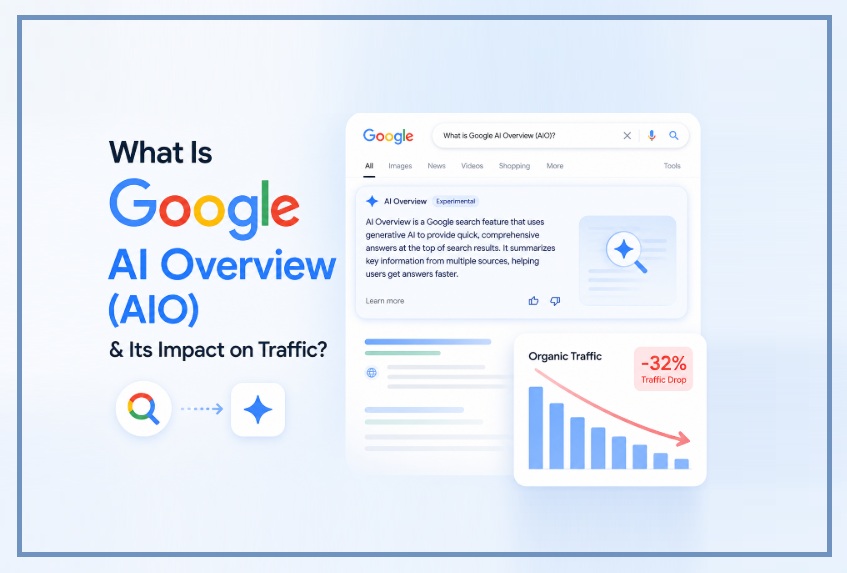
Google AI Overview (AIO) is an AI-generated summary that appears at the very top of Google search results — above all organic links, above ads, and above featured snippets. It is powered by Google’s Gemini AI model, which reads multiple websites, synthesises an answer, and presents it directly to the user inside a collapsible box.
For users, it means getting answers faster. For website owners, it means less clicks — unless your website is one of the sources cited inside the AIO box.
The History: How Did We Get Here?
To understand where we are in 2026, it helps to know how AIO evolved:
- 2023: Google began testing “Search Generative Experience (SGE)” in its Search Labs for select US users.
- May 2024: Google officially renamed SGE to “AI Overviews” and rolled it out to all US users by default — a landmark moment for search.
- Late 2024 – 2025: AIO expanded aggressively across countries, languages, and query types. Growth accelerated following the March 2025 core update, with AIO frequency increasing by 116%.
- 2026: AI Overviews now appear in 200 countries across 40 languages. They reach approximately 2 billion users every month, making this the biggest transformation in Google search since mobile.
How Does Google AI Overview Actually Work?
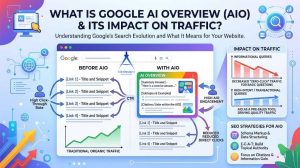
Understanding the mechanics helps you optimise for it. Here is what happens when you type a query into Google in 2026:
Step 1 — Query Classification: Google’s system evaluates whether your search is a good candidate for an AI Overview. Informational and question-based queries are far more likely to trigger one than navigational or transactional searches.
Step 2 — Source Retrieval: Google’s system retrieves a set of relevant web pages from its existing index — the same index that powers traditional blue-link results. It does not crawl the web fresh for each query.
Step 3 — AI Synthesis: Google’s Gemini model reads across multiple retrieved pages and generates a synthesised, direct answer — not copying from one source, but combining and summarising information from several.
Step 4 — Citation Display: The AIO box displays the generated answer along with links to the sources it drew from. Typically, 88% of Google AI Overviews cite three or more sources.
Step 5 — User Interaction: The user reads the summary, may expand it, and may or may not click one of the cited source links. Most of the time, they do not click at all.
Key AIO Statistics You Need to Know in 2026
Before we discuss impact, let us look at the hard numbers. These are the facts every website owner and digital marketer in 2026 must understand.
Prevalence
- AI Overviews now appear in approximately 21–50% of all Google searches depending on the query type and industry tracked.
- AIO presence has grown 58% year-over-year (February 2025 to February 2026).
- AI Overviews appear in 200 countries and 40 languages.
- Google AI Overviews reach 2 billion users monthly globally.
What Triggers an AIO
- 99% of AI Overviews are triggered by informational queries — meaning searches that ask a question or seek to learn something.
- Queries with 7+ words trigger AIO 46% of the time.
- Question-based keywords (how, what, why, when) are the primary triggers — about 25% of all AIO-triggering keywords are interrogative.
- Navigational queries (brand name searches) trigger AIO only 0.09% of the time — so branded searches are largely safe.
- E-commerce and shopping searches trigger AIO least frequently — only about 3–4% of the time.
CTR & Traffic Impact
- Position-1 organic CTR has dropped 58% on AIO queries (Ahrefs, 300,000 keywords).
- Organic CTR fell from 1.76% to 0.61% on informational queries where AIO is present — a 61% decline (Seer Interactive).
- 83% of AIO searches end in zero clicks — the user gets their answer and leaves without visiting any website.
- 58% of all Google searches globally now result in zero clicks (SparkToro).
- Small publishers have lost 60% of search referral traffic over two years (Chartbeat/Reuters Institute).
The Good News: Being Cited Changes Everything
- Sites cited inside AIO can see CTR increases of up to 35% — being a source is a competitive advantage, not just a participation badge.
- Early adopters of AIO optimisation report up to 527% year-over-year growth in AI-driven search traffic.
- A SaaS company that earned AIO citations for 23% of its target keywords recovered and exceeded its previous traffic levels.
Which Industries Are Hit the Hardest by AIO?
AIO does not affect all industries equally. Here is the industry-by-industry picture as of early 2026:
| Industry | AIO Presence (2025) | AIO Presence (2026) | Change |
|---|---|---|---|
| B2B Technology | 36% | 82% | +128% |
| Education | 18% | 83% | +361% |
| Restaurants & Food | 10% | 78% | +680% |
| Insurance | 17% | 63% | +271% |
| Healthcare / YMYL | High | High | Stable & strict |
| E-Commerce / Shopping | ~4% | ~4% | Minimal |
Key takeaway: If your website is in B2B technology, education, health, finance, or any information-heavy niche — AIO is already reshaping your search landscape significantly. If you are in pure e-commerce with transactional product pages, you are comparatively more protected for now.
Why Is My Website Traffic Dropping Even If I Still Rank?
This is the most confusing part for website owners in 2026. You check Ahrefs or Google Search Console, you still see rankings — but traffic is down. Here is exactly why that happens:
The SERP Has Changed Physically. On mobile (which now accounts for the majority of searches), the AIO box fills most of the screen before a single organic result appears. Users must scroll significantly just to see your blue link — and most do not.
Users Are Satisfied by the Summary. The majority of Google users scan, not read. If the AIO answers their question well enough, there is zero motivation to click through to a website. Data shows users typically only read about 30% of an AIO result — and even that is often enough.
Impressions Are Up, Clicks Are Down. This paradox is what confuses many people. Google Search Console may show your impressions growing (because AIO pulls your content into its context), but your actual clicks are falling. These are two different things in the AIO era.
The Zero-Click Reality. Before AIO, featured snippets already caused zero-click behaviour for some queries. AIO has accelerated this dramatically — 83% of AIO-present searches now end without a click to any website.
Who Benefits From AIO? (Yes, There Are Winners)
Despite all the scary numbers above, AIO is not purely negative. There are clear winners — and you want your website to become one of them.
Websites cited as sources get a credibility signal and brand exposure that traditional ranking never provided. Even if a user does not click today, repeated AIO citations build brand recognition and trust over time.
Brands with strong E-E-A-T signals (Experience, Expertise, Authoritativeness, Trustworthiness) are disproportionately cited. Google’s Gemini model favours well-structured content from identifiable experts with demonstrated credentials.
Websites that publish original data, research, or case studies become natural citation targets. AIO needs sources — and it prefers sources that contain verifiable, original insights rather than generic rewrites.
Local businesses are somewhat insulated — AIO currently appears on only about 7% of local queries. A business targeting “web design company in Karachi” is less threatened than a blog targeting “what is web design.”
How to Optimise Your Website for Google AIO (Step-by-Step)
This is what actually matters: not just understanding AIO, but adapting your content strategy to win in the new landscape. Here is a practical framework that works in 2026.
1. Write a Direct Answer at the Top of Every Blog Post
The single most important change you can make. When someone searches “What is X?”, your first 2–3 sentences should answer that question directly and completely. Do not bury the answer 800 words into the article.
AIO’s Gemini model is engineered to extract quick factual answers. If your page takes 500 words to get to the point, it will not be cited. If your page answers the question in the first paragraph, it will.
Example structure:
“Google AI Overview (AIO) is an AI-generated answer box that appears at the top of Google search results. It is powered by Google’s Gemini model and synthesises answers from multiple websites, citing sources inline.”
Then continue with depth below. Answer first, elaborate second.
2. Use Clear FAQ Sections with Conversational Questions
Add a dedicated FAQ section at the end of every important post. Write questions the way real people actually type them into Google:
- “What does Google AI Overview mean for my website?”
- “How do I get my website cited in Google AIO?”
- “Does AIO hurt website traffic?”
Conversational question-and-answer format is the content structure AI systems are trained on. It makes your content easy to extract, easy to cite, and easy to summarise.
3. Structure Your Content with Proper Heading Hierarchy
Clear H1, H2, and H3 headings are not just good writing — they are AIO signals. Google’s system uses your heading structure as a map to understand what each section covers. Headings that clearly describe what follows (not clever or vague headlines) perform significantly better.
Good: “How Google AI Overview Affects Organic Click-Through Rate” Weak: “The Big Picture”
4. Implement Schema Markup
Structured data (FAQ schema, HowTo schema, Article schema) directly helps Google’s systems identify and extract your content for use in AI Overviews. This is a technical step that any developer can implement, but the impact is meaningful.
At minimum, add FAQ schema to every blog post that has a question-and-answer section. This signals to Google: “This content is structured for answer extraction.”
5. Strengthen Your E-E-A-T Signals
AIO disproportionately cites authoritative sources. In 2026, E-E-A-T (Experience, Expertise, Authoritativeness, Trustworthiness) is arguably the most decisive ranking and citation factor. Here is how to build it:
- Add a detailed author bio to every post — who wrote it, what their credentials are, and why they are qualified to write on this topic.
- Cite your sources with links to credible data, studies, and references.
- Show original experience — real screenshots, real results, real case studies from your agency work.
- Keep content accurate and updated — flag the publish date and last-updated date on every post.
6. Build Topical Authority Through Content Clusters
AIO rewards websites that demonstrate deep expertise across a topic — not single pages, but entire clusters of related content. Instead of publishing random one-off posts, build interconnected clusters:
Pillar page: “Complete Guide to SEO in 2026” Cluster pages: What is AIO, How to fix Core Web Vitals, How to write for E-E-A-T, Local SEO guide, etc.
Internal linking between cluster pages tells Google’s systems that your website is a comprehensive authority on this topic — exactly the kind of source AIO wants to cite.
7. Optimise for Long-Tail and Question-Based Keywords
Since informational, question-based queries trigger 99% of all AIO results — these are the exact keywords you should be targeting. Queries of seven or more words trigger AIO 46% of the time.
Instead of targeting: “web design” Target: “how to choose a web designer for a small business in Pakistan”
Long-tail, question-based keywords have lower competition, higher AIO trigger rates, and — critically — higher intent alignment with the kind of content that gets cited.
8. Track Whether You Are Being Cited
Knowing your ranking position in 2026 is not enough. You also need to know whether your content appears inside AIO boxes for your target queries. Here is how to track it:
- Manual SERP checks: Search your target keywords regularly and note whether AIO appears, and whether your site is cited.
- Google Search Console: Look for impressions that are growing without corresponding click growth — a sign AIO may be summarising your content without crediting clicks.
- Third-party tools: BrightEdge, SE Ranking, Semrush, and Ahrefs all offer AIO tracking features.
- Brand mention monitoring: Search your target questions in ChatGPT, Perplexity, and Gemini — AI tools increasingly pull from overlapping sources.
What About AI Mode? Is That Different from AIO?
Yes, and it is important to distinguish between the two.
Google AI Overview (AIO) is the summary box at the top of standard Google Search results. It appears automatically for qualifying queries.
Google AI Mode is a separate, full AI search layer that users must opt into. It replaces the traditional results page entirely with an AI conversation interface. AI Mode reached over 100 million monthly active users across the US and India within two months of launch and now processes over 1 billion queries per month.
AI Mode is a preview of where search is heading. AIO is where it already is. Both require the same foundational content strategy: authoritative, well-structured, expert-led content.
What This Means for Pakistani Businesses and Websites
If you are running a business website or blog in Pakistan — whether in Karachi, Lahore, Islamabad, or anywhere else — here is the Pakistan-specific picture:
Google AI Overviews are available in Pakistan and are triggered by English-language searches. The businesses and blogs that start optimising for AIO today will build citation authority before their competitors even understand what AIO is.
For web design agencies, digital marketing firms, and tech blogs like Aik Designs, the opportunity is significant. Very few Pakistani websites are structured for AIO citation. That is not a threat — it is a gap you can fill right now.
The businesses most at risk are those relying on generic, keyword-stuffed blog content with no clear author expertise, no structured answers, and no E-E-A-T signals. The businesses that will win are those publishing clear, expert, well-structured content built for both human readers and AI extraction.
The 5 Things to Do Right Now
If you have read this far and want to take action today, start here:
1. Audit your top 10 blog posts. Does each one have a direct answer in the first 2–3 sentences? If not, add one.
2. Add FAQ sections. Go back to your most important posts and add 4–6 conversational Q&A pairs at the bottom.
3. Update your author bios. Add real credentials, expertise signals, and experience proof to every post.
4. Check your target keywords for AIO. Manually search your top 10 keywords and see whether AIO appears. If it does, study which sources are cited and what makes their content different.
5. Delete or consolidate thin content. Google penalises websites with too many low-quality, thin pages. Merge or delete posts under 600 words with no traffic. Quality over quantity is the rule in 2026.
Frequently Asked Questions About Google AI Overview
Q: Does AIO mean SEO is dead? No. SEO is not dead — lazy SEO is dead. Traditional rankings still matter because about 52% of queries still trigger no AIO at all. The goal is to win in both: traditional rankings AND AIO citations.
Q: Can I stop Google from putting my content in AIO? Yes. You can use the nosnippet meta tag or data-nosnippet HTML attribute to prevent Google from extracting your content for AI summaries. However, this will also prevent you from appearing in featured snippets, so weigh the trade-off carefully.
Q: How long does it take to start appearing in AIO? There is no guaranteed timeline. However, websites that consistently apply AIO optimisation strategies — direct answers, FAQ schema, strong E-E-A-T, topical clusters — typically begin seeing citation appearances within 2–4 months of systematic implementation.
Q: Does AIO cite the same sources as traditional rankings? Not always. The citation overlap between traditional top-10 organic results and AIO citations is approximately 22–30% depending on industry. This means AIO sometimes cites sources that do not even rank in the top 10 — which is a significant opportunity.
Q: What types of content are best for getting cited in AIO? Educational content, clear definitions, step-by-step how-to guides, FAQ content, comparison guides, and original data posts perform best. Promotional or sales-focused content performs worst.
Final Thoughts
Google AI Overview is not a temporary experiment. With 2 billion monthly users, 200 countries, and 58% year-over-year growth in AIO presence, this is the new permanent reality of search.
The websites that will thrive are not necessarily the ones with the most links or the longest posts. They are the ones that are most useful, most trustworthy, and most clearly structured — so that both human readers and Google’s AI systems can extract value immediately.
For Aik Designs and for any Pakistani website owner reading this: the window to get ahead of this shift is open right now. Build content that answers questions clearly. Demonstrate your expertise authentically. Structure your posts for AI extraction. And track your citations as closely as you track your rankings.
The search landscape has changed. Your content strategy should too.
Published by Aik Designs — A Multi-Award-Winning Digital Marketing & Web Design Company in Karachi, Pakistan. Ali Irfan Khan is the Founder & CEO of Aik Designs and a Google Analytics Certified Professional with over 19 years of hands-on experience in web design, SEO, and digital marketing in Pakistan.
Tags: Google AI Overview, AIO, AI Overview Optimization, SEO 2026, Google Updates, Website Traffic, Digital Marketing Pakistan, AIO SEO, Search Traffic, Generative Engine Optimization
About Author