What Are SEO Tools? The 15 Best SEO Tools In 2026 Guide
Published: Aik Designs Blogs By Ali Irfan Khan May 2026 | Reading Time: ~18 minutes | Category: SEO
If you want your website to rank on Google, Bing, or any search engine in 2026, you need SEO tools. But with hundreds of options flooding the market — from free SEO tools to enterprise-grade platforms — choosing the right one can feel overwhelming.
This guide answers the two most searched questions in the SEO world: what are SEO tools, and what are the best SEO tools available right now? Whether you’re a blogger, small business owner, digital marketer, or SEO professional, this post covers everything you need to know — including a detailed comparison, individual tool reviews, pros and cons, pricing, and FAQs.
Let’s dive in.
Table of Contents
- What Are SEO Tools?
- Why SEO Tools Are Essential in 2026
- Types of SEO Tools
- The Best SEO Tools in 2026 — Detailed Reviews
- Side-by-Side Comparison Table
- How to Choose the Right SEO Tool
- Free SEO Tools vs Paid SEO Tools
- SEO Tools for Beginners vs Professionals
- SEO Tools for WordPress
- Frequently Asked Questions (FAQ)
- Final Verdict
What Are SEO Tools?
SEO tools are software applications, platforms, or browser extensions that help you optimize your website for search engines. These tools analyze key ranking factors — such as keywords, backlinks, site speed, content quality, and technical health — and provide actionable data and recommendations to improve your search engine rankings.
In plain terms: SEO tools do the heavy lifting of SEO research and analysis so you don’t have to manually sift through millions of data points. They help you find what people are searching for, discover why competitors outrank you, fix technical issues on your site, and track your progress over time.
Core functions of SEO tools include:
- Keyword research and keyword difficulty analysis
- Backlink analysis and link building opportunities
- Technical SEO audits (crawl errors, broken links, site speed)
- On-page SEO optimization (title tags, meta descriptions, headers)
- Rank tracking (monitoring keyword positions in SERPs)
- Competitor analysis and gap identification
- Content optimization for E-E-A-T (Experience, Expertise, Authoritativeness, Trust)
- Local SEO management
- Reporting and analytics dashboards
Why SEO Tools Are Essential in 2026
SEO has changed dramatically. Google’s 2025-2026 algorithm updates — including the Helpful Content Update rollouts, AI Overviews (SGE) expansion, and E-E-A-T signals enforcement — have made it harder than ever to rank through guesswork alone. Manual SEO simply cannot keep pace.
Here’s why using the best SEO tools is non-negotiable today:
- Google processes over 8.5 billion searches per day — data-driven decisions are mandatory
- AI-generated content has exploded, making quality signals and backlink authority more important
- Core Web Vitals and page experience are confirmed ranking signals
- Voice search and AI Overviews are changing how results appear
- Local SEO competition has intensified for every business category
- Zero-click searches have increased — understanding featured snippet opportunities matters more
Without SEO tools, you’re essentially navigating blindfolded in one of the most competitive marketing channels in the world.
Types of SEO Tools
Not all SEO tools are built the same. Understanding the categories helps you pick the right stack for your needs.
1. Keyword Research Tools
Keyword research tools help you discover what your target audience is searching for, how often, and how hard it is to rank for those terms. They show search volume, keyword difficulty (KD), cost-per-click (CPC), and related keyword ideas. Examples: Ahrefs Keywords Explorer, SEMrush Keyword Magic Tool, Google Keyword Planner, Ubersuggest.
2. Backlink Analysis Tools
Backlinks remain one of Google’s top-three ranking factors. Backlink tools help you analyze your link profile, disavow toxic links, and identify link building opportunities. Examples: Ahrefs Site Explorer, Majestic, Moz Link Explorer, SEMrush Backlink Analytics.
3. Technical SEO Tools
Technical SEO tools crawl your website like Googlebot does, identifying issues such as broken links, duplicate content, missing meta tags, slow-loading pages, and poor mobile usability. Examples: Screaming Frog SEO Spider, Sitebulb, DeepCrawl, Google Search Console.
4. On-Page SEO Tools
These tools analyze individual pages and give recommendations for optimizing title tags, headers, content structure, keyword usage, internal linking, and schema markup. Examples: Yoast SEO, RankMath, Surfer SEO, Clearscope.
5. Rank Tracking Tools
Rank trackers monitor your keyword positions in search engine results pages (SERPs) over time across different devices, locations, and search engines. Examples: AccuRanker, SERPWatcher by Mangools, SE Ranking.
6. Content Optimization Tools
AI-powered content tools help you write SEO-optimized content by analyzing top-ranking pages and recommending NLP terms, word count, heading structure, and semantic keywords. Examples: Surfer SEO, Clearscope, MarketMuse, Frase.
7. Local SEO Tools
Local SEO tools help businesses rank in Google Business Profile (formerly Google My Business), local map packs, and location-based searches. Examples: BrightLocal, Whitespark, Moz Local.
8. All-in-One SEO Platforms
All-in-one platforms combine keyword research, backlink analysis, rank tracking, and auditing into a single dashboard. Examples: Ahrefs, SEMrush, Moz Pro, SE Ranking.
The Best SEO Tools in 2026 — Detailed Reviews
1. Ahrefs — Best All-in-One SEO Tool for Professionals
Ahrefs is widely considered the gold standard for SEO professionals, and for good reason. Its backlink index is one of the largest and most frequently updated in the world, crawling over 8 billion web pages every 24 hours. Ahrefs excels at backlink analysis, keyword research, content gap analysis, and site auditing.
Key Features:
- Site Explorer — deep backlink and organic traffic analysis
- Keywords Explorer — covers Google, YouTube, Amazon, Bing, and more
- Content Explorer — find top-performing content in any niche
- Site Audit — crawl and fix technical SEO issues
- Rank Tracker — monitor keyword rankings across devices and countries
- Competitive analysis and SERP overview
Pricing (2026): Lite ($129/mo), Standard ($249/mo), Advanced ($449/mo), Enterprise (custom)
Best For: SEO agencies, content marketers, link builders, and advanced users
Verdict: If you can only afford one premium SEO tool, Ahrefs is the one to get.
2. SEMrush — Best All-in-One Digital Marketing Platform
SEMrush has grown far beyond an SEO tool — it’s now a complete digital marketing suite covering SEO, PPC, content marketing, social media, and competitive intelligence. With over 55 tools under one roof, SEMrush is the choice of 10+ million digital marketers worldwide.
Key Features:
- Keyword Magic Tool — 25+ billion keywords database
- Domain Overview — instant competitor snapshot
- Backlink Gap — find link opportunities your competitors have
- On-Page SEO Checker — actionable page-by-page recommendations
- Position Tracking — daily rank monitoring
- Site Audit with 140+ checks
- Content Marketing Toolkit with SEO Writing Assistant
Pricing (2026): Pro ($139.95/mo), Guru ($249.95/mo), Business ($499.95/mo)
Best For: Agencies, e-commerce businesses, PPC marketers, and content teams
Verdict: The most feature-rich SEO platform available — unbeatable for agencies managing multiple clients.
3. Google Search Console — Best Free SEO Tool
Google Search Console (GSC) is the most important free SEO tool available, and it comes directly from Google. Every website owner should have GSC set up before using any other SEO tool. It provides first-party data straight from Google about how your site is performing in search.
Key Features:
- Performance report — clicks, impressions, CTR, and average position
- URL Inspection tool — check indexing status of any page
- Coverage report — identify indexing errors and warnings
- Core Web Vitals report — monitor page experience signals
- Mobile Usability report
- Manual Actions and Security Issues alerts
- Sitemaps submission and management
Pricing: 100% Free
Best For: Every website owner — beginners to enterprise
Verdict: Non-negotiable. Install this first, before any other SEO tool.
4. Moz Pro — Best for Beginners and Local SEO
Moz invented the concept of Domain Authority (DA) and remains one of the most trusted names in SEO. Moz Pro offers a clean, beginner-friendly interface with powerful keyword research, rank tracking, link analysis, and site audit capabilities. Its community and educational resources (Moz Blog, Whiteboard Friday) are among the best in the industry.
Key Features:
- Keyword Explorer with Keyword Priority scoring
- Link Explorer with spam score analysis
- Site Crawl with issue prioritization
- Rank Tracker with local and mobile tracking
- On-Page Grader for content optimization
- MozBar Chrome extension for instant SERP metrics
Pricing (2026): Starter ($49/mo), Standard ($99/mo), Medium ($179/mo), Large ($299/mo)
Best For: Beginners, small businesses, local SEO practitioners
Verdict: The most user-friendly premium SEO suite — excellent starting point for those new to SEO.
5. Surfer SEO — Best for AI Content Optimization
Surfer SEO has become the go-to tool for content-driven SEO strategies. It analyzes the top-ranking pages for any keyword and gives you a data-driven content brief — including recommended word count, NLP keywords, heading structure, and content score. In 2026, its AI writing and outline features have significantly matured.
Key Features:
- Content Editor with real-time SEO scoring
- SERP Analyzer — compare your page against competitors
- Keyword Research with NLP clustering
- Content Audit for existing pages
- AI Outline and Content Generator
- Google Docs and WordPress integrations
Pricing (2026): Essential ($89/mo), Scale ($129/mo), Scale AI ($219/mo)
Best For: Content marketers, bloggers, SEO writers, and agencies scaling content production
Verdict: The single best tool for ranking content through on-page and semantic optimization.
6. Screaming Frog SEO Spider — Best Technical SEO Tool
Screaming Frog SEO Spider is the industry-standard desktop application for technical SEO crawling. Used by SEO professionals at agencies and in-house teams worldwide, it crawls websites and identifies technical issues that prevent search engines from properly indexing and ranking your content.
Key Features:
- Full site crawl — find broken links, redirects, and duplicate content
- XML Sitemap generation
- Structured data and schema markup validation
- JavaScript rendering crawls
- Google Analytics 4 and Search Console integration
- Custom extraction via XPath and regex
- Crawl comparison reports
Pricing (2026): Free (up to 500 URLs), Paid license £259/year
Best For: Technical SEOs, web developers, and agencies
Verdict: Indispensable for technical SEO audits — no other tool matches its depth at this price point.
7. Yoast SEO — Best WordPress SEO Plugin
Yoast SEO is the most popular WordPress SEO plugin with over 5 million active installations. It helps you optimize individual posts and pages, manage technical SEO settings, generate sitemaps, and control how your content appears in search results and on social media — all from within the WordPress dashboard.
Key Features:
- Real-time on-page SEO analysis with traffic light system
- Readability checker (Flesch-Kincaid scoring)
- XML Sitemap auto-generation
- Breadcrumb management
- Schema markup integration
- Social media preview and Open Graph settings
- Redirect manager (Premium)
Pricing: Free, Yoast SEO Premium $99/year
Best For: WordPress website owners at all levels
Verdict: The gold standard for WordPress on-page SEO. Free version is excellent for most users.
8. RankMath — Best Feature-Rich WordPress SEO Plugin
RankMath has rapidly gained popularity as a powerful alternative to Yoast SEO, offering more features in its free tier. It includes advanced schema markup, Google Search Console integration, rank tracking, and AI-powered suggestions — all built directly into WordPress.
Key Features:
- Schema Generator with 20+ schema types
- Built-in Rank Tracker (up to 500 keywords in Pro)
- Google Search Console data inside WordPress
- AI-powered content analysis (Content AI add-on)
- WooCommerce SEO optimization
- 404 Monitor and Redirection Manager
- Local SEO and Knowledge Graph support
Pricing: Free, Pro ($59/yr), Business ($199/yr), Agency ($499/yr)
Best For: WordPress users who want maximum features without the high price
Verdict: Arguably the best free WordPress SEO plugin available in 2026.
9. Google Analytics 4 (GA4) — Best Free Analytics Tool
Google Analytics 4 is the free web analytics platform from Google that tracks how users find and interact with your website. While not exclusively an SEO tool, GA4 is essential for understanding organic traffic performance, user behavior, conversion rates, and the ROI of your SEO efforts.
Key Features:
- Organic search traffic reports
- User acquisition and retention reporting
- Engagement metrics (engagement rate replaces bounce rate)
- Event-based tracking model
- Predictive insights with Google AI
- Google Search Console integration
- Custom dimensions and reports
Pricing: Free (GA4 360 is enterprise-paid)
Best For: All website owners — mandatory for SEO measurement
Verdict: Essential alongside Google Search Console. Install on day one.
10. Ubersuggest — Best Budget Keyword Research Tool
Ubersuggest, created by Neil Patel, is a beginner-friendly SEO tool that offers keyword research, domain overview, backlink data, and site audit features at a fraction of the price of Ahrefs or SEMrush. It’s ideal for small businesses and bloggers on a tight budget.
Key Features:
- Keyword ideas and keyword difficulty scores
- Content ideas based on top-performing pages
- Domain overview with organic keyword and traffic data
- Backlink checker
- Site audit with actionable recommendations
- Chrome extension for instant SERP data
Pricing (2026): Free (limited), Individual ($29/mo), Business ($49/mo), Enterprise ($99/mo)
Best For: Beginners, bloggers, and solopreneurs with limited budgets
Verdict: Great starting point — upgrade to Ahrefs or SEMrush as your needs grow.
11. Mangools — Best Value SEO Suite
Mangools is a suite of five SEO tools — KWFinder, SERPChecker, SERPWatcher, Serp Insight Guest Post, LinkMiner, and SiteProfiler — packaged at an affordable price. It offers an exceptional balance of usability and capability, with beautiful UI design that makes it the most enjoyable SEO tool to use.
Key Features:
- KWFinder — highly accurate keyword difficulty scores
- SERPChecker — in-depth SERP analysis with 45+ metrics
- SERPWatcher — rank tracking with Dominance Index
- LinkMiner — backlink analysis and link prospecting
- SiteProfiler — competitor authority analysis
Pricing (2026): Mangools Basic ($29/mo), Premium ($44/mo), Agency ($89/mo)
Best For: Freelancers, bloggers, and small agencies
Verdict: Best value SEO suite in the mid-range market.
12. SE Ranking — Best for Agencies and White-Label SEO
SE Ranking is a comprehensive SEO platform that stands out for its white-label reporting, flexible pricing, and accurate rank tracking. It’s grown rapidly in the agency market as an affordable alternative to SEMrush.
Key Features:
- Accurate rank tracking across 4,900+ search engines
- Comprehensive website audit
- Backlink checker and monitoring
- Keyword research and keyword grouper
- On-Page SEO checker
- White-label reports with custom branding
- Social media analytics integration
Pricing (2026): Essential ($65/mo), Pro ($119/mo), Business ($259/mo)
Best For: SEO agencies, freelancers managing multiple clients
Verdict: Outstanding white-label capabilities at a fraction of SEMrush pricing.
13. Google Keyword Planner — Best Free Keyword Research Tool
Google Keyword Planner is Google’s own free keyword research tool, available inside Google Ads. While designed for PPC advertising, it remains a foundational SEO keyword tool because data comes directly from Google — giving you accurate search volume ranges, competition levels, and CPC data.
Pricing: Free (requires Google Ads account)
Best For: All SEO beginners and anyone starting keyword research
14. BrightLocal — Best Local SEO Tool
BrightLocal specializes exclusively in local SEO, making it the top choice for brick-and-mortar businesses, multi-location brands, and local SEO agencies. It tracks local pack rankings, manages Google Business Profile data, monitors reviews, and audits local citations.
Key Features:
- Local rank tracking in Google Maps and local packs
- Google Business Profile Audit
- Citation tracking and building
- Review management and monitoring
- Local SEO audit reports
- White-label reporting for agencies
Pricing (2026): Track ($39/mo), Manage ($49/mo), Grow ($59/mo)
Best For: Local businesses, multi-location brands, local SEO agencies
15. Majestic — Best for Backlink Intelligence
Majestic is one of the oldest and most respected backlink analysis tools in the SEO industry. It invented Trust Flow and Citation Flow metrics — still widely used today. Majestic’s index includes over 10 trillion URLs and is beloved for deep backlink research.
Pricing (2026): Lite ($49.99/mo), Pro ($99.99/mo), API ($399.99/mo)
Best For: Link building specialists and backlink analysts
SEO Tools Comparison Table 2026
Here is a side-by-side comparison of the top SEO tools to help you make an informed decision:
| Tool | Best For | Pricing (2026) | Free Plan? |
| Ahrefs | Backlink analysis & keyword research | $129/mo+ | Limited |
| SEMrush | All-in-one SEO & PPC | $139.95/mo+ | Limited |
| Moz Pro | Beginners & local SEO | $99/mo+ | 30-day trial |
| Google Search Console | Search performance & indexing | Free | Yes |
| Surfer SEO | AI content optimization | $89/mo+ | No |
| Screaming Frog | Technical SEO crawling | £259/yr | Up to 500 URLs |
| Yoast SEO | WordPress on-page SEO | Free / $99/yr | Yes |
| RankMath | WordPress SEO plugin | Free / $59/yr | Yes |
| Ubersuggest | Budget keyword research | $29/mo+ | Limited |
| Google Analytics 4 | Traffic & user behavior | Free | Yes |
| Mangools | SERP analysis & rank tracking | $29/mo+ | 10-day trial |
| SE Ranking | Agency & white-label SEO | $65/mo+ | 14-day trial |
| Majestic | Backlink intelligence | $49.99/mo+ | No |
| BrightEdge | Enterprise SEO | Custom | No |
How to Choose the Right SEO Tool in 2026
With so many options, choosing the right SEO tool depends on your specific situation. Here’s a practical decision framework:
Consider Your Budget
Free tools (Google Search Console, GA4, Google Keyword Planner) are sufficient for basic SEO monitoring. Budget options ($29-$65/mo) like Mangools, Ubersuggest, or SE Ranking suit freelancers and small businesses. Professional tools ($89-$250/mo) like Ahrefs, SEMrush, and Surfer SEO are best for agencies and serious marketers.
Consider Your Goals
- Rank for keywords → Ahrefs or SEMrush for research + Surfer SEO for content
- Fix technical issues → Screaming Frog + Google Search Console
- Build backlinks → Ahrefs Site Explorer or Majestic
- WordPress optimization → Yoast SEO or RankMath (free)
- Local SEO → BrightLocal + Google Business Profile
- Competitor research → SEMrush or Ahrefs
Consider Your Experience Level
Beginners should start with Google Search Console, RankMath (free), and Ubersuggest or Moz Pro. Intermediate users benefit from SE Ranking or Mangools. Advanced and agency users will get maximum ROI from Ahrefs and SEMrush.
Free SEO Tools vs Paid SEO Tools — What’s the Difference?
Free SEO tools provide a solid foundation for basic search engine optimization. Google Search Console, Google Analytics 4, and Google Keyword Planner together give you indexing data, organic traffic analytics, and keyword research at zero cost. Yoast SEO and RankMath free tiers cover on-page optimization for WordPress.
However, paid SEO tools offer significantly more depth: larger keyword databases, historical data, competitor intelligence, automated monitoring, advanced backlink analysis, and professional reporting. For anyone serious about organic growth, the ROI of a paid SEO tool justifies the investment rapidly — even a single high-traffic keyword can generate returns many times the subscription cost.
The ideal setup for most businesses: use free tools (GSC + GA4) as your data foundation, add a WordPress SEO plugin (RankMath free), and invest in one paid all-in-one tool (Ahrefs or SEMrush) for competitive research and tracking.
Best SEO Tools for WordPress in 2026
WordPress powers over 43% of all websites on the internet, so it’s no surprise there’s an entire ecosystem of WordPress-specific SEO tools:
- RankMath SEO — best all-round free WordPress SEO plugin with built-in schema, rank tracking, and GSC integration
- Yoast SEO — the original WordPress SEO plugin, trusted by millions for its simplicity and reliability
- All in One SEO Pack (AIOSEO) — another popular alternative with e-commerce and local SEO features
- Surfer SEO (WordPress plugin) — real-time content scoring inside the WordPress editor
- WP Rocket — not strictly an SEO tool, but improves Core Web Vitals scores significantly
- ShortPixel / Imagify — image optimization to improve page speed (a Core Web Vitals signal)
SEO Tool Features That Matter Most in 2026
SEO has evolved significantly. The features you should prioritize in any SEO tool in 2026 include:
- AI Overview and SGE optimization tracking — as Google’s AI-generated search results expand, tracking visibility in AI Overviews is critical
- E-E-A-T analysis — tools that evaluate author authority, content depth, and trustworthiness signals
- Core Web Vitals monitoring — real-time performance data for LCP, FID/INP, and CLS
- NLP and semantic keyword analysis — content tools that understand topics, entities, and relationships, not just keywords
- Zero-click search insights — tracking featured snippets, People Also Ask boxes, and knowledge panels
- AI content detection integration — understanding how AI-generated content performs versus human-written content
- Voice search and conversational query tracking
Frequently Asked Questions (FAQ)
What are SEO tools?
SEO tools are software applications that help you optimize your website to rank higher in search engine results pages (SERPs). They provide data and insights on keywords, backlinks, technical issues, content quality, and competitor strategies — enabling you to make data-driven decisions that improve your organic search visibility.
What are the best SEO tools in 2026?
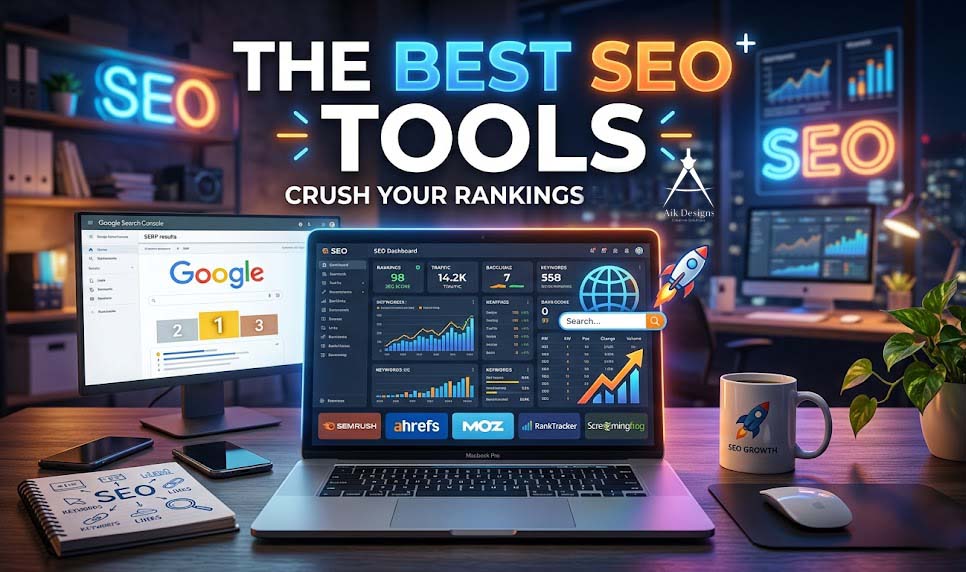
The best SEO tools in 2026 are Ahrefs (best all-in-one for professionals), SEMrush (best full digital marketing suite), Google Search Console (best free tool), Surfer SEO (best for content optimization), Screaming Frog (best for technical SEO), and RankMath or Yoast SEO (best for WordPress). Your best choice depends on your budget, goals, and experience level.
Are there free SEO tools?
Yes. Several powerful free SEO tools exist, including Google Search Console, Google Analytics 4, Google Keyword Planner, Bing Webmaster Tools, RankMath (free WordPress plugin), Yoast SEO (free), Screaming Frog (free up to 500 URLs), and Ubersuggest (limited free plan). These free tools are sufficient for basic SEO, though paid tools offer significantly more data and features.
Do I need SEO tools to rank on Google?
Technically no, but practically yes. You can do SEO without tools, but you’ll be working blind. SEO tools provide the keyword data, competitor insights, backlink analysis, and technical auditing capabilities that make modern SEO viable. In a competitive landscape, relying solely on intuition puts you at a serious disadvantage versus competitors who use data-driven tools.
Which SEO tool is best for beginners?
For beginners, start with Google Search Console and Google Analytics 4 (both free and essential). For WordPress sites, install RankMath or Yoast SEO (free tier). For keyword research, try Ubersuggest or the free version of Moz. As you grow, consider upgrading to Mangools or Moz Pro, then eventually Ahrefs or SEMrush.
Is Ahrefs or SEMrush better?
Both are industry-leading SEO platforms. Ahrefs is widely considered superior for backlink analysis and content research. SEMrush offers more tools overall — especially for PPC, social media, and content marketing — making it better for full-service digital marketing agencies. Most professionals who can afford it use both. If choosing one, Ahrefs is the top recommendation for pure SEO.
How much do SEO tools cost?
SEO tool pricing in 2026 ranges from free (Google Search Console, RankMath, Screaming Frog up to 500 URLs) to $29/mo (Mangools, Ubersuggest) to $65-139/mo (SE Ranking, Moz, SEMrush Pro) to $129-449/mo (Ahrefs) to custom enterprise pricing (BrightEdge, Conductor). Most tools offer free trials or limited free tiers.
What is the best SEO tool for keyword research?
Ahrefs Keywords Explorer and SEMrush Keyword Magic Tool are the most comprehensive paid keyword research tools, with databases of billions of keywords. For free alternatives, Google Keyword Planner and Ubersuggest are solid starting points. For accuracy of keyword difficulty scores specifically, Mangools KWFinder is highly regarded.
Can SEO tools guarantee first page rankings?
No SEO tool can guarantee rankings — and anyone claiming otherwise is misleading you. SEO tools provide data, insights, and optimization guidance, but rankings depend on many factors including content quality, domain authority, backlink profile, user experience, and competitor activity. Tools help you make better decisions; execution and quality determine results.
What SEO tools do professionals use?
Most professional SEOs and agencies use a combination of tools: Ahrefs or SEMrush as their primary platform, Google Search Console for first-party data, Screaming Frog for technical audits, Surfer SEO for content optimization, and BrightLocal for local SEO clients. GA4 is universal for analytics across all levels.
How do I use SEO tools effectively?
Start by setting up Google Search Console and GA4 to understand your current baseline. Use a keyword research tool to identify target keywords with the right balance of search volume and difficulty. Conduct a technical audit with Screaming Frog or your platform’s site audit. Optimize existing content with Surfer SEO or your on-page SEO plugin. Build backlinks by analyzing competitor link profiles in Ahrefs. Track your rankings over time and iterate based on data.
Final Verdict: The Best SEO Tools in 2026
There’s no single “best” SEO tool for everyone — the right choice depends on your goals, budget, and skill level. Here’s our recommended setup for each user type:
Beginners / Bloggers: Google Search Console + GA4 + RankMath (free) + Ubersuggest
Small Business Owners: Google Search Console + Yoast SEO/RankMath + Mangools or SE Ranking
Freelance SEOs: Ahrefs or SE Ranking + Screaming Frog + Surfer SEO
Content Marketers: Surfer SEO + Ahrefs + Google Search Console
Local Businesses: BrightLocal + RankMath + Google Search Console
SEO Agencies: SEMrush or Ahrefs + SE Ranking (white-label) + Screaming Frog + Surfer SEO + BrightLocal
Enterprise: BrightEdge or Conductor + Ahrefs + SEMrush + Screaming Frog
The common thread? Every serious website needs Google Search Console. It’s free, it’s from Google, and it gives you data no other tool can replicate. Start there, then build your stack based on your specific needs and growth stage.
Have a question about a specific SEO tool? Drop a comment below and our team will answer within 24 hours.
Related Articles You May Also Like
What Is Google AI Overview (AIO) & Its Impact on Traffic?
Search Generative Experience (SGE): The Future of Google Search In 2026
How to Write For E-E-A-T: The Complete Google Content Guide
AI Search Visibility: The Future Of SEO
How To Fix Core Web Vitals: The Complete Guide
Disclosure: Some links in this article may be affiliate links. We only recommend tools we genuinely use and trust. Pricing and features are accurate as of May 2026 and subject to change.
About Author