Bing SEO Guide 2026: How To Rank Higher On Bing Search
Most SEO professionals are leaving significant traffic — and revenue — on the table by focusing exclusively on Google. In 2026, Bing SEO has quietly become one of the highest return-on-effort channels available to website owners, marketers, and businesses. Here’s why: Bing’s index now powers not just Bing.com itself, but also Yahoo Search, DuckDuckGo, AOL Search, Microsoft Copilot, Windows Search, Edge browser search, and — critically — ChatGPT’s web browsing feature. When ChatGPT reached 900 million weekly active users in early 2026, every web search it performs pulls results from Bing’s index. Rank well on Bing, and you’re not just appearing on one search engine — you’re appearing across the entire Microsoft-powered AI search ecosystem.
In this complete Bing SEO guide for 2026, we cover everything: how Bing’s ranking algorithm actually works, how it differs from Google, how to set up and master Bing Webmaster Tools, exactly which on-page and off-page SEO factors move the needle, how to dominate Bing’s local search results, how to use IndexNow to get pages indexed faster, and the precise action plan to start ranking higher on Bing this week — even if you’ve never thought about Bing SEO before.
Bing SEO Related Guide 2026
- 📖 Bing SEO Guide
- 📖 Bing Webmaster Tools
- 📖 Microsoft Copilot SEO Guide
- 📖 IndexNow Complete Guide
- 📖 How To Set Up IndexNow In WordPress
📋 Table of Contents
- Why Bing SEO Matters More Than Ever in 2026
- Bing vs Google: Key Differences in Ranking Algorithms
- Bing Ranking Factors: The Complete 2026 Breakdown
- Bing Webmaster Tools: Complete Setup Guide (Step by Step)
- IndexNow: How to Get Pages Indexed Instantly on Bing
- On-Page SEO for Bing: Exact Optimization Checklist
- Keyword Research for Bing: Finding Opportunities Google Misses
- Content Strategy for Bing: What Ranks and What Doesn’t
- Backlinks and Off-Page SEO for Bing
- Social Signals: Bing’s Secret Ranking Factor
- Technical SEO for Bing: Speed, Mobile, HTTPS & Structured Data
- Bing Local SEO: How to Rank in Bing Maps & Local Pack
- Bing Image & Video SEO: Capture Extra SERP Real Estate
- Bing Copilot & AI SEO: Ranking in Microsoft’s AI Search
- Best Bing SEO Tools for 2026
- Complete Bing SEO Action Plan: What to Do This Week
- Bing vs Google SEO Comparison Table
- FAQs: Bing SEO Guide 2026
- Conclusion & Next Steps
1. Why Bing SEO Matters More Than Ever in 2026
The conventional wisdom among SEO professionals has long been “optimize for Google, everything else follows.” In 2026, that thinking is dangerously outdated. Here are the concrete, data-backed reasons why ranking on Bing in 2026 deserves a dedicated strategy:
Bing Powers Far More Than Just Bing.com
Bing’s index is the backbone of an entire ecosystem of search experiences that collectively reach hundreds of millions of users every day. When you achieve strong Bing search rankings, your content automatically surfaces across:
- Yahoo Search — powered entirely by Bing’s organic results
- DuckDuckGo — private search engine used by privacy-conscious users
- AOL Search, Ecosia, Neeva AI — all syndicated from Bing’s index
- Microsoft Copilot — millions of AI-assisted queries daily, drawing answers from Bing’s index
- ChatGPT’s Browse with Bing — 900M weekly ChatGPT users whose web searches all pull from Bing’s index
- Windows Search and Edge browser — default search in over 1 billion Windows devices worldwide
- Perplexity AI — partially powers web retrieval through Bing’s index
Bing’s Audience Is Highly Valuable
Bing users are not a random cross-section of the internet. They skew significantly toward older adults with higher disposable incomes, enterprise employees on Microsoft-managed devices, and users in high-value sectors — finance, insurance, legal, B2B services, and healthcare. For many industries, Bing’s audience converts at rates comparable to or exceeding Google traffic, despite lower volume.
Competition on Bing is Dramatically Lower
Because 95%+ of SEO practitioners focus exclusively on Google, Bing’s SERPs are significantly less competitive for most keywords. The same content that ranks on Google page 3 might sit on Bing page 1 with minimal additional effort. This asymmetry makes Bing SEO one of the most efficient traffic-acquisition strategies available to website owners who are willing to treat it as a real priority.
Bing SEO Builds on What You’re Already Doing
The foundational work of good SEO — quality content, technical health, backlinks, page speed — benefits Bing and Google simultaneously. Bing-specific optimization (Webmaster Tools setup, IndexNow implementation, social signals, on-page keyword emphasis) requires modest additional effort that pays dividends across the entire Microsoft search ecosystem.
2. Bing vs Google: Key Differences In Ranking Algorithms
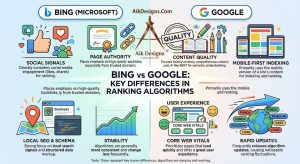
Understanding exactly how Bing and Google differ is the foundation of an effective Bing SEO strategy. Both engines share broad similarities — content quality, backlinks, technical health, user experience — but their weighting of specific signals varies significantly. Here’s a comprehensive breakdown:
| Ranking Factor | Google’s Approach | Bing’s Approach | Advantage |
|---|---|---|---|
| Keyword Matching | Semantic/AI-driven; understands synonyms, intent | Prefers exact-match keywords in title & metadata | 🔵 More predictable for SEOs |
| Social Signals | Officially ignored as ranking factor | Confirmed direct ranking signal (likes, shares, engagement) | 🔵 Bing rewards social activity |
| Meta Keywords | Completely ignored | Weak signal, but noted in official docs as potentially used | 🔵 Worth including for Bing |
| Backlinks | Quality, context, and diversity are primary factors | Volume + trust matters; .edu & .gov links carry extra weight | 🔵 Older link profiles rewarded |
| Domain Age | Less weight; newer sites can rank fast with quality | Established, older domains get a trust boost | 🔵 Rewards established sites |
| Mobile Indexing | Mobile-first indexing; crawls mobile version first | Desktop-first; desktop version used for primary indexing | 🔵 Desktop-heavy businesses benefit |
| Page Speed | Core Web Vitals are formal ranking signals | Speed is important for UX signals but not formalized like CWV | 🔵 Slightly more forgiving |
| Author Authority | E-E-A-T signals; focuses on topical expertise | Explicitly looks for clear author attribution and bio | 🔵 Clear author bios rewarded |
| Multimedia | Images & video help but less directly tied to rankings | Image & video search deeply integrated; multimedia helps rankings | 🔵 Richer pages win on Bing |
| Structured Data | Rich snippets; supports most schema types | Also supports schema; helps Bing understand page context | 🔵 Both benefit equally |
| Freshness | High value especially for news/trending queries | Values freshness particularly for news & event pages | 🔵 Both value regular updates |
3. Bing Ranking Factors: The Complete 2026 Breakdown
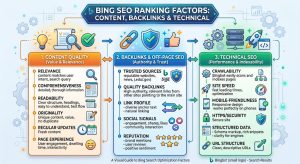
Bing’s algorithm in 2026 evaluates websites across four core pillars, each containing multiple specific signals. Understanding all of them is essential for a comprehensive Bing SEO optimization strategy.
🏆 Pillar 1: Content Quality & Relevance
Content remains king on Bing, just as on Google. But Bing evaluates content quality through a slightly different lens:
- Exact-match keyword relevance: Unlike Google’s increasingly semantic approach, Bing gives more direct weight to the presence of your target keyword phrase in your title tag, H1, opening paragraph, meta description, and URL. This means traditional, precise keyword optimization is more directly rewarded on Bing.
- Depth and comprehensiveness: Bing favors content that thoroughly covers a topic. Pages with shallow, thin content struggle to rank, while comprehensive guides tend to perform exceptionally well.
- Content freshness: Bing rewards regularly updated content, particularly for news, events, and fast-moving topics. Static pages that haven’t been touched in years gradually lose ranking ground.
- Clear author attribution: Bing explicitly evaluates who created the content. Pages with clear bylines, author bios, and credentials signal credibility and authority to Bingbot.
- Question-style titles boost CTR: Research from SEO.com (2026) reports that question-style title tags improve average click-through rates by +14.1% in Bing SERPs — and higher CTR is itself a Bing ranking signal.
🔗 Pillar 2: Backlinks & Off-Page Authority
- Backlink volume: Bing places more weight on total backlink quantity than Google does, alongside quality. A page with 200 legitimate backlinks tends to perform well.
- .edu and .gov links: These carry extraordinary trust weight in Bing’s algorithm. A single .edu or .gov link often outperforms dozens of commercial backlinks in Bing’s eyes.
- Domain age and history: Established domains with years of consistent operation and link accumulation earn stronger baseline trust from Bing’s algorithm.
- Keyword-rich anchor text: Bing pays more direct attention to descriptive, keyword-optimized anchor text in inbound links than Google’s more skeptical approach to exact-match anchors.
- Social signals: LinkedIn (especially important given Microsoft’s ownership), Facebook, and X/Twitter engagement are confirmed Bing ranking signals — treated similarly to external links in terms of trust building.
⚙️ Pillar 3: Technical SEO Health
- Crawlability: Bingbot must be able to access, crawl, and understand every page you want to rank. Blocked URLs, noindex errors, and poor robots.txt configuration directly prevent Bing indexing.
- XML sitemap quality: Bing processes submitted XML sitemaps at least once every 24 hours. A clean, accurate, up-to-date sitemap is essential for comprehensive indexing.
- HTTPS implementation: HTTPS is a baseline requirement — unsecured HTTP pages are explicitly disadvantaged in Bing’s rankings.
- Page speed: Fast-loading pages provide better user experience. Bing monitors how users interact with search results — high bounce rates and low dwell time from slow pages negatively impact rankings.
- Mobile responsiveness: While Bing is desktop-first in indexing, mobile-friendly sites are explicitly preferred. With 60% of global web traffic on mobile (Webnyxt, 2026), poor mobile UX hurts engagement signals.
- Structured data (Schema.org): Schema markup helps Bing correctly understand your page’s content, entities, and relationships — and unlocks rich results in Bing’s SERP features.
👤 Pillar 4: User Experience & Engagement Signals
- Click-through rate (CTR): Bing monitors how often users click your result for a given query. High CTR signals relevance and can boost your ranking position.
- Dwell time: How long users spend on your page after clicking from Bing tells the engine whether your content satisfied the query. Long dwell time = strong quality signal.
- Bounce rate: Users who immediately return to Bing from your page send a negative quality signal. Content that matches search intent keeps users engaged.
- Site revisits: Users who return to your site directly signal high satisfaction and brand trust to Bing’s algorithm.
- Core Web Vitals (increasingly): LCP, FID/INP, and CLS metrics are becoming more important to Bing’s ranking evaluation as page experience becomes central to UX quality assessment.
4. Bing Webmaster Tools: Complete Setup Guide (Step by Step)
Bing Webmaster Tools (BWT) is your free, official command center for everything related to Bing SEO. Think of it as Google Search Console’s counterpart — but in some respects more generous with the data it shares. It’s completely free and gives you sitemap submission, crawl diagnostics, keyword research, backlink analysis, IndexNow integration, technical audits, and an AI assistant (Copilot in BWT) — all in one place.
Step 1: Access Bing Webmaster Tools
Go to webmaster.bing.com and sign in with a Microsoft account, Google account, or Facebook account. If you don’t have a Microsoft account, create one during sign-up — it’s free and takes under two minutes.
Step 2: Add and Verify Your Website
There are two paths to add your site:
- Import from Google Search Console (Recommended): If your site is already verified in Google Search Console, click the “Import from GSC” option on the Bing Webmaster Tools dashboard. Authorize the connection, and Bing automatically imports your verified sites and existing sitemaps. This takes approximately 2 minutes and is the fastest setup path available.
- Manual verification: If you prefer manual setup, choose from three verification methods:
- XML file upload: Download a unique BWT XML file and upload it to your website’s root directory (e.g., yoursite.com/BingSiteAuth.xml)
- HTML meta tag: Add the provided meta tag inside the <head> element of your homepage
- DNS CNAME record: Add a CNAME record to your domain’s DNS settings (best for enterprise sites)
- Domain Connect: If your DNS provider (GoDaddy, Bluehost, Wix) is supported, verify automatically with one click
Step 3: Submit Your XML Sitemap
Once verified, navigate to Sitemaps in the left sidebar and submit your XML sitemap URL (typically yoursite.com/sitemap.xml or yoursite.com/sitemap_index.xml). Bing processes submitted sitemaps at least once every 24 hours for indexing updates. Also reference your sitemap in your robots.txt file for additional discoverability.
Step 4: Enable IndexNow (Critical for Fast Indexing)
IndexNow is a free open-source protocol that lets you ping Bing instantly whenever you publish, update, or delete a page — eliminating the days or weeks of waiting for Bingbot to rediscover your content on its own schedule. See the full IndexNow section below for implementation details.
Step 5: Run Your First Site Scan
Use the Site Scan tool in BWT to run a technical SEO audit of your entire site. It detects:
- Missing or duplicate title tags
- Missing or duplicate meta descriptions
- Missing image alt text
- Broken links and 404 errors
- Thin content pages
- Crawl errors and blocked URLs
Run this scan immediately after setup, fix every flagged issue, and then re-run it quarterly to maintain technical health. Bing’s Site Scan often catches issues that Google Search Console misses.
Step 6: Explore Your Keyword Data
The Search Performance report in BWT shows impressions, clicks, CTR, and average ranking positions for every keyword bringing users to your site via Bing. Use this data to identify:
- Keywords ranking in positions 6–20 (quick-win ranking improvements)
- Pages with high impressions but low CTR (title tag and meta description optimization opportunities)
- New keyword opportunities that don’t appear in Google Search Console
Step 7: Connect Microsoft Clarity
From the Diagnostics & Tools menu, enable Microsoft Clarity — a completely free behavior analytics tool that provides session recordings, heatmaps, and click maps. Clarity shows you exactly how Bing users interact with your pages, where they drop off, and which elements drive engagement. This data directly helps you improve the UX signals that Bing uses as ranking inputs.
5. IndexNow: How to Get Pages Indexed Instantly on Bing
IndexNow is one of the most underutilized — and most powerful — tools in modern SEO. Developed by Microsoft and adopted by Bing, Yandex, and several other search engines, it’s a free open-source protocol that fundamentally changes how search engines discover new and updated content. Instead of waiting for Bingbot to crawl your site on its own schedule (which can take days to weeks), IndexNow lets you push your updated URLs directly to participating search engines the moment your content changes.
Why IndexNow Matters for Bing SEO
- Without IndexNow: Bingbot crawls your site on a schedule based on your site’s crawl budget and authority. New pages can take several days to several weeks to be discovered and indexed.
- With IndexNow: Bing validates your ping within 24 hours and typically crawls and indexes your new/updated content within 1–3 days. For frequently updated sites — news, e-commerce, blogs — this is transformative.
- One ping, multiple engines: A single IndexNow API call notifies Bing, Yandex, and all other participating search engines simultaneously.
How to Implement IndexNow on Your Website
Option A: WordPress Plugin (Easiest)
If you run a WordPress site, the easiest implementation is through your existing SEO plugin:
- RankMath SEO: IndexNow is built into RankMath. Navigate to RankMath → General Settings → Analytics → Enable IndexNow. Your site will automatically ping Bing whenever you publish or update content.
- Yoast SEO: Yoast has integrated IndexNow support. Enable it in Yoast → General → Features → IndexNow toggle.
- Bing’s official WordPress plugin: Microsoft provides a dedicated IndexNow plugin for WordPress available in the WordPress plugin repository.
Option B: Cloudflare Integration (No Coding Required)
If your site uses Cloudflare, enable “Crawler Hints” in your Cloudflare dashboard. Cloudflare automatically sends IndexNow pings to participating search engines whenever your cached content changes — no plugin or API key management required.
Option C: Direct API Implementation (For Developers)
For custom-built sites or maximum control, implement IndexNow via direct API:
POST /IndexNow HTTP/1.1
Content-Type: application/json; charset=utf-8
Host: api.indexnow.org

{
  "host": "www.yoursite.com",
  "key": "YOUR-API-KEY-HERE",
  "keyLocation": "https://www.yoursite.com/YOUR-API-KEY-HERE.txt",
  "urlList": [
    "https://www.yoursite.com/new-blog-post/",
    "https://www.yoursite.com/updated-product-page/",
    "https://www.yoursite.com/deleted-page/"
  ]
}
Steps for API implementation:
- Generate an API key (a random alphanumeric string, minimum 8 characters)
- Create a text file named after your key (e.g.,
abc123def456.txt) containing only the key - Upload this file to your website root (e.g., yoursite.com/abc123def456.txt)
- Call the IndexNow API whenever you publish, update, or delete content
- Monitor submissions in Bing Webmaster Tools under the IndexNow reporting section
6. On-Page SEO for Bing: Exact Optimization Checklist
On-page SEO for Bing follows many of the same fundamentals as Google, but with specific differences in emphasis. Use this checklist for every page you want to rank higher on Bing:
✅ Title Tag Optimization for Bing
- Include your exact target keyword phrase in the first 30–40 characters of the title tag — Bing gives more direct weight to keyword position in the title than Google
- Keep title tags between 50–60 characters to ensure full display in Bing SERPs
- Use question-style titles where natural — research shows a +14.1% CTR improvement on Bing for question-format title tags
- Ensure every page has a unique title tag — duplicate titles significantly hurt Bing indexing and ranking
- Include your brand name at the end of the title (Brand Name | Keyword Focus)
✅ Meta Description Optimization for Bing
- Write compelling meta descriptions of 150–160 characters — Bing Webmaster Tools specifically flags descriptions under 120 characters as too short
- Include your primary keyword naturally within the meta description — Bing bolds keywords matching the user’s query, increasing CTR
- Add a clear call-to-action (Learn More, Get Started, Download Free, etc.)
- Every page needs a unique meta description — Bing treats duplicate meta descriptions as a quality issue
✅ Meta Keywords (Bing-Specific)
- Unlike Google, Bing’s documentation notes that relevant meta keywords may occasionally be considered as a weak signal
- Include 3–5 highly relevant meta keywords per page — avoid keyword stuffing, which can harm rankings
- Use exactly the keywords that genuinely describe the page’s content
✅ URL Structure for Bing
- Use clean, descriptive URLs containing your target keyword (e.g., /bing-seo-guide/ not /page?id=47)
- Keep URLs short and readable — avoid excessive parameters, numbers, or symbols
- Use hyphens to separate words in URLs (not underscores)
✅ Heading Structure (H1, H2, H3)
- Use exactly one H1 per page, containing your exact target keyword phrase
- Structure H2s to cover the main sub-topics and expected sub-questions a user might have
- Use H3s inside H2 sections for additional detail — this logical hierarchy helps Bingbot understand your content’s organization
- Avoid over-optimization: Bing’s guidelines note that excessive keyword use in headings can harm rankings
✅ Image Alt Text Optimization
- Every image must have descriptive, keyword-relevant alt text — this is critical for Bing Image Search rankings as well as standard web rankings
- Use descriptive image file names before upload (e.g., bing-seo-guide-2026.jpg, not IMG_2847.jpg)
- Include relevant captions under key images — Bing uses captions as additional content context signals
- Optimize images for fast loading — compress to under 150KB without visible quality loss
✅ Internal Linking Strategy
- Use descriptive, keyword-rich anchor text in internal links — Bing weighs descriptive anchors more heavily than Google
- Ensure your most important pages receive the most internal links from other pages on your site
- Create a logical site hierarchy — homepage → category pages → individual posts/pages — that Bingbot can follow efficiently
- Fix all broken internal links — these are flagged in Bing’s Site Scan tool and hurt crawl efficiency
✅ Author Attribution (Bing-Specific)
- Every content page should have a clearly visible author byline
- Link author bylines to dedicated author pages with a full bio, credentials, and links to social profiles (especially LinkedIn)
- Include publication and last-updated dates prominently on all articles and blog posts
- Bing explicitly evaluates author credibility as part of its trust assessment — this is unique emphasis compared to Google
7. Keyword Research for Bing: Finding Opportunities Google Misses
Keyword research for Bing isn’t just about applying Google keyword data to Bing — it’s about finding the unique opportunities in Bing’s search behavior that your competitors are completely missing because they never look.
Microsoft Advertising Keyword Planner (Bing’s Native Tool)
The Microsoft Advertising Keyword Planner (formerly Bing Ads Keyword Planner) uses actual Bing search data — making it the most accurate tool for understanding what users are searching for specifically on Bing and Microsoft’s network. Access it through the Microsoft Advertising platform (ads.microsoft.com), even without running paid ads. It shows:
- Bing-specific search volumes (different from Google volumes)
- Bid estimates that indicate commercial intent and competition level
- Related keyword suggestions based on Bing’s actual query data
- Seasonal trends for Bing searches specifically
Bing Webmaster Tools Keyword Research
BWT’s built-in keyword research tool provides real Bing search data about queries your site appears for. Use it to:
- Find long-tail keywords driving impressions but few clicks (title/meta optimization opportunities)
- Discover keyword variations that Bing users search for that don’t appear in Google-focused tools
- Identify seasonal Bing keyword trends in your industry
Bing’s Search Suggest and People Also Ask
Bing’s autocomplete and “People Also Ask” features reveal exactly what Bing users type and the follow-up questions they have. These are real Bing search queries that make perfect H2 and H3 subheadings, FAQ sections, and content topics. Search your target keywords on Bing.com and systematically capture all suggest and PAA results.
Bing-Specific Keyword Opportunities
Several audience characteristics of Bing users create keyword opportunities that Google SEOs typically ignore:
- Desktop-heavy queries: Bing skews to desktop users, meaning longer, more detailed search queries perform well
- Older demographic queries: Bing users tend to be older; optimize for more formal, detailed, authoritative content on topics like finance, health, legal, and retirement
- Enterprise/B2B queries: Enterprise employees on Microsoft devices frequently search Bing; B2B keywords have lower Bing competition than Google
- Brand + location queries: Bing’s local search behavior is strong; “near me” and location-specific queries perform differently on Bing than Google
8. Content Strategy for Bing: What Ranks and What Doesn’t
Bing’s content quality evaluation is systematic and rewards content that demonstrates clear expertise, is well-structured, and directly answers search queries. Here’s what the data shows about what content ranks well on Bing in 2026:
Content Types That Rank Well on Bing
- Comprehensive long-form guides: Bing rewards thorough coverage of topics. Detailed guides (1,500–5,000+ words) that comprehensively answer a query consistently outperform thin content in Bing rankings.
- Expert-authored content with clear bios: Pages with named authors, professional credentials, and linked author profiles rank better on Bing due to its stronger emphasis on author attribution.
- Multimedia-rich pages: Pages incorporating relevant, optimized images and embedded videos perform better on Bing because visual search is more deeply integrated into Bing’s results. Bing also surfaces image and video results prominently on the main SERP.
- Statistics and data-driven content: Publishing expert content with original statistics and data increases the likelihood of being cited in Bing’s AI-assisted results by approximately 40% (Vingtdeux, 2025).
- Regularly updated content: Bing’s freshness signals reward content that’s visibly updated with new publication dates, new statistics, and revised information.
Content Optimization Best Practices for Bing
- Write a precise, intent-aligned title: Don’t stack keyword variants — write one clear title perfectly aligned with the user’s likely search intent for that query
- Structure with predictive H2s: Each H2 should address a sub-question a user would naturally ask about the main topic
- Avoid keyword over-optimization: Bing’s guidelines explicitly warn that excessive keyword stuffing can harm rankings. Aim for natural keyword integration
- Include clear expertise signals: Author credentials, publication date, data sources, external citations — all signal credibility to Bing’s quality evaluation
- Optimize for dwell time: Content that genuinely engages users — structured formatting, useful subheadings, relevant examples, visual breaks — keeps users on page longer, sending positive Bing ranking signals
9. Backlinks and Off-Page SEO for Bing
Backlinks are a significant ranking signal for Bing, but Bing evaluates them differently from Google in several important ways that shape your off-page Bing SEO strategy:
How Bing Evaluates Backlinks (Key Differences from Google)
- Volume alongside quality: Bing places notable weight on the total number of backlinks to a page, not just their quality. A page with 220 good links from relevant domains tends to rank well.
- .edu and .gov links are extraordinary: These domain extensions carry exceptional trust weight in Bing’s algorithm. A single backlink from a university or government website often outperforms dozens of commercial backlinks for Bing rankings.
- Domain age matters: Bing prefers older, established domains as link sources. A backlink from a domain founded in 2015 carries more inherent trust than a link from a domain registered last month.
- Keyword-rich anchor text: Bing is more receptive to descriptive, keyword-relevant anchor text in backlinks than Google’s modern algorithmic skepticism of exact-match anchors. Use descriptive anchors consistently.
- Organic link building over time: Bing’s algorithm particularly rewards natural backlink profiles that have grown organically over time — sudden spikes in link acquisition can trigger scrutiny.
Link Building Strategies That Work for Bing
- Guest posting on authoritative sites: Write expert articles for well-established industry publications with clear author attribution. These links carry both authority (for Bing’s backlink evaluation) and author credibility signals.
- Academic and educational partnerships: Research opportunities to earn .edu links through scholarships, educational resources, expert contributions to university content, or academic citations of your original research.
- Government and nonprofit collaboration: Contributing expert content, resources, or tools that government agencies or nonprofits link to earns the highest-trust backlinks in Bing’s hierarchy.
- Directory listings in legitimate directories: Unlike Google which has largely discounted general directories, Bing still gives weight to listings in legitimate, well-established business directories.
- HARO (Help a Reporter Out): Providing expert quotes to journalists earns high-authority publication backlinks with clear author attribution — a double benefit for Bing SEO.
- Original research and data: Publishing unique industry statistics, surveys, or research that other sites cite creates natural backlinks at scale.
10. Social Signals: Bing’s Unique Ranking Factor
Social signals represent the most significant difference between Bing and Google SEO. While Google has consistently maintained that social media engagement (likes, shares, followers) does not directly influence search rankings, Bing has explicitly confirmed that social engagement is a direct ranking factor. This creates a unique optimization lever that Google SEO simply doesn’t offer.
How Social Signals Affect Bing Rankings
When your content gets significant engagement on social media platforms — shares, likes, comments, retweets, reposts — Bing treats this as a “vote of confidence” from real people, similar to how it treats backlinks. If lots of real users are sharing and engaging with your content, Bing infers that it must be valuable, relevant, and trustworthy — and boosts its ranking accordingly.
Which Platforms Matter Most for Bing Social Signals?
- LinkedIn (Most Important): Microsoft owns LinkedIn — which has 1.2 billion members globally (Microsoft Annual Report 2025). LinkedIn social signals carry the most direct weight in Bing’s ranking algorithm of any social platform. Posting content, earning shares and comments, and maintaining an active LinkedIn company presence directly benefits Bing rankings.
- Facebook: Facebook share engagement and URL mentions are significant Bing social signals. Pages with strong Facebook sharing tend to perform better on Bing than equivalent non-shared pages.
- X/Twitter: Twitter/X URL engagement (tweets containing your URLs, retweets, replies) is a confirmed Bing ranking signal. Active X presence distributing your content provides measurable Bing ranking benefits.
- Pinterest: High engagement Pinterest pins from your site contribute to Bing’s social signal evaluation, particularly beneficial for visual and product-focused content.
Social Signal Optimization Strategy for Bing
- Always share on LinkedIn first: Every new piece of content should be shared on LinkedIn immediately upon publication — frame it as an expert insight to drive comments and reshares
- Create share-worthy content: Lists, statistics, original research, strong opinions, and practical guides generate the most organic social sharing
- Encourage engagement explicitly: End social posts with a question that prompts comments — engagement signals (not just shares) contribute to Bing’s social quality assessment
- Build an active social following: Active social profiles with consistent content sharing from your domain provide an ongoing Bing ranking lever with no equivalent mechanism in Google SEO
- Time your posts for peak engagement: Share content when your audience is most active to maximize engagement velocity — Bing monitors engagement patterns, not just total counts
11. Technical SEO for Bing: Speed, Mobile, HTTPS & Structured Data
Technical SEO for Bing follows the same foundational principles as Google technical SEO, with a few important nuances. A technically healthy site is the prerequisite for all other Bing ranking factors to work effectively.
Page Speed Optimization for Bing
- Target sub-3-second load times: 53% of mobile users leave a site that takes more than 3 seconds to load. Every additional 2 seconds can increase bounce rate by over 100% (HubSpot, 2026) — and high bounce rates send negative quality signals to Bing.
- Image compression: Compress all images without visible quality loss. Use next-gen formats (WebP) where browser support allows.
- Browser caching: Enable caching to reduce load times for returning visitors — positive repeat-visit behavior is a Bing trust signal.
- Minimize redirects: Every redirect adds latency. Audit and eliminate unnecessary redirect chains.
- CDN implementation: Use a Content Delivery Network to serve your site from servers geographically close to your users, reducing latency across all regions.
- Tools to use: Google PageSpeed Insights (works for all sites), GTmetrix, Microsoft’s Mobile Friendliness Test (Bing’s official tool at bing.com/webmaster/tools/mobile-friendliness)
Mobile Optimization for Bing
- Responsive design is mandatory: While Bing is desktop-first in its indexing, mobile-friendliness is an explicit ranking factor. With 60% of global web traffic on mobile, poor mobile UX will devastate engagement signals from all traffic sources.
- Use Microsoft’s Mobile Friendliness Test: Test your key pages at bing.com/webmaster/tools/mobile-friendliness to see exactly how Bingbot evaluates your mobile experience.
- Viewport meta tag: Ensure every page includes the responsive viewport meta tag: <meta name=”viewport” content=”width=device-width, initial-scale=1″>
- Touch target sizing: Interactive elements (buttons, links) must be at minimum 44×44 pixels to be usable on touchscreens
HTTPS and Security for Bing
- HTTPS is a ranking requirement: HTTP pages are explicitly disadvantaged in Bing rankings. Ensure your entire site — not just the homepage — uses HTTPS.
- 301 redirect all HTTP to HTTPS: Permanently redirect every HTTP URL to its HTTPS equivalent to consolidate ranking signals and ensure user security.
- Valid SSL certificate: Use a certificate from a trusted Certificate Authority. Expired or invalid SSL certificates will cause Bingbot to treat your site as insecure.
Structured Data (Schema Markup) for Bing
Structured data helps Bing correctly understand your page content, entities, and relationships — and unlocks rich results (rich snippets) that dramatically improve SERP click-through rates.
- Supported schema types for Bing: Article, Blog Posting, Product, Recipe, FAQPage, HowTo, Event, LocalBusiness, Organization, Person, Review, VideoObject, BreadcrumbList
- Implementation: Use JSON-LD format (recommended), embedded in the <head> of your HTML
- Validate with Bing’s Markup Validator: Test structured data at bing.com/webmaster/tools/markup-validator before deploying
- FAQ schema: Implementing FAQPage schema on content pages can earn FAQ-style rich results on Bing, dramatically expanding SERP real estate and CTR
- WordPress plugins: RankMath and Yoast SEO both auto-generate and inject structured data for most content types
Robots.txt and Crawl Configuration for Bing
- Verify Bingbot is not blocked: Check your robots.txt file to confirm Bingbot is allowed to crawl all content pages. Use Bing Webmaster Tools → Robots.txt Tester to validate.
- Allow OAI-SearchBot: OpenAI’s crawler (OAI-SearchBot) must not be blocked if you want your content appearing in ChatGPT Search. Many sites accidentally block it.
- Crawl budget management: Prevent Bingbot from wasting crawl budget on low-value pages (admin pages, duplicate parameter URLs, thin tag pages) by noindexing or disallowing them
12. Bing Local SEO: How to Rank in Bing Maps & the Local Pack
For local businesses — restaurants, contractors, dentists, law firms, retailers, service businesses of any type — Bing local SEO is one of the fastest paths to visible ranking gains. Bing’s local pack and map results are less competitive than Google’s, meaning a well-optimized Bing Places listing can consistently outperform established competitors who only focus on Google My Business.
Step 1: Claim and Verify Your Bing Places for Business Listing
Bing Places for Business is the direct equivalent of Google Business Profile — and it’s free. Go to bingplaces.com to claim your listing. If you already have a Google Business Profile, you can import it directly into Bing Places in minutes.
Verify your listing through:
- Automated phone call: Bing calls your business number with a verification PIN
- Email verification: Confirm via your business email address
- Mail verification: Postcard with PIN sent to your business address
Step 2: Complete Your Bing Places Profile 100%
A fully completed Bing Places profile consistently outranks incomplete profiles in Bing’s local pack. Ensure you’ve filled in every available field:
- Business name: Exactly as it appears on your signage and official documents
- Address: Complete, accurate, formatted consistently with your NAP across all directories
- Phone number: Local area code preferred; consistent across all platforms
- Website URL: Link to your homepage or location-specific landing page
- Business categories: Choose the most specific, accurate categories available
- Business hours: Complete and accurate, updated for holidays
- Business description: Write 200–300 words incorporating local keywords naturally
- Photos: Upload at minimum 10 high-quality photos — exterior, interior, products/services, team
- Services/menu: List all services or products with descriptions and prices where applicable
Step 3: Optimize with Local Keywords
- Include your city + service keywords naturally in your business description (e.g., “plumbing services in Austin, Texas” not just “plumbing services”)
- Create location-specific pages on your website for each city or neighborhood you serve
- Include LocalBusiness schema markup on your website with NAP (Name, Address, Phone) data that exactly matches your Bing Places listing
Step 4: Build NAP Consistency Across All Directories
Your business’s Name, Address, and Phone number (NAP) must be exactly identical across all online directories — Bing Places, Google Business Profile, Yelp, Yellow Pages, BBB, industry directories, and your own website. Even minor inconsistencies (St. vs Street, Suite vs Ste) can reduce Bing’s local ranking confidence.
Step 5: Earn and Respond to Reviews
Customer reviews on Bing Places directly influence local pack rankings. Businesses with more positive reviews — and that actively respond to reviews — rank higher in Bing’s local results. Build a system to:
- Ask satisfied customers to leave reviews on Bing Places specifically
- Respond professionally to all reviews — positive and negative
- Aim for a consistent flow of new reviews rather than a one-time burst
13. Bing Image & Video SEO: Capture Extra SERP Real Estate
Bing’s SERPs are significantly more visual than Google’s — images often fill the entire first page for visual queries, and video results are prominently featured on main SERPs rather than being confined to a separate video tab. This means Bing image SEO and Bing video SEO represent additional ranking opportunities that Google-focused SEOs completely ignore.
Bing Image SEO Best Practices
- Descriptive, keyword-rich file names: Rename every image before uploading (e.g., bing-seo-guide-2026.jpg, not DSC_4821.jpg)
- Precise alt text: Write alt text that accurately describes the image content using natural keyword language — both for accessibility and Bing Image Search ranking
- Image captions: Add captions where contextually appropriate — Bing uses caption text as an additional content signal for both image and page ranking
- High-resolution, original images: Bing Image Search favors high-quality, original images over stock photos used by thousands of other sites
- Image sitemaps: Submit an image sitemap (or include image data in your main sitemap) to help Bing discover all images on your site
- Proper image schema: Use ImageObject schema markup on pages with key images to provide Bing with structured metadata about your images
Bing Video SEO Best Practices
- Host videos on your own domain: While YouTube videos can rank in Bing’s results, self-hosted videos or embedded videos on your pages give your domain ranking credit
- VideoObject schema markup: Implement VideoObject schema on any page containing a video — this enables Bing to display rich video results with thumbnails directly in SERPs
- Video transcripts: Publish full text transcripts of your videos on the same page — Bing can’t “watch” videos directly and relies on text content to understand what a video is about
- Video sitemap: Submit a video sitemap to Bing Webmaster Tools to ensure all video content is discovered and properly indexed
- Engaging video thumbnails: Custom thumbnails dramatically improve CTR for video results in Bing SERPs
14. Bing Copilot & AI SEO: Ranking in Microsoft’s AI Search
In 2026, optimizing for Bing is inseparable from optimizing for Microsoft Copilot and the broader AI search ecosystem. Bing Copilot processes millions of AI-assisted queries daily and draws its answers directly from Bing’s organic index. Strong Bing rankings directly translate into AI search visibility. Here’s what you need to know:
How Bing Copilot Finds and Uses Content
When a Bing Copilot user asks a question, Copilot searches Bing’s live index, retrieves relevant pages, synthesizes the information, and generates a conversational answer — with citations to the source pages. This means:
- If your page isn’t indexed in Bing, Copilot can’t cite it — period
- If your page is indexed but poorly structured, Copilot may find it but struggle to extract clear, citable passages
- Well-structured, authoritative, clearly-attributed pages from sites with strong Bing authority are most likely to be cited in Copilot answers
Optimize Content to Be Cited by Bing Copilot
- Direct answer first: Structure your content to answer the main query clearly in the first 2–3 paragraphs. Copilot extracts concise, quotable passages — not entire articles.
- Include statistics and data: Expert content with original statistics increases citation likelihood by approximately 40%. Copilot strongly prefers data-backed, citable claims.
- Clear author credentials: Pages where the author’s expertise is clearly established are preferred as citation sources for authoritative queries.
- Structured content: H2/H3 heading structure, bullet lists, and clear paragraph breaks make content easier for Copilot’s AI to parse and extract relevant passages.
- Keep content current: Copilot uses Bing’s live index, meaning recently updated, freshly relevant content is prioritized over stale articles.
- Implement IndexNow: The faster Bing indexes your new and updated content, the sooner it becomes available for Copilot to cite in AI-generated answers.
15. Best Bing SEO Tools for 2026
Effective Bing SEO optimization is supported by both official Microsoft tools and third-party platforms. Here’s the complete toolkit:
🔵 Official Microsoft/Bing Tools (All Free)
- Bing Webmaster Tools (webmaster.bing.com): Your primary Bing SEO command center — crawl data, keyword performance, backlink analysis, site scans, sitemap submission, IndexNow, and URL inspection. Free, essential, no excuse not to use it.
- Microsoft Clarity (clarity.microsoft.com): Free behavior analytics — session recordings, heatmaps, click maps, scroll depth. Reveals how Bing users interact with your pages, directly informing UX improvements that improve engagement signals.
- Microsoft Advertising Keyword Planner: Real Bing search volume data and keyword suggestions. Access through ads.microsoft.com even without running paid campaigns.
- Bing Mobile Friendliness Test: Official tool to test how Bingbot evaluates your mobile pages. Available within Bing Webmaster Tools.
- Bing Markup Validator: Test and validate your structured data (schema markup) for Bing rich results eligibility. Available within Bing Webmaster Tools.
- IndexNow (indexnow.org): Free open-source protocol for instant URL submission to Bing and partner search engines.
🔧 Third-Party Tools with Bing-Specific Features
| Tool | Bing-Specific Features | Starting Price |
|---|---|---|
| RankMath SEO | IndexNow built-in, schema auto-generation, Bing sitemap integration | Free / $6.99/mo |
| Yoast SEO | IndexNow integration, sitemap generation, meta optimization | Free / $99/year |
| SEMrush | Bing keyword research, position tracking, competitor analysis | $139.95/mo |
| Ahrefs | Bing keyword data, SERP analysis, backlink research | $99/mo |
| Nightwatch | Bing rank tracking by ZIP code, local SEO monitoring, Bing-specific reports | $39/mo |
| GTmetrix | Page speed analysis, Core Web Vitals, performance recommendations | Free / $10/mo |
| Moz Local | NAP consistency across Bing Places and directories, local citation management | $14/mo |
16. Complete Bing SEO Action Plan: What to Do This Week
Stop reading and start doing. Here’s your prioritized, step-by-step Bing SEO action plan to implement immediately:
🚀 Day 1: Foundation Setup (1–2 Hours)
- ✅ Go to webmaster.bing.com, sign in, and add your site — use the GSC import if available (takes 2 minutes)
- ✅ Submit your XML sitemap and check current index coverage
- ✅ Run the Site Scan and capture all flagged issues
- ✅ Enable Microsoft Clarity from the Diagnostics menu
- ✅ Check robots.txt — confirm Bingbot AND OAI-SearchBot are NOT blocked
- ✅ Claim your Bing Places for Business listing if you’re a local business
⚡ Day 2–3: IndexNow Implementation (30–60 Minutes)
- ✅ Install IndexNow via RankMath, Yoast, or your SEO plugin of choice
- ✅ Verify IndexNow is active in Bing Webmaster Tools → IndexNow section
- ✅ Submit your top 10 priority URLs manually via BWT URL Submission if IndexNow isn’t live yet
📝 Day 4–5: On-Page Quick Wins (2–3 Hours)
- ✅ Open your Search Performance report in BWT and identify your top 10 pages by impressions
- ✅ For each page, update the title tag to include the exact target keyword in the first 40 characters
- ✅ Rewrite any meta descriptions under 120 characters — expand to 150–160 characters with a keyword and CTA
- ✅ Add meta keywords to your top pages (3–5 highly relevant keywords each)
- ✅ Audit every image on your top 5 pages — add or improve alt text, ensure descriptive file names
- ✅ Add clear author bylines and bios to all content pages where missing
📣 Week 2: Social Signal Activation
- ✅ Share your top 5 content pieces on LinkedIn with expert framing and an engagement-prompting question
- ✅ Schedule a consistent social sharing calendar — at minimum, share every new content piece on LinkedIn, X/Twitter, and Facebook within 24 hours of publication
- ✅ Engage actively with comments on shared posts to drive deeper engagement signals
🔗 Month 1: Ongoing Link Building for Bing
- ✅ Identify 5–10 guest posting opportunities on high-authority sites in your niche
- ✅ Reach out to relevant industry directories for listing submission
- ✅ Register for HARO (helpareporter.com) and respond to relevant reporter queries for media backlinks
- ✅ Research .edu or .gov link opportunities (scholarships, expert contributions, academic resources)
📊 Monthly Ongoing: Measure and Optimize
- ✅ Check BWT Search Performance weekly — track ranking improvements for target keywords
- ✅ Run Site Scan monthly and fix any new technical issues
- ✅ Update and refresh your top-performing Bing content quarterly with new statistics and information
- ✅ Monitor Microsoft Clarity for engagement patterns — optimize pages where bounce rates are high
17. Bing vs Google SEO: Complete Comparison Table
| SEO Element | 🔵 Bing | Action for Both | |
|---|---|---|---|
| Keyword in Title | 🟢 High weight (exact match) | 🟡 Medium (semantic) | Use exact keyword first 40 chars |
| Meta Keywords | 🟡 Weak signal | 🔴 Completely ignored | Add 3–5 for Bing benefit, harmless for Google |
| Social Signals | 🟢 Confirmed direct factor | 🔴 Not a direct factor | Build social distribution for Bing advantage |
| Backlink Volume | 🟢 High weight | 🟡 Quality > Quantity | Pursue volume + quality link building |
| .edu/.gov Links | 🟢 Exceptional weight | 🟡 Good but not special | Prioritize these for Bing authority |
| Domain Age | 🟢 Trust boost for older domains | 🟡 Less directly weighed | Consistent presence builds both engines |
| Author Attribution | 🟢 Explicit ranking signal | 🟡 E-E-A-T signal | Always include bylines and author bios |
| Multimedia Content | 🟢 Direct ranking boost | 🟡 UX benefit mainly | Add optimized images and video to key pages |
| IndexNow | 🟢 Fully supported | 🔴 Not adopted | Implement for Bing fast indexing |
| Mobile Indexing | 🟡 Desktop-first | 🟢 Mobile-first | Responsive design satisfies both |
| Structured Data | 🟢 Unlocks rich results | 🟢 Unlocks rich results | Implement JSON-LD schema on all key pages |
| Page Speed | 🟢 UX-driven signal | 🟢 Core Web Vitals formal signal | Target <3 second load times universally |
18. FAQs: Bing SEO Guide 2026
19. Conclusion: Your Bing SEO Strategy Starts Today
Bing SEO in 2026 is not a “nice to have” addition to your search strategy — it’s a strategic multiplier that amplifies your existing SEO investment across an entire ecosystem of search experiences: Bing, Yahoo, DuckDuckGo, Microsoft Copilot, Baidu SEO, Windows Search, Edge, and — most significantly — ChatGPT Search with its 900 million weekly active users.
The competitive reality is stark: most of your competitors focus exclusively on Google. That means Bing’s SERPs are wide open to businesses willing to implement even a fraction of the optimizations covered in this guide. Lower competition. A high-value, high-income audience. An AI search ecosystem where Bing indexing is the foundational requirement for visibility. These three factors combine to make Bing SEO one of the highest-return, lowest-effort growth channels available to digital marketers and website owners in 2026.
Your immediate action items — start today:
- ⚡ Set up Bing Webmaster Tools (webmaster.bing.com) — 2 minutes via GSC import
- ⚡ Submit your XML sitemap and check index coverage gaps
- ⚡ Enable IndexNow via your WordPress SEO plugin — takes 5 minutes
- ⚡ Update your top 5 title tags — put exact keyword in first 40 characters
- ⚡ Claim Bing Places if you’re a local business — import from GBP
- ⚡ Share your top content piece on LinkedIn right now — start building social signals
Every optimization you make for Bing today pays dividends immediately across Bing.com, the entire Bing-powered ecosystem, and — through the Bing-ChatGPT connection — in AI search results that are growing at 5x year-over-year. There has never been a better time to invest in Bing SEO.
SEO Related Guides 2026 By Aik Designs Blogs
 What Is Search Engine Optimization
- Google SEO 2026
- Bing SEO Guide
- Yahoo SEO Guide
- Yandex SEO
- Baidu SEO
- Brave Search SEO
- DuckDuckGo SEO Guide
- Ecosia SEO
Need Help Implementing Your Bing SEO Strategy?
Aik Designs has helped businesses rank on Google, Bing, and AI search platforms since 2006. Explore our full range of SEO and digital marketing services — and read more expert guides on our blog.
About Author