Off-Page SEO Guide 2026: Complete Ranking Checklist
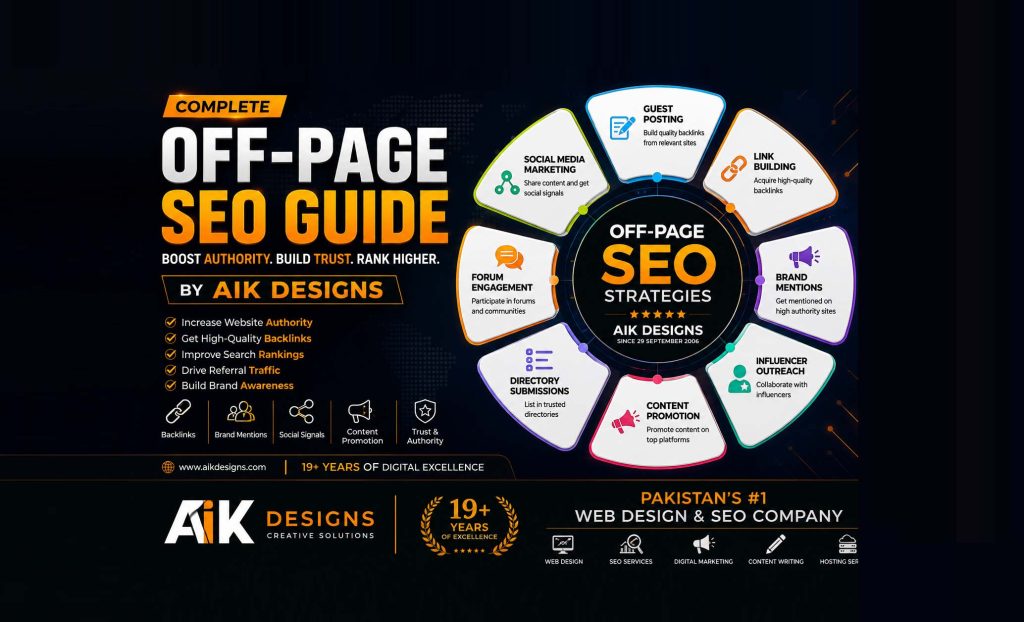
Your website is what you say about yourself. Off-page SEO is what everyone else says about you. It covers every activity performed outside your own website — backlinks, brand mentions, digital PR, social signals, local citations, and reviews — that signals trust and authority to search engines and, increasingly, to AI systems. This Aik Designs guide covers everything: what off-page SEO is, why it still matters in 2026, 20+ proven strategies, a step-by-step framework, tools, costs, common mistakes, and every related keyword and search term worth targeting.
⚡ Quick Facts: Off-Page SEO in 2026
- 🔗 Backlinks remain the #1 off-page ranking signal in Google’s algorithm, even in 2026
- ⏱️ Most off-page strategies need 3–6 months to produce noticeable ranking improvements
- 🤖 73.2% of SEO professionals believe backlinks influence visibility in AI-generated search results
- 🎯 One link from a relevant, high-authority site outperforms dozens of low-quality links
- 📍 Consistent NAP (name, address, phone) citations strengthen local search trust signals
- 🧹 Regular backlink audits and disavow files keep your link profile clean and penalty-safe
Table of Contents
- What Is Off-Page SEO?
- Off-Page SEO vs On-Page SEO vs Technical SEO
- Why Off-Page SEO Still Matters in 2026
- Step-by-Step Off-Page SEO Framework
- Link Building: The Foundation of Off-Page SEO
- Digital PR & Journalist Outreach
- Guest Posting Done Right
- Brand Mentions & Unlinked Mention Reclamation
- Social Signals & Engagement
- Local Citations & NAP Consistency
- Reviews & Reputation Management
- Evaluating Link Quality & Avoiding Toxic Links
- Off-Page SEO for AI Search & AI Citation Readiness
- Complete Off-Page SEO Checklist (25+ Points)
- Best Off-Page SEO Tools
- Off-Page SEO Cost in 2026
- Common Off-Page SEO Mistakes to Avoid
- Off-Page SEO for the India & Pakistan Market
- Longtail Keywords & Search Terms for Off-Page SEO
- Frequently Asked Questions
- Conclusion
1. What Is Off-Page SEO?
Off-page SEO (also called off-site SEO) includes all the activities performed away from your own website that improve its search engine rankings and authority. This includes link building, guest blogging, digital PR, brand citations, social media engagement, local citations, and reviews. Unlike on-page SEO, which you fully control, off-page SEO is about earning trust signals from the wider web — much like word-of-mouth builds a business’s reputation offline.
2. Off-Page SEO vs On-Page SEO vs Technical SEO
| Type | What It Covers | Examples |
|---|---|---|
| Off-Page SEO | External trust and authority signals | Backlinks, digital PR, brand mentions, citations, reviews |
| On-Page SEO | Elements on the page itself | Titles, headings, content, schema, internal links |
| Technical SEO | Crawling, indexing, infrastructure | Site speed, mobile-first rendering, sitemaps, robots.txt |
Off-page SEO works best when it’s built on a strong on-page foundation — for the full breakdown of that side, see our complete on-page SEO guide.
3. Why Off-Page SEO Still Matters in 2026
Backlinks and other off-site signals remain the foundation of Google’s algorithm, with a well-documented correlation between total quality backlinks and organic rankings. What’s changed in 2026 is the second layer of value: the same off-page signals that build traditional search authority also shape how often AI systems like ChatGPT, Claude, Gemini, and Perplexity cite a brand in generated answers. A recent survey of SEO professionals found the large majority believe backlinks directly influence a site’s odds of appearing in AI-generated search results.
4. Step-by-Step Off-Page SEO Framework
Step 1: Audit Your Current Backlink Profile
Use a backlink tool to review referring domains, anchor text distribution, and Domain Rating trends. Flag any spammy or irrelevant links for later disavowal.
Step 2: Run a Competitor Backlink Gap Analysis
Identify every site linking to your top competitors but not to you — these sites have already proven they’ll link to content in your niche.
Step 3: Build Linkable Assets
Create original research, comprehensive guides, free tools, or data-driven studies that other sites want to reference naturally.
Step 4: Run Outreach in Parallel
Combine guest posting, digital PR, and unlinked brand mention reclamation simultaneously rather than sequentially.
Step 5: Build Local Citations and Strengthen Reviews
Ensure NAP consistency across directories and actively encourage genuine customer reviews.
Step 6: Monitor, Clean, and Repeat
Track new referring domains monthly, disavow toxic links promptly, and treat off-page SEO as an ongoing process, not a one-time project.
5. Link Building: The Foundation of Off-Page SEO
Link building is still the single most powerful off-page ranking signal. In 2026, the rule is quality over quantity — one link from a high-authority, relevant website is worth more than a hundred links from random, low-quality sites. Core link building tactics include:
- Competitor backlink gap analysis — target sites already linking to your competitors
- Linkable assets — original research, free tools, and comprehensive guides that earn links passively
- Broken link building — offer your content as the replacement for dead links on relevant resource pages
- Resource page outreach — get listed on curated “best of” and resource pages in your niche
- Niche edits — insert a contextual link into an already-published, ranking article
For an in-depth breakdown of link building tactics specifically for software and technical brands, read our complete SaaS link building guide.
6. Digital PR & Journalist Outreach
Digital PR earns backlinks and brand mentions through press releases, journalist outreach, and placements in major publications. A press release covering something genuinely newsworthy can get picked up and syndicated across multiple outlets, turning one placement into many. Journalist request platforms (the post-HARO landscape) connect experts with reporters actively looking for quotes — responding quickly with specific, data-backed insight dramatically increases placement odds.
7. Guest Posting Done Right
Guest posting remains effective in 2026 when done selectively:
- Target sites with genuine traffic, real audiences, and topical relevance to your niche
- Pitch specific, valuable topics — research what the site already covers and propose a genuine content gap
- Write content that’s as good as or better than what’s already on your own site
- Use natural anchor text that flows within the sentence, never forced exact-match phrases
- Prioritize 2-4 quality placements per month over a large volume of generic ones — consistency and relationships matter more than speed
8. Brand Mentions & Unlinked Mention Reclamation
Not every mention of your brand includes a link. Search for instances where your company, product, or content is mentioned without a hyperlink, then reach out and request one be added. This is one of the fastest, lowest-effort off-page wins available since the relationship and context already exist.
9. Social Signals & Engagement
Social shares, likes, and comments are not a direct Google ranking factor, but they increase content visibility — and visibility leads to more organic backlinks, branded searches, and citations over time. Active engagement on platforms relevant to your audience (LinkedIn and X for B2B, Instagram and Pinterest for consumer brands) compounds this effect.
10. Local Citations & NAP Consistency
Local citations are online mentions of a business’s Name, Address, and Phone number (NAP) across directories, maps, and platforms. Consistent citations strengthen local search trust signals and directly support rankings in Google’s local 3-pack. Inconsistent NAP data across different directories is one of the most common (and easiest to fix) local SEO problems.
11. Reviews & Reputation Management
Reviews, ratings, and comments carry real weight in how both users and search engines perceive your brand’s authority. Actively encourage genuine reviews on Google Business Profile and relevant industry platforms, and respond professionally to both positive and negative feedback — response patterns themselves are a trust signal.
12. Evaluating Link Quality & Avoiding Toxic Links
| Signal | Good Link | Toxic / Risky Link |
|---|---|---|
| Relevance | Same or adjacent niche | Completely unrelated topic |
| Traffic | Real, verifiable organic traffic | High DR, near-zero real traffic |
| Outbound profile | Clean, relevant outbound links | “Link cemetery” — mostly outbound links |
| Content quality | Original, editorially reviewed | Spun, AI-generated spam content |
| Anchor text pattern | Natural mix of branded, partial, and contextual anchors | Over-optimized, exact-match anchors everywhere |
Run regular backlink audits, compile toxic domains into a plain text disavow file, and submit it through Google Search Console. If you’re recovering from a manual action or algorithmic link penalty, this audit-and-disavow process is the starting point before any new link building begins.
13. Off-Page SEO for AI Search & AI Citation Readiness
In 2026, off-page SEO does double duty: it builds traditional search authority and shapes how often AI systems cite your brand. AI-generated answers pull from the same trusted, well-linked, well-cited sources that already rank well traditionally. To improve AI citation readiness:
- Earn mentions and links from sites AI systems already trust — established publications, Wikipedia-adjacent sources, and well-cited industry blogs
- Publish original data and research that gives other sites (and AI systems) a specific, citable statistic
- Keep brand mentions consistent across the web so AI systems can confidently associate your name with your category
- Combine this with the on-page structural signals covered in our SEO and AI optimization strategy guide
14. Complete Off-Page SEO Checklist (25+ Points)
- Full backlink profile audit completed
- Toxic and spammy links identified and disavowed
- Competitor backlink gap analysis run
- At least one linkable asset created (tool, research, or guide)
- Guest posting targets identified with real traffic and relevance
- 2-4 quality guest posts published per month
- Natural, varied anchor text used across all new links
- Digital PR / press release strategy in place for newsworthy updates
- Journalist request platforms monitored for relevant opportunities
- Unlinked brand mentions searched for and reclaimed
- Broken link building opportunities identified in your niche
- Resource page outreach list compiled
- Local business listings claimed with consistent NAP data
- Google Business Profile fully optimized and active
- Review generation process in place across relevant platforms
- Negative reviews responded to professionally
- Social media profiles active and linked from the website
- Content actively shared and promoted across relevant social channels
- Referring domain growth tracked monthly
- Anchor text distribution reviewed for over-optimization
- Domain Rating / Authority Score benchmarked against competitors
- Affiliate or partner program links reviewed for quality
- Integration/partnership link opportunities identified (for SaaS/tech brands)
- Off-page KPIs reported monthly (referring domains, DR, organic traffic)
- Ongoing outreach cadence maintained, not a one-time campaign
15. Best Off-Page SEO Tools
- Ahrefs / Semrush — backlink audits, competitor gap analysis, Domain Rating tracking
- Google Search Console — disavow tool, link reports, and manual action alerts
- Moz Link Explorer / Majestic — Domain Authority and link profile analysis
- BrightLocal / Whitespark — local citation building and NAP consistency audits
- Qwoted / Featured — journalist request platforms for digital PR
For a complete category-by-category tool breakdown, see our 15 Best SEO Tools guide.
16. Off-Page SEO Cost in 2026
| Tier | Monthly Budget | What You Get |
|---|---|---|
| Entry-level | $500 – $1,500 | Local citations, basic guest posting, review generation |
| Mid-tier | $1,500 – $5,000 | Regular link building, digital PR outreach, content-led assets |
| Enterprise | $5,000 – $15,000+ | Full digital PR program, original research, high-authority placements |
17. Common Off-Page SEO Mistakes to Avoid
- ❌ Buying bulk, low-quality links from link farms or PBNs
- ❌ Chasing Domain Rating instead of topical relevance and real traffic
- ❌ Ignoring anchor text diversity, over-optimizing with exact-match phrases
- ❌ Skipping regular backlink audits and letting toxic links accumulate
- ❌ Treating off-page SEO as a one-time campaign instead of an ongoing process
- ❌ Inconsistent NAP data across local directories
- ❌ Ignoring unlinked brand mentions that could easily become backlinks
- ❌ Expecting ranking movement within weeks instead of months
18. Off-Page SEO for the India & Pakistan Market
For businesses targeting India and Pakistan, off-page SEO benefits from a few regional priorities on top of the fundamentals:
- Prioritize backlinks and mentions from regional tech, business, and news publications alongside global sites
- Claim and optimize local directory listings relevant to Pakistani and Indian cities
- Build citations with consistent NAP data across region-specific business directories
- Pursue guest posting and digital PR on publications your specific local audience actually reads, not just high-DR global sites
- Encourage Google Business Profile reviews actively — they carry outsized trust weight in local search results across South Asia
19. Longtail Keywords & Related Search Terms for Off-Page SEO
Here is a comprehensive keyword, longtail, and LSI list covering this topic — useful for building your own off-page SEO content cluster:
- off-page seo
- off page seo checklist
- off page seo guide 2026
- what is off-page seo
- off-page seo vs on-page seo
- off page seo strategies
- off page seo techniques
- link building strategies
- backlink building for seo
- high quality backlinks
- backlink audit checklist
- toxic backlinks disavow
- competitor backlink gap analysis
- guest posting strategy
- guest blogging seo
- digital pr for seo
- list of free backlink websites
- journalist outreach seo
- haro alternatives
- brand mention reclamation
- unlinked brand mentions
- broken link building
- resource page link building
- niche edits seo
- local citations seo
- nap consistency local seo
- google business profile optimization
- online reputation management seo
- review generation strategy
- social signals seo
- social media and seo ranking
- domain authority building
- domain rating vs authority score
- anchor text optimization
- e-e-a-t off page signals
- off page seo tools
- off page seo services
- off page seo audit
- link building for local business
- press release link building
- influencer outreach seo
- affiliate link building
- ai citation readiness seo
- generative engine optimization off page
- off page seo cost
- off page seo mistakes
- off page seo for wordpress
- off page seo for ecommerce
- off page seo agency
20. Frequently Asked Questions
1. What is off-page SEO?
It covers all the activities performed outside a website that improve its search engine rankings and authority, including backlinks, brand mentions, digital PR, social signals, local citations, and reviews.
2. What is the difference between on-page and off-page SEO?
On-page SEO covers everything you control directly on your website. Off-page SEO covers external trust and authority signals that happen away from your site.
3. Are backlinks still the most important off-page factor in 2026?
Yes, but quality and relevance matter far more than volume. One link from a highly relevant, authoritative site outperforms dozens of low-quality links.
4. How long does off-page SEO take to show results?
Most strategies take 3-6 months to produce noticeable ranking improvements.
5. What is a toxic backlink and how do I remove it?
A toxic backlink comes from a spammy or low-quality site. Identify these through a backlink audit and submit a disavow request through Google Search Console.
6. Does social media affect off-page SEO?
Not directly, but social shares increase visibility, which can lead to more organic backlinks and citations over time.
7. What are local citations and why do they matter?
Local citations are online mentions of a business’s name, address, and phone number. Consistent citations strengthen local search trust signals and local pack rankings.
8. Do off-page signals affect AI search visibility?
Yes. Most SEO professionals believe backlinks influence a brand’s chances of appearing in AI-generated search results, since AI systems pull from the same trusted, well-cited sources.
9. What is digital PR in off-page SEO?
Digital PR earns backlinks and brand mentions through press releases, journalist outreach, and major publication placements.
10. How many guest posts should I publish per month?
Two to four genuinely relevant, well-placed guest posts per month outperform a much larger volume of generic placements.
11. Can off-page SEO fix a Google penalty?
A link-related penalty is typically resolved by auditing the link profile, disavowing toxic links, and rebuilding authority through legitimate link building.
21. Conclusion
Off-page SEO is how the rest of the internet vouches for your website. It’s not a one-time campaign — it’s an ongoing process of earning relevant backlinks, digital PR placements, brand mentions, local citations, and reviews that compound in value over months and years. Combine the 25-point checklist above with strong on-page fundamentals, and you build the kind of durable, trusted authority that both Bing SEO, Google and AI search engines reward.
Want a professional off-page SEO audit and link building program for your website? Explore our SEO Services, or read our related guides on on-page SEO, SaaS link building, and SEO + AI optimization strategy , Search Generative Experience (SGE) to build a complete, full-funnel ranking approach.
About Author