Local SEO Guide: How To Rank Higher In Google Maps
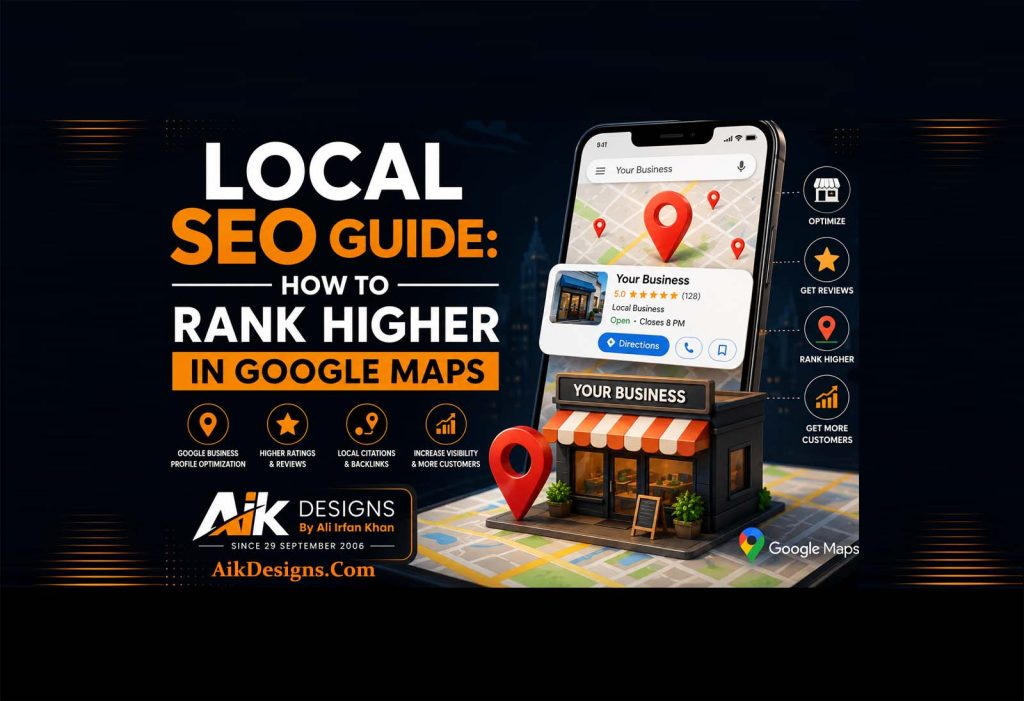
When someone searches “near me,” Google isn’t showing them the best website in the world — it’s showing them the best-optimized business nearby. Local SEO is how businesses with a physical location or service area win that visibility, from the Google Maps pack to local organic rankings. This guide covers everything from Google Business Profile setup to citations, reviews, and local content, so you can turn “near me” searches into real customers.
📊 Quick Facts: Local SEO
📍 Google Business Profile — free and the single biggest local ranking asset
⭐ Reviews — quantity, quality, and response rate all factor into rankings
🧭 Ranking Factors — relevance, distance, and prominence drive the local pack
🗂️ NAP Consistency — matching name, address, and phone across the web builds trust
🎙️ Voice Search — a large share of “near me” queries now come from voice assistants
Table of Contents
- What Is Local SEO?
- How Local Search Ranking Works
- Setting Up Your Google Business Profile
- NAP Consistency and Local Citations
- Reviews and Reputation Management
- Local Keyword Research
- On-Page Local SEO
- Local Link Building
- Local Content and Location Pages
- Technical SEO for Local Businesses
- Voice Search and AI Search for Local
- Common Local SEO Mistakes
- Local SEO Checklist
- Frequently Asked Questions
- Conclusion
1. What Is Local SEO?
Local SEO is a specialized branch of Search Engine Optimization focused on improving visibility for location-based searches — think “plumber near me,” “best pizza restaurants in Karachi,” or “dentist open now.” Instead of competing nationally or globally, local SEO helps a business dominate results for people physically close to it or within its service area, primarily through Google Maps, the local three-pack, and localized organic results.
2. How Local Search Ranking Works
Google’s local ranking systems are generally understood to weigh three core factors:
| Factor | What It Means |
|---|---|
| Relevance | How well your business profile matches what the searcher is looking for |
| Distance | How close your business is to the searcher’s location or the location they searched |
| Prominence | How well-known and trusted your business is, based on reviews, links, and citations |
You can’t control distance, but relevance and prominence are entirely within your control — which is where the rest of this guide comes in.
3. Setting Up Your Google Business Profile
Your Google Business Profile (GBP) is the foundation of local SEO. It’s the free listing that powers your appearance in Google Maps and the local pack.
Step 1: Claim and Verify
Search for your business on Google Maps, claim it if it already exists or create a new listing, and complete Google’s verification process — typically by postcard, phone, or email.
Step 2: Complete Every Field
Fill in your business category, secondary categories, service areas, hours, attributes, and a keyword-relevant business description. Incomplete profiles rank worse than fully optimized ones.
Step 3: Add Photos and Posts
Upload real photos of your storefront, team, and products, and use Google Posts regularly to signal an active, maintained profile.
✅ Tip: Choose the most specific primary category available (e.g., “Italian Restaurant” instead of just “Restaurant”) — category selection is one of the strongest relevance signals in local ranking.
4. NAP Consistency and Local Citations
NAP stands for Name, Address, and Phone number. Search engines cross-reference this information across the web to confirm your business is legitimate and correctly located. Local citations are mentions of your NAP on directories, review sites, and industry listings — even without a clickable link, they still carry ranking weight.
⚠️ Warning: Inconsistent NAP details — an old address on one directory, a different phone format on another — actively confuse search engines and can suppress your local rankings even if everything else is optimized.
5. Reviews and Reputation Management
Review quantity, average rating, recency, and how consistently you respond all factor into local rankings, and reviews are one of the biggest influences on whether a searcher actually clicks or calls.
Step 1: Ask for Reviews Consistently
Build review requests into your normal customer process — a follow-up email, a QR code at checkout, or a simple ask at the end of a service.
Step 2: Respond to Every Review
Reply to positive and negative reviews alike. Thoughtful responses to criticism often build more trust with future customers than five-star reviews alone.
Step 3: Never Buy or Fake Reviews
Fake reviews violate Google’s policies and risk profile suspension. Focus on genuine volume instead.
6. Local Keyword Research
Local keyword research follows the same core principles covered in our Keyword Research Guide, with an added location layer — “[service] in [city],” “[service] near me,” and neighborhood-specific variations. Look at what your Google Business Profile Insights and Search Console show searchers actually typing before choosing target terms.
7. On-Page Local SEO
Apply standard On-Page SEO principles with a local twist: include your city and service area naturally in title tags, headers, and body content, embed a Google Map on your contact page, and add your NAP details in the footer of every page so it’s consistent site-wide.
8. Local Link Building
Local backlinks carry extra weight for local rankings. Beyond the general strategies in our Off-Page SEO guide, focus on links from local news sites, community organizations, chambers of commerce, sponsorships, and partnerships with nearby complementary businesses.
9. Local Content and Location Pages
Businesses serving multiple areas should build unique, genuinely useful location pages for each city or neighborhood rather than duplicating the same template with a swapped city name. Local guides and roundups — the kind of content you’d find covering the best spots in a specific city — also build topical relevance and natural local backlinks.
10. Technical SEO for Local Businesses
Local SEO still depends on a technically sound website. Make sure your site loads fast and passes Core Web Vitals, is fully indexed and monitored through Google Search Console, and follows the fundamentals covered in our broader Technical SEO Guide. Adding LocalBusiness schema markup to your site also explicitly confirms your NAP, hours, and location to search engines.
11. Voice Search and AI Search for Local
A large share of “near me” and “open now” queries now come through voice assistants and AI-driven search. The conversational, question-based phrasing covered in our Voice Search SEO guide applies directly to local businesses, and tools like Google AI Overview increasingly pull directly from Google Business Profile data and structured local content to answer these queries.
12. Common Local SEO Mistakes
- Leaving Google Business Profile fields incomplete or outdated
- Inconsistent NAP details across directories and the website
- Ignoring or deleting negative reviews instead of responding professionally
- Using duplicate content across multiple location pages
- Choosing an overly broad or inaccurate business category
- Neglecting mobile experience, despite most local searches happening on mobile
13. Local SEO Checklist
☑️ Claim and fully verify your Google Business Profile
☑️ Complete every GBP field, including category, hours, and description
☑️ Audit and fix NAP consistency across all directories
☑️ Build citations on relevant local and industry directories
☑️ Set up a consistent review request process
☑️ Add LocalBusiness schema markup to your website
☑️ Create unique content for each service area or location
☑️ Confirm mobile speed and usability are fully optimized
14. Frequently Asked Questions
What is local SEO in simple words?
Local SEO is the process of optimizing a business’s online presence so it appears in search results for people searching in a specific city, town, or nearby area, particularly in Google Maps and the local pack.
How do I rank higher on Google Maps?
Rank higher on Google Maps by fully optimizing your Google Business Profile, keeping your name, address, and phone number consistent everywhere online, gathering genuine reviews, and building local citations and links.
What is NAP consistency and why does it matter?
NAP stands for Name, Address, and Phone number. Keeping this information identical across your website, Google Business Profile, and online directories builds trust signals that help search engines confirm your business is legitimate and accurately located.
Do online reviews really affect local rankings?
Yes. Review quantity, quality, recency, and how a business responds to them are all factored into Google’s local ranking systems, and reviews also strongly influence whether a searcher clicks through or calls.
What are local citations in SEO?
Local citations are online mentions of a business’s name, address, and phone number on directories, review sites, and industry listings, even without a link, and they help confirm business legitimacy and location to search engines.
Is a Google Business Profile free?
Yes, creating and managing a Google Business Profile is completely free and is the single most important asset for ranking in local search results and Google Maps.
How is local SEO different from regular SEO?
Regular SEO focuses on ranking a website broadly in search results, while local SEO specifically targets location-based searches and Google Maps visibility using signals like proximity, Google Business Profile optimization, and local citations.
What are the top three local ranking factors?
Google’s local ranking systems weigh relevance, distance, and prominence most heavily, meaning how well a business matches the search, how close it is to the searcher, and how well-known and trusted it is online.
Does having multiple locations help local SEO?
Yes, if each location has its own accurately optimized Google Business Profile and unique location page on the website, rather than duplicating the same content across every location.
How long does local SEO take to show results?
Local SEO improvements often show initial movement within four to eight weeks, especially from Google Business Profile optimization, though building strong citations and review volume for competitive areas can take three to six months.
Does local SEO work for online-only businesses?
Local SEO is designed for businesses that serve customers in a physical location or defined service area, so it offers limited value for purely online businesses with no local service radius.
15. Conclusion
Local SEO Services In Karachi Pakistan rewards businesses that get the fundamentals right and stay consistent: a fully optimized Google Business Profile, matching NAP details everywhere, a steady stream of genuine reviews, and a technically solid website behind it all. Pair this guide with our On-Page SEO, Off-Page SEO, and Technical SEO guides for a complete strategy that works both locally and beyond.
Want your Google SEO or Google Business Profile and website working together instead of against each other? Get in touch with Aik Designs and let’s get your business showing up where local customers are searching.
About Author