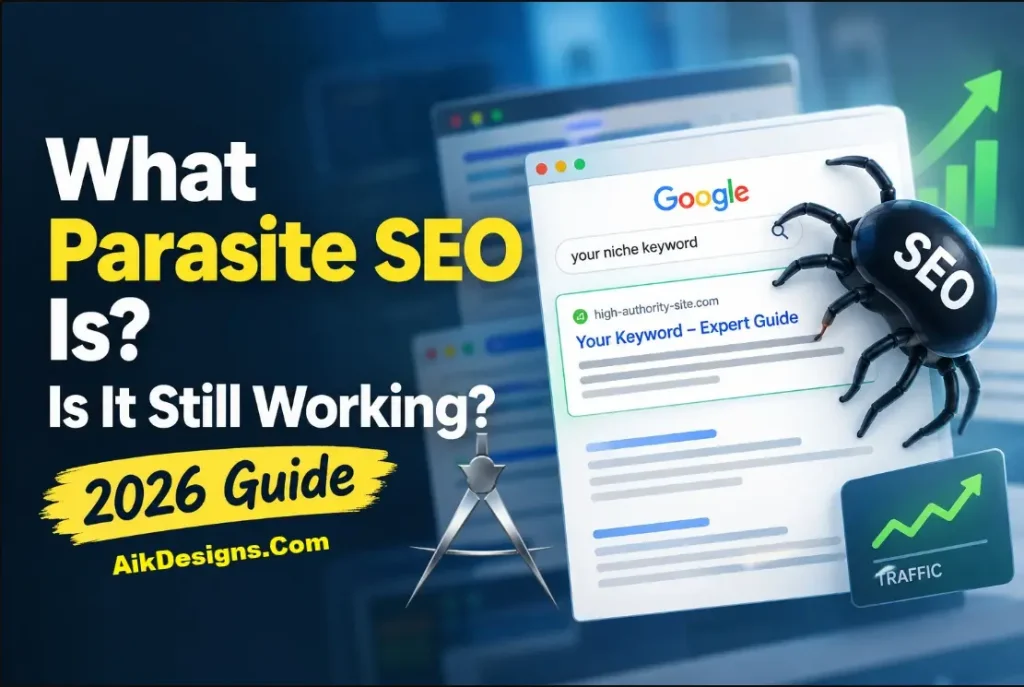
What Parasite SEO Is? Is It Still Working? 2026 Guide
Ranking a brand-new website on Google can take months. Parasite SEO promises a shortcut: publish on a website that already ranks well and borrow its strength. But after Google’s site reputation abuse policy and the changes announced in August 2026, many people ask the same question: what parasite SEO is, and is it still working?
This Aik Designs blog guide explains the tactic in plain language, how it works, what Google says about it, which versions are risky, and how a business can use the safe version to build visibility and organic traffic without putting its main website at risk.
📑 Table Of Contents
- Who, What, When, Where, Why And How
- What Parasite SEO Is
- How Parasite SEO Works
- Types Of Parasite SEO
- Why People Use Parasite SEO
- Is Parasite SEO Still Working?
- Google’s Site Reputation Abuse Policy Explained
- Parasite SEO Vs Guest Posting Vs Barnacle SEO
- Risks And Downsides
- How To Do Parasite SEO Safely
- Best Platforms For Safe Parasite-Style SEO
- Ideas For A Web Design And SEO Agency
- Common Mistakes To Avoid
- Parasite SEO Vs Building Your Own Authority
- How To Measure Results
- Frequently Asked Questions
- Conclusion
Who, What, When, Where, Why And How
| Question | Answer |
|---|---|
| Who uses parasite SEO? | Affiliate marketers, local businesses, agencies, publishers and brands that want fast visibility without waiting for a new domain to build trust. |
| What is it? | Publishing content on a high-authority third-party site so it ranks quickly by borrowing that site’s authority. |
| When did Google respond? | Google introduced its site reputation abuse policy in March 2024, alongside the March 2024 core update, and began manual enforcement in May 2024. |
| Where is it done? | Open platforms (LinkedIn, Medium, Reddit, Quora, YouTube) and, in riskier cases, paid sections on publisher or news domains. |
| Why do people do it? | Speed, lower cost than building a domain from scratch, and a quick way to test keywords and demand. |
| How does it work? | Choose a strong host, target a keyword, publish genuinely useful content and link naturally back to your own website. |
What Parasite SEO Is
Parasite SEO is the practice of placing your content on an established, high-authority website so that your page can rank in search results faster than it could on your own domain. The “host” is the trusted website. The “parasite” is your content, which benefits from the host’s backlinks, age and trust signals.
For example, a brand-new website targeting “best web design company” would have to compete against agencies with years of backlinks. A helpful article on a platform that Google already trusts can sometimes appear on page one much sooner, because the platform itself has the authority.
How Parasite SEO Works
- Pick a host that already has strong authority and is visible on Google for your topic.
- Choose a target keyword where pages on that host already rank, or where you can realistically compete.
- Publish a page on that host, optimized for the keyword and written for readers.
- Add a natural link or call to action that sends readers to your own website, product or service.
- Earn traffic faster than a new site could, then track which pages bring visits and leads.
The speed comes from the host. Google already trusts the domain, so a page on it starts with a head start that a new website does not have.
Types Of Parasite SEO
| Type | Where It Happens | Risk Level | Notes |
|---|---|---|---|
| Open-platform articles | LinkedIn, Medium, Substack | Low | Genuinely useful articles written under your own name. |
| Video content | YouTube | Low | Optimized titles and descriptions can rank within days. |
| Community answers | Quora, Reddit | Low To Medium | Works when answers are helpful; spammy link-dropping gets removed. |
| Directory and profile listings (barnacle SEO) | Google Business Profile, Clutch, DesignRush | Low | Ranks for “best agency in city” style searches. |
| Editorial guest posts | Relevant blogs with real editors | Low To Medium | Legitimate when the host reviews and the topic fits. |
| Paid placements on publisher domains | News and review sites | Medium To High | The pattern targeted by Google’s site reputation abuse policy. |
Why People Use Parasite SEO
- Speed: pages can appear in days or weeks instead of months.
- Authority without a big domain: you do not need years of backlinks to start getting seen.
- Keyword testing: quickly check whether a topic brings real traffic or leads before investing in a full content plan.
- Brand reach: platforms like LinkedIn and YouTube put your name in front of audiences your website may not reach yet.
- Extra search real estate: owning a page on your own site plus a YouTube video and a LinkedIn article for the same topic gives you more chances to be found.
Is Parasite SEO Still Working?
Partly, but the risky version works much less reliably than it used to. Google has spent the last two years narrowing the gap between what it sees as helpful third-party content and what it sees as ranking manipulation.
What Has Changed
- March 2024: Google introduced the site reputation abuse policy as part of its spam updates, aimed at third-party content published to exploit a host’s ranking signals.
- May 2024: manual enforcement started, with human reviewers able to apply actions to the affected sections of a site.
- August 30, 2026: because of a European Commission mandate, Google stopped enforcing manual actions under this policy in the European Economic Area. Outside the EEA, manual actions can still directly change how the affected section ranks, and Google has said it still stands by the policy.
What Still Works
- Helpful, original articles on open platforms such as LinkedIn and Medium.
- YouTube videos with strong titles, descriptions and chapters.
- Real answers on Quora and Reddit that follow each community’s rules.
- Profiles and listings on trusted directories and review platforms.
- Editorial guest posts on relevant websites where the host really reviews the content.
What Is Risky
- Paid pages on a publisher’s domain that have nothing to do with the publisher’s normal topics.
- Content produced at scale with little or no editorial review by the host.
- The same article copied across many hosts with only the links changed.
- Pages that exist only to rank for a commercial keyword and send visitors to an affiliate or lead-generation page.
Google’s Site Reputation Abuse Policy Explained
Google describes site reputation abuse as third-party content published on a host site mainly to take advantage of the host’s ranking signals, usually with little or no first-party oversight or involvement. You can read the wording in Google’s official spam policies documentation.
Signals Google Looks At
- Does the host have real editorial control over the content?
- Is the content on-topic for the host, or unrelated to its normal purpose?
- Is the design and authorship consistent with the rest of the site?
- Is the content unique, or duplicated across many hosts?
- Is the page there to help readers, or mainly to pass ranking value?
Parasite SEO Vs Guest Posting Vs Barnacle SEO
| Feature | Parasite SEO | Guest Posting | Barnacle SEO |
|---|---|---|---|
| Main goal | Rank a page fast on another domain | Earn a backlink and exposure | Appear where people already search |
| Typical host | Platform or publisher | Relevant blog or website | Directory, map or marketplace listing |
| Editorial review | Often little or none | Usually yes | Platform rules only |
| Speed | Fast | Medium | Fast |
| Policy risk | Medium to high if paid | Low when editorial | Low |
| Best for | Testing keywords, brand visibility | Authority and referral traffic | Local and service searches |
For a deeper look at safe link building, see our free backlink websites list for SEO and our guide to reviewing guest post sites before you buy.
Risks And Downsides
| Risk | What Can Happen |
|---|---|
| Ranking loss | Your off-site page can disappear from search results after a policy action or algorithm update. |
| No ownership | You do not own the platform, its audience or its rules. |
| Wasted money | Paid placements that get demoted deliver no return. |
| Brand damage | Spammy or off-topic content can make your business look untrustworthy. |
| Link devaluation | Links from pages Google treats as manipulative may pass little or no value. |
How To Do Parasite SEO Safely
Step 1: Choose The Right Platform
Pick a platform where your audience already spends time and where you are allowed to publish. LinkedIn works well for B2B services, YouTube for tutorials and demonstrations, Quora and Reddit for answering specific problems, and directories for local discovery.
Step 2: Research The Keyword
Search your target keyword on Google and see which platforms already appear. If LinkedIn articles, YouTube videos or Quora threads appear in the top results, those platforms are good candidates for your content.
Step 3: Write Original, Helpful Content
Write a unique piece for each platform. Do not copy and paste the same article everywhere. Add real examples, screenshots, steps or data that readers can use immediately.
Step 4: Match The Platform’s Style
A Quora answer should read like an answer, a LinkedIn article like a professional insight, and a YouTube video like a clear walkthrough. Content that looks like an advertisement gets removed or ignored.
Step 5: Link Naturally To Your Website
Add one relevant link to a specific page on your site, such as a case study or guide, only where it helps the reader. Avoid pointing every link to your homepage or stuffing exact-match anchor text.
Step 6: Follow Platform Rules And Disclose Relationships
Read each platform’s rules about self-promotion. Disclose sponsored or affiliate content, and never use fake accounts, fake reviews or hidden links.
Step 7: Track And Improve
Review which pages receive impressions, clicks and leads. Improve what works, and stop investing in platforms or topics that bring no results.
Best Platforms For Safe Parasite-Style SEO
| Platform | Best For | Effort | Risk |
|---|---|---|---|
| YouTube | Tutorials, demos, how-to topics | High | Low |
| LinkedIn Articles | B2B services, thought leadership | Medium | Low |
| Medium / Substack | Educational articles and opinion | Medium | Low |
| Quora | Answering specific questions | Low | Low To Medium |
| Community discussions and advice | Medium | Medium | |
| Clutch, GoodFirms, DesignRush | Agency profiles and reviews | Medium | Low |
| Google Business Profile | Local and map searches | Medium | Low |
Local businesses should also optimize their map listing. Our Google My Business setup and ranking guide explains how.
Ideas For A Web Design And SEO Agency
- A LinkedIn article titled “How We Fixed Googlebot 403 Errors On A CDN” based on a real client case.
- A YouTube walkthrough of an on-page SEO audit with chapters and a link to the full guide in the description.
- Quora answers to questions like “How much does a website cost in Pakistan?” with honest ranges and no hard selling.
- Agency profiles on Clutch and DesignRush with real client reviews and project details.
- An editorial guest post on a marketing blog about local SEO for service businesses.
Common Mistakes To Avoid
- Publishing the same article on many platforms with only the links changed.
- Using exact-match keywords in every anchor text.
- Paying for placements on a publisher’s domain without checking editorial control.
- Ignoring platform rules about self-promotion.
- Treating off-site pages as a replacement for your own website.
- Writing for search engines only and forgetting the reader.
Parasite SEO Vs Building Your Own Authority
| Factor | Parasite-Style Content | Your Own Website |
|---|---|---|
| Speed to rank | Fast | Slower |
| Ownership | Platform owns it | You own it |
| Long-term stability | Can change overnight | Grows over time |
| Cost | Time or placement fees | Time, content and hosting |
| Brand control | Limited | Full control |
| Lead capture | Indirect | Direct forms, calls and email |
The strongest approach combines both: build helpful content on your own site, use open platforms to reach new audiences, and earn real backlinks through useful resources. If you are unsure whether to invest in a blog at all, read do you need a blog for your business.
How To Measure Results
- Google Search Console: track impressions and clicks for pages on your own site that receive new links or mentions.
- Google Analytics: check referral traffic from LinkedIn, Medium, Quora, Reddit and YouTube.
- Platform analytics: watch views, watch time, reactions and profile visits.
- Lead tracking: add UTM parameters to links so you can see which platform produces enquiries.
- Rankings: monitor your target keyword to see whether an off-site page or your own page appears.
Frequently Asked Questions
What is parasite SEO in simple words?
Parasite SEO means publishing your content on a website that already ranks well on Google so your page can rank quickly by borrowing that website’s authority. The host website is the “parasite’s” source of strength, and your page is the content that benefits from it.
Is parasite SEO still working in 2026?
Partly. Open platforms such as LinkedIn, Medium, Quora, Reddit and YouTube can still rank and send traffic when the content is genuinely useful. Paid or low-oversight placements on publisher websites are much riskier because of Google’s site reputation abuse policy.
Is parasite SEO against Google’s rules?
It can be. Google’s site reputation abuse policy targets third-party content published on an established site mainly to exploit the host’s ranking signals, usually with little or no first-party oversight. Honest content on open platforms is treated differently.
What is Google’s site reputation abuse policy?
It is a spam policy Google introduced in March 2024. It covers third-party pages published on a trusted site mainly to manipulate rankings, such as unrelated coupon, loan or review sections hosted on a news publisher’s domain.
What changed on August 30, 2026?
Google announced that, because of a European Commission mandate, it would stop enforcing manual actions under the site reputation abuse policy in the European Economic Area from August 30, 2026. Outside the EEA, manual actions can still directly affect the affected part of a site. Google has said it still stands by the policy.
What is the difference between parasite SEO and barnacle SEO?
Barnacle SEO means getting visibility by having a profile or listing on a big platform (like a Google Business Profile or a directory) that already ranks for your target search. Parasite SEO usually means publishing keyword-focused articles or pages on a high-authority host.
Is guest posting the same as parasite SEO?
Not always. A real guest post that is reviewed by an editor and written for that website’s audience is a legitimate contribution. It becomes parasite SEO when the page exists only to rank for your keyword on someone else’s domain, with no editorial control.
Which platforms are safest for parasite-style SEO?
Open, user-driven platforms are generally safest: LinkedIn Articles, Medium, Substack, YouTube, Quora and Reddit. Always follow each platform’s rules and avoid copying the same text across all of them.
Can parasite SEO hurt my own website?
The penalty usually falls on the host’s third-party section, not directly on your own site. But your off-site pages can lose their rankings overnight, and spammy tactics can damage your brand reputation and any links you earned from them.
How long does parasite SEO take to rank?
Pages on strong platforms can sometimes appear in days or a few weeks, compared with months for a new website. Rankings can also disappear just as quickly, which is why it should be a supporting channel, not your only strategy.
How much does parasite SEO cost?
Posting on open platforms is free apart from your time. Paid placements on publisher domains have been reported at roughly $600 to over $2,000 depending on the host’s authority, and that spend carries the highest risk.
Should a web design or SEO agency use parasite SEO?
An agency can use it safely as a brand-visibility channel through helpful articles, videos and Q&A answers on open platforms. An agency that sells SEO should avoid tactics Google treats as spam, because trust is its main asset.
What is better than parasite SEO for long-term organic traffic?
Building your own website’s authority with helpful content, strong internal linking, real backlinks, a well-optimized Google Business Profile and a fast, technically sound site. Parasite-style content works best as a supplement to that foundation.
Conclusion
So, what parasite SEO is, and is it still working? It is a fast-ranking tactic that borrows another website’s authority. The paid, low-oversight version is increasingly risky because of Google’s site reputation abuse policy, while the honest version, genuinely helpful content on open platforms, can still bring traffic, brand mentions and leads.
For lasting organic traffic, treat parasite-style content as a supporting channel. Build your own website first, publish helpful content, earn real links and use platforms like LinkedIn, YouTube and Quora to extend your reach.
Need Help Ranking Your Website?
Aik Designs is a web design and SEO company in Karachi, Pakistan, serving clients in 13+ countries.
About Author