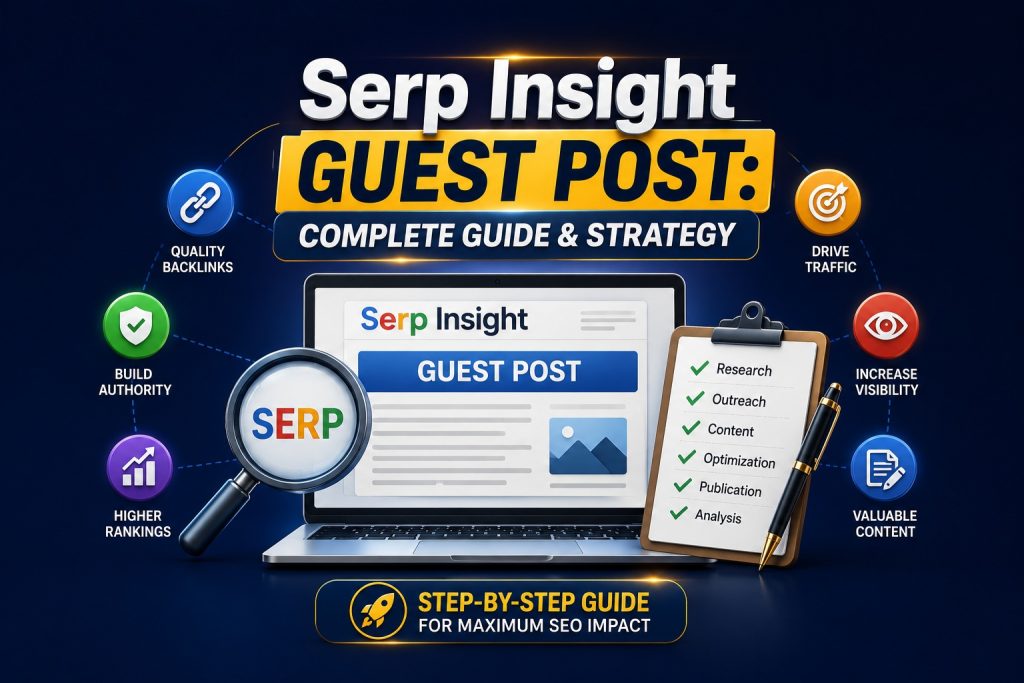
Serp Insight Guest Post: Complete Guide & Strategy
A Serp Insight Guest Post is fast becoming one of the most talked-about approaches in modern link building — and if you’re reading this, you’re probably trying to figure out exactly what it is, whether it actually works, and how to use it without wasting a content budget on articles nobody links to naturally. This guide covers everything: the concept, the platform behind the term, a step-by-step workflow, real comparisons, a worked case study, and the mistakes that quietly kill most guest posting campaigns.
Table of Contents
- 1. What Is a Serp Insight Guest Post?
- 2. SerpInsight as a Platform
- 3. Why the Serp Insight Guest Post Approach Works
- 4. Step-by-Step: How to Get a Serp Insight Guest Post Published
- 5. Data Snapshot: SERP-First vs Guesswork Content
- 6. Case Study: A Data-Backed Guest Post Workflow
- 7. Serp Insight Guest Post vs Other Link Building Methods
- 8. Expert Tips for Better Results
- 9. Common Mistakes to Avoid
- 10. Frequently Asked Questions
- 11. Final Verdict
1. What Is a Serp Insight Guest Post?
A Serp Insight Guest Post is a guest article that’s planned, written, and placed based on a complete analysis of the pages currently ranking on page one for a target keyword or topic cluster — instead of starting from a random idea and optimizing it afterward. The logic runs in reverse compared to traditional guest posting: you look at what Google is already rewarding, the angles, formats, and intent patterns visible on the SERP, and then you build content that fits that pattern while filling a gap the existing top results don’t cover.
The result, when done properly, is a guest post that reads as editorially justified rather than link-motivated — which is exactly the kind of backlink search engines are built to reward.
2. SerpInsight as a Platform
Separately from the strategy, “SerpInsight” is also the name of a guest posting marketplace. It functions as a searchable directory connecting people who need guest posts with website owners willing to publish them, cutting out a large chunk of manual outreach. The platform’s network spans a reported 1,246+ registered publisher sites and more than 103,246+ completed tasks, covering not just guest posts but link insertions (niche edits), content writing, and footer link placements — effectively a one-stop shop for off-page SEO work.
3. Why the Serp Insight Guest Post Approach Works
Traditional guest posting broke down into a mechanical loop: write an article, drop a link, hope it helps. That pattern is exactly what large-scale, low-quality link campaigns look like to search engines — and it’s the pattern Google Guide has explicitly warned against for years. A Serp Insight Guest Post avoids that trap in three ways:
It starts with evidence, not intuition
Instead of guessing what an audience wants, the topic is chosen because the SERP already proves demand for it.
It targets a genuine content gap
Because it’s built against what’s missing from current top-ranking pages, the article adds something search engines and readers don’t already have easy access to.
It earns links that “look like they belong”
A backlink sitting inside content that fills a real gap reads as natural editorial context, not an inserted link — which is the core distinction search engines are trying to detect.
4. Step-by-Step: How to Get a Serp Insight Guest Post Published
Step 1: Research the SERP first
Before picking a topic, search your target keyword and study the top 10 results — their structure, depth, format (listicle, guide, comparison), and the angle they take.
Step 2: Find the content gap
Note what’s missing: outdated data, no comparison table, no real example, no downloadable template, thin FAQ coverage. That gap becomes your article’s reason to exist.
Step 3: Shortlist relevant publishers
Filter guest post opportunities by topical relevance first, domain metrics second. A mid-size site that already ranks in your niche outperforms a large, unrelated one for both traffic and link equity.
Step 4: Pitch with SERP evidence
Show the editor exactly what you found — “here’s what’s ranking, here’s what it’s missing, here’s the piece I’ll write to fill it.” This out-converts generic outreach templates by a wide margin.
Step 5: Write to match search intent
Match the format and depth already rewarded on page one. If every top result is a step-by-step guide, a short opinion piece won’t hold up — regardless of link quality.
Step 6: Place the link naturally
Insert the backlink inside genuinely relevant context — mid-content, tied to a specific claim or resource — rather than forcing it into the opening sentence or leaving it isolated in an author bio.
Step 7: Track rankings and referral traffic
After publishing, monitor keyword position changes and referral visits over the following weeks to confirm the post is doing real SEO work, not just sitting live.
5. Data Snapshot: SERP-First vs Guesswork Content
The chart below is an illustrative comparison of typical outcomes reported anecdotally across SEO practitioners when comparing a SERP-first content process against a guesswork (“write first, optimize later”) process. Treat it as a directional framework for prioritizing your own workflow, not a scientific benchmark.
6. Case Study: A Data-Backed Guest Post Workflow

The following is an illustrative walkthrough of the workflow, not a specific named company’s audited results.
A small SaaS marketing team wanted a backlink cluster around “project management for remote teams.” Instead of pitching a generic “10 tips” article, they ran Step 1 and 2 of the workflow above: they searched the term, found that every top-10 result covered tools and tips, but none included a comparison table weighing async vs synchronous workflows for distributed teams.
They pitched that specific gap to three topically relevant publishers already ranking for adjacent remote-work terms. Two accepted on the first pitch — a noticeably faster response than their previous generic outreach, which had required pitching 15–20 sites per accepted post. The published articles placed the backlink inside the comparison section itself, tied directly to a linked internal resource, rather than in the author bio.
The takeaway isn’t a guaranteed ranking outcome — it’s that starting from a real content gap changed both the acceptance rate and the quality of the placement.
7. Serp Insight Guest Post vs Other Link Building Methods
| Method | Approach | Best For | Risk Level |
|---|---|---|---|
| Serp Insight Guest Post | SERP-first, gap-driven content | Long-term authority + rankings | Low, when relevant |
| Traditional guest posting | Write first, pitch broadly | Brand exposure, quick volume | Medium |
| Link insertion / niche edit | Add a link into existing published content | Fast turnaround | Medium–High if overused |
| Footer / sitewide links | Bulk, low-context placements | Not recommended for SEO | High |
| Paid press mentions | News-style coverage, often nofollow | Brand credibility | Low, limited SEO value |
8. Expert Tips for Better Results
9. Common Mistakes to Avoid
10. Frequently Asked Questions
What is a Serp Insight Guest Post?
A Serp Insight Guest Post is a guest article planned around an analysis of the current top-ranking pages for a target keyword or topic cluster, so the content fills a real gap instead of guessing what to write.
Is SerpInsight a real guest posting platform?
Yes, SerpInsight is a guest posting marketplace connecting people who need guest posts with website publishers, alongside services like link insertions, content writing, and footer links.
How is a Serp Insight Guest Post different from regular guest posting?
Regular guest posting usually starts with an idea and adds SEO later. A Serp Insight Guest Post starts with SERP data — what’s already ranking and why — and builds the article and link placement around that evidence.
Does guest posting still help SEO in 2026?
Yes, when done as genuine, relevant, editorially justified content. Search engines continue to reward expertise and authoritative backlinks, but penalize large-scale, low-quality link campaigns.
How many guest post sites does SerpInsight offer?
SerpInsight lists a large, searchable network of registered publisher websites, reported at over 1,246 sites, along with a high volume of completed guest posting and link tasks.
What services does SerpInsight offer besides guest posts?
Along with guest posting, SerpInsight offers link insertions (niche edits), content writing, and footer link placements as part of its off-page SEO marketplace.
How do you choose the right site for a Serp Insight Guest Post?
Prioritize topical relevance and genuine ranking authority over raw domain metrics — a smaller site that already ranks in your niche is usually more valuable than a large, unrelated one.
What mistakes should you avoid in Serp Insight guest posting?
Common mistakes include over-optimized anchor text, picking topics without checking the SERP first, ignoring publisher relevance, and treating the link as more important than the content quality.
How long does it take to see results from a Serp Insight Guest Post?
Most SEO practitioners see initial indexing within days, with ranking and referral traffic effects building gradually over weeks to months as authority compounds.
Is a Serp Insight Guest Post worth it for a small business?
Yes, especially because the SERP-first approach reduces wasted effort — small businesses with limited content budgets benefit from writing only what the data shows is missing.
Want a guest posting strategy built around your actual SERP?
Aik Designs plans, writes, and places data-backed guest content as part of full off-page SEO campaigns.
11. Final Verdict
A Serp Insight Guest Post isn’t a shortcut or a loophole — it’s a more disciplined version of guest posting that replaces guesswork with evidence. Whether you use the SerpInsight marketplace itself or apply the same SERP-first thinking to manual outreach, the core idea holds: research the SERP, find the gap, write to fill it, and place the link where it genuinely belongs. That’s what separates a guest post that quietly helps your rankings from one that just sits there.
Related reading: See Aik Designs Blogs guides on Off-Page SEO and On-Page SEO for the full picture of how link building fits into an overall SEO strategy.
About Author