Top Saas Companies In The USA Dominating The Market In 2026
Published On Aik Designs Blog By Ali Irfan | Category: Technology | Read Time: 12 Minutes
Introduction: The SaaS Revolution Is Here — And It’s American
The United States remains the undisputed epicenter of the global Software as a Service (SaaS) industry. In 2026, the US SaaS market is projected to surpass $300 billion in annual revenue, up from $237 billion in 2023. The numbers are staggering — and still climbing.
Whether you’re a startup founder, a digital marketer, an IT manager, or simply a business owner trying to scale intelligently — understanding which SaaS companies are leading the pack in 2026 is critical to making smarter software decisions.
At Aik Designs, we have compiled the definitive list of the top SaaS companies in the USA dominating the market in 2026, backed by revenue data, market share, and real-world impact.
What Is SaaS? (Quick Refresher)
SaaS — or Software as a Service — is a cloud-based software delivery model in which applications are hosted on the internet and made available to users via a subscription. Unlike traditional on-premise software, SaaS requires no installation, no hardware investment, and is automatically updated by the provider.
Key characteristics of SaaS include:
- ✅ Subscription-based pricing (monthly or annual)
- ✅ Cloud-hosted, accessible via browser or mobile app
- ✅ Automatic updates and maintenance by the vendor
- ✅ Scalable for businesses of all sizes
- ✅ Lower upfront costs vs. traditional enterprise software
Why Does The USA Dominate The Global SaaS Market?
Before diving into the list, it’s important to understand why American SaaS companies consistently outperform the rest of the world:
- 🏆 Access to Silicon Valley’s world-class tech talent pipeline
- 💰 Deep venture capital ecosystem that fuels rapid product development
- 🌍 Large domestic market of over 330 million consumers and millions of SMBs
- 🤝 Established enterprise relationships with Fortune 500 companies
- ☁️ Early adoption of cloud infrastructure (AWS, Azure, GCP) enabling fast scaling
- ⚖️ Strong IP protection and regulatory environment that encourages innovation
According to Statista and Gartner, over 65% of global SaaS revenue originates from US-based companies. With cities like San Francisco, New York, Seattle, and Austin becoming major SaaS hubs, the USA is not just leading — it’s setting the pace for the entire world.
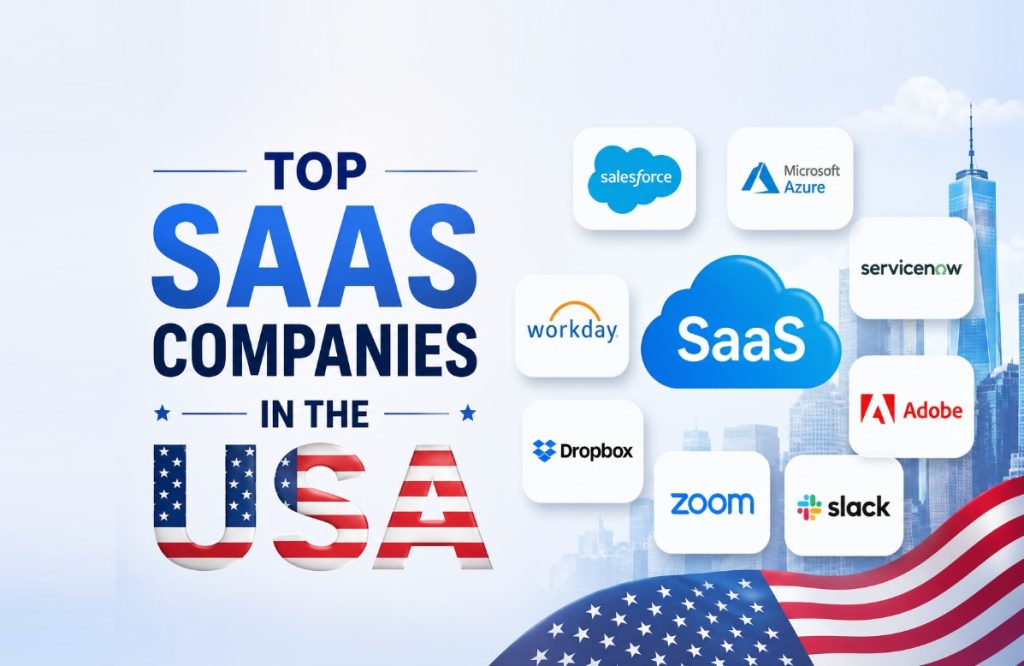
Quick Reference: Top 10 SaaS Companies In The USA (2026)
Here’s a snapshot before we deep-dive into each company:
| # | Company | Category | Best For |
| 1 | Salesforce | CRM | Enterprise Sales Teams |
| 2 | Microsoft 365 | Productivity | All Business Sizes |
| 3 | ServiceNow | IT Management | IT & HR Automation |
| 4 | Workday | HR & Finance | Enterprise HR |
| 5 | Adobe Experience | Marketing | Creative Enterprises |
| 6 | Zoom | Communication | Remote Teams |
| 7 | HubSpot | CRM/Marketing | SMBs & Startups |
| 8 | Shopify | eCommerce | Online Retailers |
| 9 | Slack (Salesforce) | Communication | Team Collaboration |
| 10 | Snowflake | Data Cloud | Data-Driven Enterprises |
Detailed Profiles: Top SaaS Companies In The USA In 2026
1. Salesforce — The King of CRM SaaS
Founded: 1999 | Headquarters: San Francisco, CA
Salesforce is arguably the most recognizable name in B2B SaaS. It remains the undisputed leader in Customer Relationship Management (CRM) software. Its platform helps businesses manage customer data, sales pipelines, marketing automation, customer service, and analytics — all under one roof.
In 2026, Salesforce has doubled down on AI with its “Einstein GPT” features, enabling sales teams to generate AI-written emails, predict deal closures, and automate repetitive tasks. The Einstein AI layer is embedded across all Salesforce Clouds: Sales Cloud, Service Cloud, Marketing Cloud, and Commerce Cloud.
Why Salesforce dominates:
- Largest CRM market share globally (over 22%)
- Robust AppExchange marketplace with 7,000+ apps
- Trusted by 99 of the Fortune 100 companies
- Strong AI-driven automation with Einstein GPT
- Aggressive acquisition strategy (Slack, Tableau, MuleSoft)
Related keywords: Salesforce CRM 2026, best CRM SaaS platform USA, Salesforce alternatives, enterprise CRM software, Salesforce pricing 2026
2. Microsoft 365 — The Productivity Powerhouse
Founded: 1975 | Headquarters: Redmond, WA
Microsoft’s SaaS transformation is one of the greatest business pivots in tech history. Under CEO Satya Nadella, Microsoft successfully transitioned from a legacy software company to a cloud-first, SaaS-first enterprise. Microsoft 365 (formerly Office 365) alone serves over 400 million paid users worldwide in 2026.
Key SaaS products from Microsoft include:
- Microsoft 365 (Word, Excel, PowerPoint, Teams, OneDrive)
- Azure Cloud Services (IaaS, PaaS, SaaS)
- Dynamics 365 (CRM + ERP)
- GitHub Copilot (AI-powered coding assistant)
- Power Platform (low-code business automation)
Microsoft’s integration of Copilot AI (powered by OpenAI’s GPT-4) across its entire product suite has cemented its position as the most comprehensive SaaS ecosystem in the world in 2026.
3. ServiceNow — Automating Enterprise IT at Scale
Founded: 2004 | Headquarters: Santa Clara, CA
ServiceNow is the go-to SaaS platform for enterprise IT service management (ITSM). it’s one of the fastest-growing large-cap SaaS companies in the USA. Its Now Platform allows enterprises to automate workflows across IT, HR, customer service, and security operations.
In 2026, ServiceNow’s “Now Intelligence” AI suite — embedded across all workflows — is revolutionizing how large organizations handle approvals, incident management, and compliance. Over 80% of Fortune 500 companies use ServiceNow.
- Leading platform for IT Service Management (ITSM)
- Strong HR service delivery and employee experience tools
- GRC (Governance, Risk, Compliance) automation
- AI-powered Now Intelligence for smart routing and prediction
4. Workday — The Enterprise HR & Finance SaaS Leader
Founded: 2005 | Headquarters: Pleasanton, CA
Workday has established itself as the premier cloud HCM (Human Capital Management) and financial management SaaS platform for large enterprises. In 2026, Workday serves over 10,000 organizations worldwide, including companies like Amazon, Netflix, and Bank of America.
Workday’s strengths include:
- Unified HR and Finance on a single cloud platform
- Real-time analytics and workforce planning tools
- AI-driven talent acquisition and performance management
- GDPR, SOC 2, and ISO 27001 compliance built-in
- Seamless integration with Salesforce, Microsoft, and SAP
5. Adobe Experience Cloud — The Creative & Marketing SaaS Giant
Founded: 1982 | Headquarters: San Jose, CA
Adobe’s successful pivot from boxed software to SaaS (via Creative Cloud and Experience Cloud) is a masterclass in digital transformation. Adobe Experience Cloud combines digital marketing, analytics, advertising, and commerce tools into one integrated platform — serving enterprise brands like Coca-Cola, Verizon, and BMW.
Adobe’s SaaS portfolio includes:
- Adobe Creative Cloud — Photoshop, Illustrator, Premiere Pro, and 20+ apps
- Adobe Experience Manager — Content management for enterprise marketing
- Adobe Analytics — Real-time customer behavior analytics
- Adobe Marketo Engage — Marketing automation platform
- Adobe Firefly — AI-powered generative creative tools (2026 growth driver)
6. Zoom — Beyond Video Calls: A Full Communications Platform
Founded: 2011 | Headquarters: San Jose, CA
While many predicted Zoom’s decline post-pandemic, the company has successfully evolved into a comprehensive communications and collaboration SaaS platform. In 2026, Zoom’s product suite extends far beyond video conferencing to include phone, contact centers, webinars, and AI-powered meeting summaries.
- Zoom Phone — Cloud-based business phone system
- Zoom Contact Center — Omnichannel customer support platform
- Zoom AI Companion — Real-time meeting summarization and task creation
- Zoom Webinar — Virtual events for up to 50,000 attendees
- Zoom Docs — Collaborative document workspace
7. HubSpot — The SMB SaaS Champion
Founded: 2006 | Headquarters: Cambridge, MA
HubSpot is the definitive inbound marketing and CRM SaaS platform for small-to-medium businesses. With over 215,000 customers in 120+ countries, HubSpot has democratized enterprise-grade marketing tools for growing businesses.
HubSpot’s all-in-one platform includes:
- Marketing Hub — Email marketing, landing pages, SEO tools
- Sales Hub — CRM, deal pipelines, email sequences
- Service Hub — Customer support ticketing and live chat
- CMS Hub — Website builder optimized for marketing
- Operations Hub — Data sync and workflow automation
In 2026, HubSpot’s AI Content Assistant and ChatSpot features have made it the top choice for lean marketing teams looking to scale content production without increasing headcount.
8. Shopify — The eCommerce SaaS Empire
Founded: 2006 | Headquarters: Ottawa, Canada (US operations dominant)
Shopify powers over 1.75 million merchants worldwide and processes hundreds of billions in GMV (Gross Merchandise Volume) annually. While technically Canadian-founded, Shopify’s primary market is the USA, and it’s widely considered a dominant US SaaS company by revenue, user base, and Wall Street positioning.
In 2026, Shopify’s key differentiators include:
- Shopify Payments — Native payment gateway with best-in-class fraud prevention
- Shopify Markets — Cross-border selling made simple
- Shopify Audiences — First-party ad targeting using purchase data
- Shopify Flow — No-code eCommerce automation
- Shopify Hydrogen — Headless commerce framework for custom storefronts
9. Slack (by Salesforce) — The Team Collaboration Standard
Founded: 2013 | Headquarters: San Francisco, CA
Slack has continued to grow as the team messaging platform of choice for tech-forward companies. In 2026, Slack is deeply integrated with Salesforce CRM, allowing sales reps, support agents, and developers to collaborate in context — without switching apps.
- 10 million+ daily active users globally
- Deep Salesforce CRM integration (Sales signals in Slack channels)
- Slack AI — Thread summaries, search answers, workflow building with natural language
- Slack Canvas — Persistent project documentation inside channels
- Salesforce Customer 360 integration built-in
10. Snowflake — The Data Cloud SaaS Leader
Founded: 2012 | Headquarters: Bozeman, MT
Snowflake is the premier cloud data platform, enabling organizations to store, analyze, and share data across any cloud provider. In 2026, Snowflake’s Data Cloud connects thousands of businesses, data providers, and data consumers — making it an irreplaceable layer of the modern data stack.
Snowflake’s competitive advantages:
- Multi-cloud architecture — works on AWS, Azure, and Google Cloud simultaneously
- Near-zero data governance overhead with automatic optimization
- Snowpark — Developers can write Python, Java, and Scala directly in Snowflake
- Cortex AI — Built-in LLM capabilities for data querying in natural language
- Marketplace — Access to 2,000+ ready-to-query data sets from partners
Honorable Mentions: Other Top SaaS Companies In The USA
The US SaaS landscape is incredibly competitive. These companies also deserve recognition for their market impact in 2026:
| Company | Industry | Key Product |
| Stripe | FinTech | Payment APIs |
| Twilio | Communications | SMS/Voice APIs |
| Datadog | DevOps/Monitoring | Cloud monitoring |
| Okta | Security/IAM | Identity management |
| monday.com | Project Management | Work OS platform |
| Zendesk | Customer Service | Support ticketing |
| DocuSign | eSignature | Digital signature |
| Asana | Project Management | Task management |
Key SaaS Trends Shaping The USA Market In 2026
The SaaS landscape is evolving rapidly. Here are the defining trends every business needs to understand in 2026:
1. AI-First Product Development
Every major SaaS platform in 2026, including taxi booking software, logistics solutions, food delivery platforms, eCommerce marketplaces, multi-service app, and healthcare apps, has integrated generative AI into its core product.— not as a feature, but as the foundation. Salesforce Einstein, Microsoft Copilot, HubSpot AI Assistant, and Adobe Firefly are redefining what software can do autonomously. Companies that have not embedded AI are losing market share.
2. Vertical SaaS is Exploding
While horizontal SaaS (tools for every business) still dominates, vertical SaaS — tailored software for specific industries like healthcare, legal, construction, and real estate — is the fastest-growing SaaS segment. Companies like Veeva Systems (pharma), Toast (restaurants), and Procore (construction) are dominating their niches.
3. Usage-Based Pricing (Consumption Model)
Flat-rate subscriptions are giving way to usage-based models. Snowflake, Twilio, and AWS charge customers based on what they use, not what they subscribe to. This lowers the entry barrier and aligns vendor incentives with customer success.
4. SaaS Consolidation & Platform Plays
Businesses are experiencing “SaaS fatigue” — managing 50+ disconnected tools. In response, vendors are building platforms that replace entire categories of software. Microsoft 365, Salesforce, HubSpot, and monday.com are all racing to become the single platform of record.
5. Security & Compliance as a Feature
With data breaches costing companies an average of $4.5 million in 2025, enterprise buyers now make security a non-negotiable requirement. SOC 2 Type II, ISO 27001, GDPR, and FedRAMP compliance badges are table stakes for enterprise SaaS deals.
How To Choose The Right SaaS Platform For Your Business
With thousands of SaaS options available, choosing the right platform can feel overwhelming. Here’s a practical framework used by successful businesses in 2026:
Step 1: Define Your Primary Business Problem
Don’t start with software. Start with your pain point. Are you losing customers due to poor follow-up? You need CRM SaaS. Is your team scattered across time zones? You need collaboration SaaS. Are you spending 10 hours a week on payroll? You need HR SaaS.
Step 2: Assess Your Team Size and Technical Ability
Small teams of under 50 employees typically benefit most from HubSpot, monday.com, or Zoho. Mid-market companies (50-500 employees) often find the right balance with Salesforce Essentials or Workday. Enterprise (500+) should evaluate Salesforce, ServiceNow, or Microsoft Dynamics.
Step 3: Evaluate Integration Capabilities
Modern businesses run on 20-30 tools simultaneously. The best SaaS platforms connect seamlessly with your existing stack. Prioritize platforms that offer native integrations with Zapier, Slack, Gmail, or your ERP system.
Step 4: Evaluate Total Cost of Ownership (TCO)
Subscription price is only part of the equation. Factor in implementation costs, training, add-ons, API usage fees, and annual price escalations. Enterprise SaaS contracts often carry 20-40% price increases upon renewal.
Step 5: Start with a Free Trial or Freemium Tier
Most major SaaS companies offer free trials (14-30 days) or freemium plans. HubSpot’s free CRM, Zoom’s free tier, Shopify’s 3-day trial, and Slack’s free workspace are all designed to let you experience value before committing.
Frequently Asked Questions (FAQ)
Q: What is the largest SaaS company in the USA in 2026?
A: By dedicated SaaS revenue, Salesforce is the largest SaaS company in the USA with approximately $34.9 billion in FY2025 revenue. However, if you include Microsoft’s total cloud and SaaS revenue, Microsoft far surpasses all competitors at over $200 billion annually.
Q: How big is the US SaaS market in 2026?
A: The US SaaS market is estimated to be worth over $300 billion in 2026, accounting for approximately 65% of global SaaS revenue. The market is expected to grow at a CAGR of 18-22% through 2030.
Q: What types of SaaS companies are growing fastest in 2026?
A: AI-native SaaS, vertical SaaS (industry-specific), and security/compliance SaaS are the fastest-growing categories in 2026. AI-first companies like Anthropic’s Claude API, OpenAI’s ChatGPT Enterprise, and AI coding tools (GitHub Copilot) are experiencing exponential growth.
Q: Is SaaS better than on-premise software?
A: For most businesses, yes. SaaS offers faster deployment, automatic updates, no hardware costs, and built-in security. However, companies with highly specialized workflows, strict data sovereignty requirements (government/military), or very limited internet access may still prefer on-premise solutions.
Q: What is the difference between SaaS, PaaS, and IaaS?
A: SaaS (Software as a Service) delivers ready-to-use applications like Salesforce or Zoom. PaaS (Platform as a Service) provides development environments like Heroku or AWS Elastic Beanstalk. IaaS (Infrastructure as a Service) offers raw cloud computing resources like AWS EC2 or Azure Virtual Machines. Most businesses primarily consume SaaS.
Conclusion: The Future of SaaS Is Bright — And Still American
The top SaaS companies in the USA are not just building software — they are fundamentally reshaping how modern businesses operate. From Salesforce’s AI-powered CRM to Snowflake’s multi-cloud data platform, these companies are setting the standard for the entire global software industry.
In 2026, the defining competitive advantage for US SaaS companies is their ability to embed generative AI into workflows, consolidate point solutions into unified platforms, and deliver measurable business outcomes to their enterprise customers.
For businesses evaluating SaaS investments, the data is clear: investing in the right cloud software today is not just a productivity play — it’s a survival strategy. Companies that adopt AI-enabled SaaS tools in 2026 will operate faster, leaner, and smarter than competitors still relying on legacy systems.
Want More Expert Business and Design Insights?
Visit Aik Designs Official Website for curated guides, design resources, and technology insights that help your business grow.
SaaS Related Tags Covered:
SaaS, Cloud Software, Business Tools, Salesforce, SaaS Link Building, HubSpot, Microsoft 365, Zoom, Workday, Snowflake, Tech 2026, USA Business, Enterprise Software, cloud software, subscription software, web-based applications, B2B SaaS, enterprise SaaS, SaaS platforms, cloud computing services, online business tools, SaaS solutions, software subscription model, Top SaaS Companies In The USA 2026, best SaaS companies in USA, leading SaaS platforms 2026, top software as a service companies, SaaS market leaders United States, biggest SaaS companies in America, SaaS industry trends 2026, enterprise SaaS solutions USA, cloud software companies USA, B2B SaaS companies list, SaaS platform comparison 2026, which SaaS companies are dominating the US market in 2026, top 10 SaaS companies by revenue USA, best B2B SaaS tools for small businesses 2026, fastest growing SaaS companies in America, list of top SaaS companies United States, SaaS companies to watch in 2026, how big is the US SaaS market 2026, best cloud-based software companies in USA, what is the number one SaaS company in USA, top SaaS platforms for enterprise businesses, cloud computing services, subscription software, web-based applications, CRM software, HR SaaS, marketing automation, data cloud,Salesforce, Microsoft 365, HubSpot, Shopify, Workday, Snowflake, SaaS market size, SaaS growth rate, SaaS revenue statistics, AI-powered SaaS, generative AI in enterprise software, SaaS pricing model, subscription business model, usage-based pricing, vertical SaaS, horizontal SaaS, niche SaaS platforms, SaaS vs on-premise software, cloud vs traditional software, best productivity software USA, business software 2026, software for startups USA, enterprise software solutions.
About Author