How Creators Are Using Free AI Anime Generators to Build Stronger Visual Branding
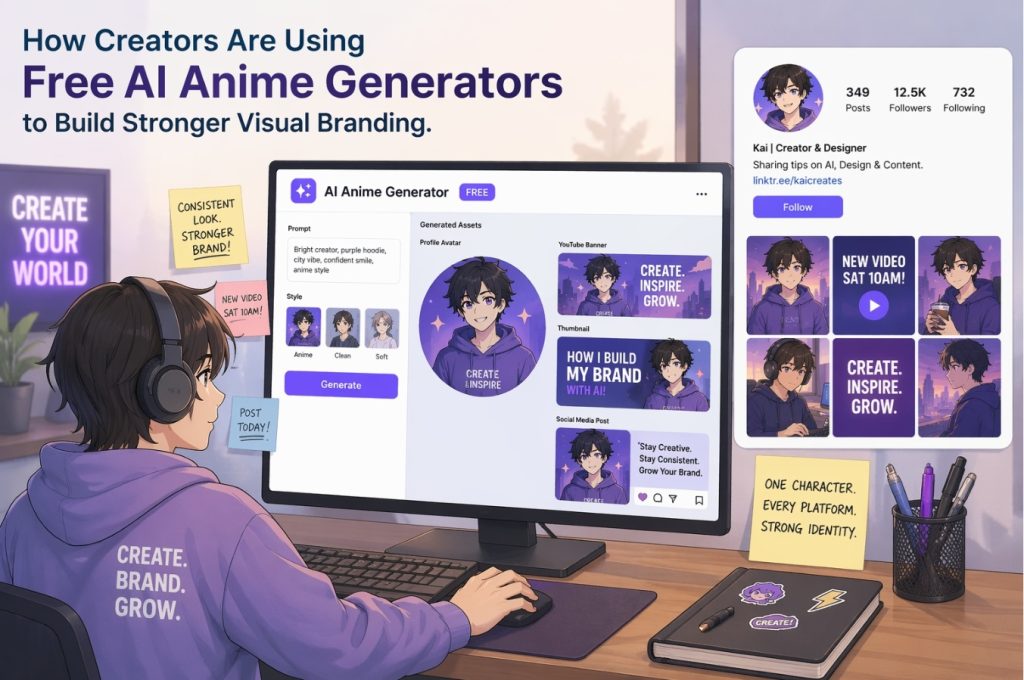
I have noticed something interesting over the past year: a lot of people who say they “just need a quick visual” are really trying to solve a branding problem. They may not phrase it that way. They might say they want a profile image, a mascot, a channel identity, or a set of stylized visuals for social posts. Yet the real issue is consistency. They want people to remember what they make.
That is one reason a free AI anime generator can be more useful than it first appears. On the surface, it sounds like a fun image tool. In practice, it often becomes a lightweight branding system for creators who do not have an in-house designer, an illustrator on retainer, or the time to build a visual identity from scratch.
Why anime-inspired visuals work unusually well online
Not every brand should look like an anime project. I do not believe in forcing a style where it does not belong. Still, anime-inspired visuals have a few advantages that are hard to ignore in digital spaces.
They are expressive at small sizes. They tend to read well in profile circles, thumbnails, banners, and mobile feeds. They also let creators exaggerate personality in a way that feels intentional rather than messy. A realistic portrait can look generic very quickly. A stylized character, when done well, carries more identity.
For smaller creators, that matters. Recognition usually starts before trust does. A viewer remembers the character, the color palette, or the overall vibe long before they remember a slogan.
The difference between making pretty images and building a visual system
This is where many people waste time. They generate isolated images and mistake variety for progress. I have done that myself. The results look exciting for an hour, but they do not help much when I need a second banner, a new thumbnail set, a landing page graphic, or a social post next week.
Branding works better when there is a repeatable base. In visual terms, that means I need some elements to stay stable:
- a recognizable face or silhouette
- a limited color direction
- clothing or accessories that feel intentional
- a mood that carries across different contexts
Once those elements exist, the tool becomes more than a generator. It becomes part of a content workflow.
Where AI anime tools help most in design and marketing
I would not use anime visuals for every client, every website, or every campaign. That would be lazy thinking. But there are many cases where they perform better than expected.
I have seen strong results in:
- creator branding for YouTube, TikTok, and streaming channels
- blog illustrations where stock images feel flat
- mascots for small digital products
- visual identities for gaming, fandom, and youth-oriented communities
- launch graphics for lightweight campaigns that need personality, not corporate polish
The common thread is emotional clarity. These visuals are good at telling people what kind of world they are entering. That is valuable in marketing, because design is often doing pre-verbal work before a visitor reads a single line.
How I turn a character idea into a usable content asset
When I am working on this kind of project, I no longer begin with “make it look cool.” That instruction sounds creative, but it usually leads nowhere stable. I begin with role.
Is this character a mascot, a guide, a narrator, a founder persona, or a decorative brand symbol? The answer changes everything. A mascot can be bold and simplified. A narrator may need warmth and subtlety. A founder-style avatar should feel distinctive without becoming distracting.
Once I know the role, I sketch a mini brief:
- audience
- platform
- tone
- color direction
- visual purpose
Only after that do I move into generation. If I want a toolset centered more directly on character development, I would naturally look at something like OCMaker AI because the real challenge is rarely “can this tool make an image?” The real challenge is whether it helps me build a character I can keep using.
Free tools are useful, but only if you use them with discipline
I like free tools for exploration. They are excellent for testing visual directions before committing time or budget. They are also great for creators who are still discovering their own style.
That said, “free” can become a trap if it encourages random iteration without a framework. I have seen creators generate fifty images and still end up with no usable identity because each output belongs to a different visual universe.
A better approach is to treat free generation as a discovery phase. Use it to answer specific questions:
- Does this face shape feel distinctive enough?
- Is this color palette memorable?
- Does this design still work as a thumbnail?
- Would this character fit on a website hero image without looking childish or off-brand?
Those questions produce better decisions than simply asking for more variations.
Also Read: FREE Image-To-AI Video Tools
What I look for when judging whether an anime tool is actually useful
Here is the standard I use now:
| Evaluation point | What I want to see |
| Character recognizability | The design should still feel like the same persona across variations |
| Brand fit | The style should match the audience, not just current trends |
| Thumbnail performance | Key facial and color elements should read clearly at small size |
| Reusability | The character should work across banners, posts, and landing pages |
| Speed to decision | The tool should help me choose a direction faster, not keep me looping |
That last point matters more than people admit. A tool can produce beautiful art and still be a poor branding tool if it does not help me make consistent decisions.
The branding advantage most people overlook
What makes this category valuable is not that it replaces designers. It does not. What it can do, though, is help creators arrive at a stronger starting point before deeper design work begins.
For solo founders, content creators, newsletter writers, indie developers, and small online brands, that is often enough to create momentum. A recognizable visual identity makes content feel more deliberate. Deliberate content tends to earn more trust. More trust usually means better recall, stronger audience attachment, and cleaner positioning.
That chain reaction is easy to underestimate when people talk about AI image tools as if they are only for entertainment.
Final thoughts
I do not see free AI anime generation as a gimmick category anymore. Used carelessly, it absolutely turns into noise. Used with a clear role, a stable brief, and some design judgment, it becomes a fast way to shape visual identity for digital work.
The creators getting the best results are not the ones generating the most images. They are the ones making a few smart visual decisions and repeating them consistently. In my own workflow, that is the point where AI stops being a novelty and starts becoming useful.
About Author