4 Qul With Urdu Translation & English: Read Online
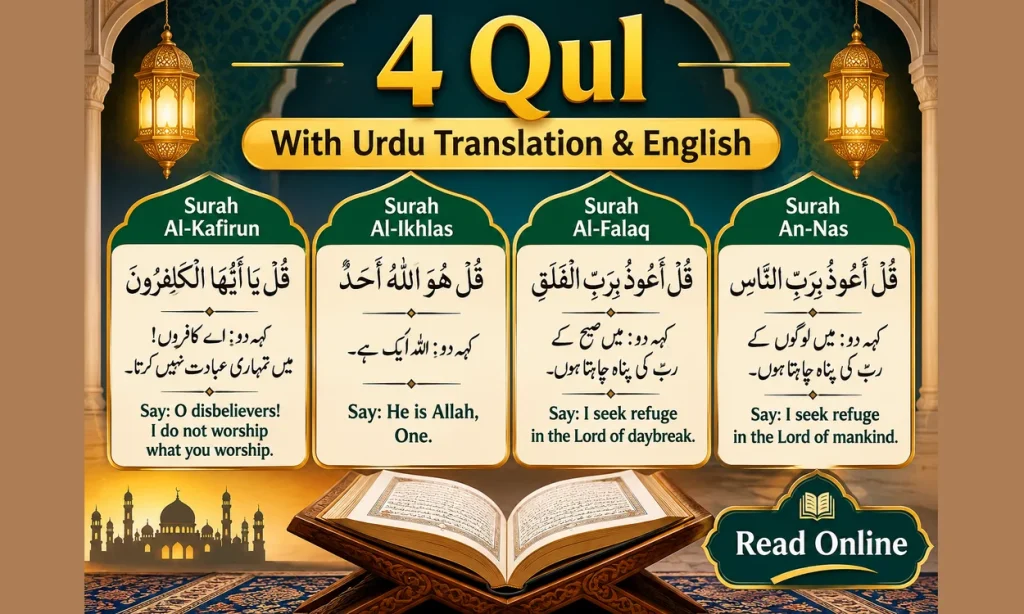
The 4 Qul are four short and powerful surahs of the Quran: Surah Al-Kafirun, Surah Al-Ikhlas, Surah Al-Falaq and Surah An-Nas. Muslims recite them every day in Pakistan, India and around the world, and children usually learn them first. This guide gives you the full Arabic text, Urdu translation, English translation and transliteration of every ayat, plus Ayatul Kursi and the benefits mentioned in Sahih al-Bukhari and Sahih Muslim.
Whether you searched for 4 Qul In English, 4 Qul In Urdu, 4 Qul Transliteration, 4 Qul Benefits, 4 Qul Surah PDF or 4 Qul And Ayatul Kursi, everything is on this one page.
- Who, What, When, Where, Why And How
- 4 Qul List At A Glance
- Surah Al-Kafirun In Arabic, Urdu And English
- Surah Al-Ikhlas In Arabic, Urdu And English
- Surah Al-Falaq In Arabic, Urdu And English
- Surah An-Nas In Arabic, Urdu And English
- 4 Qul And Ayatul Kursi
- 4 Qul Benefits
- How And When To Recite 4 Qul
- 4 Qul Surah PDF And Images
- Sahih Hadith References At A Glance
- Read More Surahs Online
- Frequently Asked Questions
- Conclusion
1. Who, What, When, Where, Why And How
| Question | Answer |
|---|---|
| Who | Every Muslim. Children learn the 4 Qul first, and adults recite them daily across Pakistan, India, the UK, the US and Canada. |
| What | The 4 Qul are Surah Al-Kafirun, Surah Al-Ikhlas, Surah Al-Falaq and Surah An-Nas. Each one starts with the word Qul, which means “Say”. |
| When | Mainly in the morning, in the evening and before sleeping, as mentioned in Sahih al-Bukhari and Sahih Muslim. They can be read at any time. |
| Where | At home, in prayer, or anywhere suitable for reciting the Quran. They are in Juz 30, the last part of the Quran. |
| Why | For their virtue in sahih hadith, for protection through seeking refuge in Allah, and because they teach Tawheed in the simplest words. |
| How | Read the Arabic slowly, understand the Urdu or English meaning, and use the transliteration only as a help while you learn from a teacher. |
2. 4 Qul List At A Glance
Here is a quick list of the 4 Qul with the surah number, number of ayats and the main theme of each one.
4 Qul Image In HD With Full 4 Qul Arabic Text
👉Download 4 Qul Image in Arabic Text
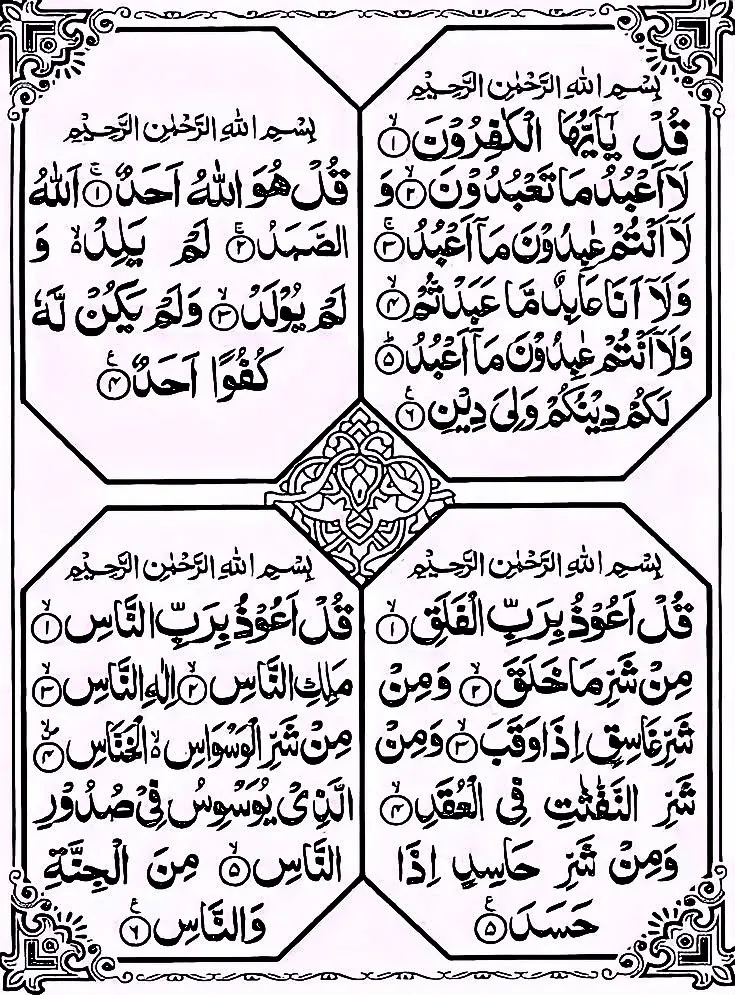
| # | Surah | Surah Number | Ayats | Main Theme |
|---|---|---|---|---|
| 1 | Surah Al-Kafirun | 109 | 6 | Clear Worship Of Allah Alone |
| 2 | Surah Al-Ikhlas | 112 | 4 | Pure Oneness Of Allah (Tawheed) |
| 3 | Surah Al-Falaq | 113 | 5 | Seeking Refuge From Outside Evil |
| 4 | Surah An-Nas | 114 | 6 | Seeking Refuge From Whispers Of Shaytan |
3. Surah Al-Kafirun In Arabic, Urdu And English
Surah Al-Kafirun is the 109th surah of the Quran and has 6 short ayats. It is a clear declaration that a Muslim worships Allah alone, while showing respect and peace in how we deal with people of other beliefs. It is also known as Surah Kafirun, Surah Kafiroon and Surah Al-Kafirun In English as “The Disbelievers”.
Surah Al-Kafirun In Arabic
لَا أَعْبُدُ مَا تَعْبُدُونَ ﴿٢﴾
وَلَا أَنتُمْ عَابِدُونَ مَا أَعْبُدُ ﴿٣﴾
وَلَا أَنَا عَابِدٌ مَّا عَبَدتُّمْ ﴿٤﴾
وَلَا أَنتُمْ عَابِدُونَ مَا أَعْبُدُ ﴿٥﴾
لَكُمْ دِينُكُمْ وَلِيَ دِينِ ﴿٦﴾
Surah Al-Kafirun Transliteration, Urdu Translation And English
| Ayat | Arabic | Transliteration | Urdu Translation | English Translation |
|---|---|---|---|---|
| 1 | قُلْ يَا أَيُّهَا الْكَافِرُونَ ﴿١﴾ | Qul yaa ayyuhal-kaafiroon | کہہ دو: اے کافرو! | Say: O disbelievers, |
| 2 | لَا أَعْبُدُ مَا تَعْبُدُونَ ﴿٢﴾ | Laa a’budu maa ta’budoon | میں اُس کی عبادت نہیں کرتا جس کی تم عبادت کرتے ہو | I do not worship what you worship. |
| 3 | وَلَا أَنتُمْ عَابِدُونَ مَا أَعْبُدُ ﴿٣﴾ | Wa laa antum ‘aabidoona maa a’bud | اور نہ تم اُس کی عبادت کرنے والے ہو جس کی میں عبادت کرتا ہوں | Nor are you worshippers of what I worship. |
| 4 | وَلَا أَنَا عَابِدٌ مَّا عَبَدتُّمْ ﴿٤﴾ | Wa laa ana ‘aabidum maa ‘abattum | اور نہ میں اُس کی عبادت کرنے والا ہوں جس کی تم نے عبادت کی | Nor will I be a worshipper of what you have worshipped. |
| 5 | وَلَا أَنتُمْ عَابِدُونَ مَا أَعْبُدُ ﴿٥﴾ | Wa laa antum ‘aabidoona maa a’bud | اور نہ تم اُس کی عبادت کرنے والے ہو جس کی میں عبادت کرتا ہوں | Nor will you be worshippers of what I worship. |
| 6 | لَكُمْ دِينُكُمْ وَلِيَ دِينِ ﴿٦﴾ | Lakum deenukum wa liya deen | تمہارے لیے تمہارا دین اور میرے لیے میرا دین | For you is your religion, and for me is my religion. |
4. Surah Al-Ikhlas In Arabic, Urdu And English
Surah Al-Ikhlas is the 112th surah of the Quran and has 4 ayats. It describes Allah in the simplest and clearest words: One, Eternal, not born and not a father, and without any equal. It is also searched as Surah Ikhlas, Surah Ikhlas Text and Surah Ikhlas In Arabic.
Surah Al-Ikhlas In Arabic
اللَّهُ الصَّمَدُ ﴿٢﴾
لَمْ يَلِدْ وَلَمْ يُولَدْ ﴿٣﴾
وَلَمْ يَكُن لَّهُ كُفُوًا أَحَدٌ ﴿٤﴾
Surah Al-Ikhlas Transliteration, Urdu Translation And English
| Ayat | Arabic | Transliteration | Urdu Translation | English Translation |
|---|---|---|---|---|
| 1 | قُلْ هُوَ اللَّهُ أَحَدٌ ﴿١﴾ | Qul huwal-laahu ahad | کہہ دو: وہ اللہ ایک ہے | Say: He is Allah, the One. |
| 2 | اللَّهُ الصَّمَدُ ﴿٢﴾ | Allaahus-samad | اللہ بے نیاز ہے، سب اس کے محتاج ہیں | Allah is the Eternal Refuge, whom all creation needs. |
| 3 | لَمْ يَلِدْ وَلَمْ يُولَدْ ﴿٣﴾ | Lam yalid wa lam yoolad | نہ اس کی کوئی اولاد ہے اور نہ وہ کسی کی اولاد ہے | He neither begets nor was He born. |
| 4 | وَلَمْ يَكُن لَّهُ كُفُوًا أَحَدٌ ﴿٤﴾ | Wa lam yakul-lahoo kufuwan ahad | اور نہ کوئی اس کے برابر ہے | And there is none comparable to Him. |
5. Surah Al-Falaq In Arabic, Urdu And English
Surah Al-Falaq is the 113th surah of the Quran and has 5 ayats. In it we seek refuge with the Lord of daybreak from the evil of creation, the darkness of night, magic and envy. It is also searched as Surah Falaq, Surah Al-Falaq In English and Surah Falaq Urdu Translation.
Surah Al-Falaq In Arabic
مِن شَرِّ مَا خَلَقَ ﴿٢﴾
وَمِن شَرِّ غَاسِقٍ إِذَا وَقَبَ ﴿٣﴾
وَمِن شَرِّ النَّفَّاثَاتِ فِي الْعُقَدِ ﴿٤﴾
وَمِن شَرِّ حَاسِدٍ إِذَا حَسَدَ ﴿٥﴾
Surah Al-Falaq Transliteration, Urdu Translation And English
| Ayat | Arabic | Transliteration | Urdu Translation | English Translation |
|---|---|---|---|---|
| 1 | قُلْ أَعُوذُ بِرَبِّ الْفَلَقِ ﴿١﴾ | Qul a’oodhu bi-Rabbil-falaq | کہہ دو: میں صبح کے رب کی پناہ مانگتا ہوں | Say: I seek refuge in the Lord of daybreak, |
| 2 | مِن شَرِّ مَا خَلَقَ ﴿٢﴾ | Min sharri maa khalaq | ہر اس چیز کے شر سے جو اس نے پیدا کی | from the evil of what He has created, |
| 3 | وَمِن شَرِّ غَاسِقٍ إِذَا وَقَبَ ﴿٣﴾ | Wa min sharri ghaasiqin idhaa waqab | اور اندھیری رات کے شر سے جب وہ چھا جائے | and from the evil of darkness when it settles, |
| 4 | وَمِن شَرِّ النَّفَّاثَاتِ فِي الْعُقَدِ ﴿٤﴾ | Wa min sharrin-naffaathaati fil-‘uqad | اور گرہوں میں پھونکنے والیوں کے شر سے | and from the evil of those who blow on knots (practise magic), |
| 5 | وَمِن شَرِّ حَاسِدٍ إِذَا حَسَدَ ﴿٥﴾ | Wa min sharri haasidin idhaa hasad | اور حسد کرنے والے کے شر سے جب وہ حسد کرے | and from the evil of an envier when he envies. |
6. Surah An-Nas In Arabic, Urdu And English
Surah An-Nas is the 114th and last surah of the Quran and has 6 ayats. We seek refuge with Allah as the Lord, King and God of mankind from the whispers of Shaytan. It is also searched as Surah Nas, Surah An-Nas In English and Surah An-Nas Ki Tilawat.
Surah An-Nas In Arabic
مَلِكِ النَّاسِ ﴿٢﴾
إِلَٰهِ النَّاسِ ﴿٣﴾
مِن شَرِّ الْوَسْوَاسِ الْخَنَّاسِ ﴿٤﴾
الَّذِي يُوَسْوِسُ فِي صُدُورِ النَّاسِ ﴿٥﴾
مِنَ الْجِنَّةِ وَالنَّاسِ ﴿٦﴾
Surah An-Nas Transliteration, Urdu Translation And English
| Ayat | Arabic | Transliteration | Urdu Translation | English Translation |
|---|---|---|---|---|
| 1 | قُلْ أَعُوذُ بِرَبِّ النَّاسِ ﴿١﴾ | Qul a’oodhu bi-Rabbin-naas | کہہ دو: میں لوگوں کے رب کی پناہ مانگتا ہوں | Say: I seek refuge in the Lord of mankind, |
| 2 | مَلِكِ النَّاسِ ﴿٢﴾ | Malikin-naas | لوگوں کے بادشاہ کی | the King of mankind, |
| 3 | إِلَٰهِ النَّاسِ ﴿٣﴾ | Ilaahin-naas | لوگوں کے معبود کی | the God of mankind, |
| 4 | مِن شَرِّ الْوَسْوَاسِ الْخَنَّاسِ ﴿٤﴾ | Min sharril-waswaasil-khannaas | وسوسہ ڈالنے والے، پیچھے ہٹ جانے والے (شیطان) کے شر سے | from the evil of the whispering, retreating one, |
| 5 | الَّذِي يُوَسْوِسُ فِي صُدُورِ النَّاسِ ﴿٥﴾ | Alladhee yuwaswisu fee sudoorin-naas | جو لوگوں کے سینوں میں وسوسے ڈالتا ہے | who whispers in the hearts of mankind, |
| 6 | مِنَ الْجِنَّةِ وَالنَّاسِ ﴿٦﴾ | Minal-jinnati wan-naas | خواہ وہ جنوں میں سے ہو یا انسانوں میں سے | among jinn and among mankind. |
7. 4 Qul And Ayatul Kursi
Ayatul Kursi is not one of the 4 Qul, but many people recite 4 Qul and Ayatul Kursi together, so it is added here for easy reading. It is verse 255 of Surah Al-Baqarah. If you are looking for a printable layout, you can also save this page as an Ayatul Kursi 4 Qul PDF using the browser Print option.
Ayatul Kursi Transliteration
Allaahu laa ilaaha illaa huwal-Hayyul-Qayyoom. Laa ta’khudhuhoo sinatun wa laa nawm. Lahoo maa fis-samaawaati wa maa fil-ard. Man dhal-ladhee yashfa’u ‘indahoo illaa bi-idhnih. Ya’lamu maa bayna aydeehim wa maa khalfahum. Wa laa yuheetoona bi-shay’im min ‘ilmihee illaa bimaa shaa’. Wasi’a kursiyyuhus-samaawaati wal-ard. Wa laa ya’ooduhoo hifzuhumaa. Wa huwal-‘Aliyyul-‘Azeem.
Ayatul Kursi Urdu Translation
Ayatul Kursi English Translation
Allah, there is no god except Him, the Ever-Living, the Sustainer of all. Neither drowsiness nor sleep overtakes Him. To Him belongs whatever is in the heavens and whatever is on the earth. Who can intercede with Him except by His permission? He knows what is before them and what is behind them, and they encompass nothing of His knowledge except what He wills. His Kursi extends over the heavens and the earth, and guarding them does not tire Him. He is the Most High, the Most Great.
8. 4 Qul Benefits
The 4 Qul benefits mentioned below come from Sahih al-Bukhari and Sahih Muslim. We have avoided popular claims that have no sound source.
1. Surah Ikhlas Equals One Third Of The Quran
Abu Sa’id al-Khudri (may Allah be pleased with him) reported that a man kept repeating Surah Al-Ikhlas, and the Prophet (peace be upon him) said that, by Him in whose hand is my soul, it equals one third of the Quran (Sahih al-Bukhari 5013, Sahih Muslim 811).
2. Love For Surah Ikhlas Brings Allah’s Love
Aisha (may Allah be pleased with her) narrated about a man who ended his recitation in prayer with Surah Al-Ikhlas. The Prophet (peace be upon him) said to tell him that Allah loves him (Sahih al-Bukhari 7375, Sahih Muslim 813). The man said he loved it because it describes the Most Merciful.
3. Recite And Blow Before Sleeping
Aisha (may Allah be pleased with her) said that every night when the Prophet (peace be upon him) went to bed, he joined his palms, blew into them and recited Surah Al-Ikhlas, Surah Al-Falaq and Surah An-Nas. Then he wiped his hands over as much of his body as he could, starting with his head, face and the front of his body, and he did this three times (Sahih al-Bukhari 5017).
4. Surah Falaq And Nas Are Unmatched For Seeking Refuge
Uqbah ibn Amir (may Allah be pleased with him) reported that the Prophet (peace be upon him) said that verses had been revealed to him the like of which had never been seen: Surah Al-Falaq and Surah An-Nas (Sahih Muslim 814). They teach us to seek refuge with Allah from outside harm and from the whispers of Shaytan.
5. Surah Kafirun And Ikhlas In The Fajr Sunnah
Abu Hurayrah (may Allah be pleased with him) reported that the Prophet (peace be upon him) recited Surah Al-Kafirun and Surah Al-Ikhlas in the two rakahs of Fajr (Sahih Muslim 726). Following this Sunnah is an easy way to keep both surahs on your tongue.
9. How And When To Recite 4 Qul
- Before sleeping: recite Surah Ikhlas, Falaq and Nas, blow into your palms and wipe over your body, three times, following Sahih al-Bukhari 5017.
- In the Fajr Sunnah: recite Surah Al-Kafirun in the first rakah and Surah Al-Ikhlas in the second, following Sahih Muslim 726.
- Morning and evening: many Muslims recite the three Quls as part of their daily adhkar.
- At bedtime: add Ayatul Kursi, as mentioned in Sahih al-Bukhari 2311.
- Learning: read slowly, use the Urdu or English meaning, and learn tajweed from a qualified teacher.
10. 4 Qul Surah PDF And Images
Many readers search for 4 Qul Surah PDF and 4 Qul Surah Images so they can read offline. You can do this in two simple steps:
- Save as PDF: open this page, use your browser Print option and choose Save As PDF. This gives you a 4 Qul Surah PDF with the Arabic, Urdu and English text.
- Save as image: take a screenshot of the surah box you want and save it in your phone gallery for bedtime reading without internet.
11. Sahih Hadith References At A Glance
Here is a quick table of the narrations used in this article, so you can verify them yourself. The last two rows are included only as extra context and are graded hasan, not sahih.
| Hadith Subject | Narrator | Source | Grade |
|---|---|---|---|
| Surah Ikhlas equals one third of the Quran | Abu Sa’id al-Khudri | Sahih al-Bukhari 5013, Sahih Muslim 811 | Sahih |
| Allah loves the one who loves Surah Ikhlas | Aisha | Sahih al-Bukhari 7375, Sahih Muslim 813 | Sahih |
| Three Quls recited and blown over the body before sleep | Aisha | Sahih al-Bukhari 5017 | Sahih |
| Surah Falaq and Nas are unmatched verses for seeking refuge | Uqbah ibn Amir | Sahih Muslim 814 | Sahih |
| Surah Kafirun and Ikhlas in the Fajr Sunnah | Abu Hurayrah | Sahih Muslim 726 | Sahih |
| Ayatul Kursi brings a guardian from Allah at night | Abu Hurayrah | Sahih al-Bukhari 2311 | Sahih |
| Surah Kafirun before sleep is freedom from shirk | Nawfal al-Ashja’i | Sunan Abi Dawud 5055, Jami at-Tirmidhi 3403 | Hasan |
| Three Quls three times in the morning and evening suffice | Abdullah ibn Khubayb | Sunan Abi Dawud 5082, Jami at-Tirmidhi 3575 | Hasan |
12. Read More Surahs Online
If you like reading the Quran online with a clear layout, you can also read Surah Baqarah last 2 ayats, Surah Waqiah read online and Surah Mulk read online on Aik Designs. You can also check the today Islamic date in Pakistan page for the current Hijri date.
13. Frequently Asked Questions
What Is 4 Qul?
4 Qul means the four surahs of the Quran that begin with the word Qul (say): Surah Al-Kafirun (109), Surah Al-Ikhlas (112), Surah Al-Falaq (113) and Surah An-Nas (114). They are short, easy to memorise and recited daily by Muslims across Pakistan, India and the rest of the world.
Which Surahs Are Included In 4 Qul?
The 4 Qul are Surah Al-Kafirun, Surah Al-Ikhlas, Surah Al-Falaq and Surah An-Nas. All four are in Juz 30 (Juz Amma) and together they have 21 ayats: 6, 4, 5 and 6.
Where Can I Read 4 Qul In English?
You can read 4 Qul In English on this page. Each surah has the Arabic text, a transliteration to help you read the sounds, and a simple English translation for every ayat. Use a teacher or trusted recitation to learn correct pronunciation.
Where Can I Read 4 Qul In Urdu?
You can read 4 Qul In Urdu on this page. Every ayat has the Arabic text, the Urdu translation (tarjuma) and an English meaning, so Urdu readers and English readers can use the same page.
What Is The 4 Qul Transliteration?
The 4 Qul transliteration is the Arabic text written in English letters, for example Qul huwal-laahu ahad for the first ayat of Surah Al-Ikhlas. Transliteration is only a help for beginners and does not replace learning proper tajweed from a teacher.
What Are The 4 Qul Benefits?
According to Sahih al-Bukhari and Sahih Muslim, Surah Al-Ikhlas equals one third of the Quran in reward, the Prophet (peace be upon him) recited the three Quls and blew over his body before sleeping, and Surah Al-Falaq and An-Nas are described as unmatched verses for seeking refuge. Surah Al-Kafirun was recited by the Prophet in the Fajr Sunnah.
Is Ayatul Kursi Part Of 4 Qul?
No. Ayatul Kursi is verse 255 of Surah Al-Baqarah, not one of the four Quls. Many people recite 4 Qul and Ayatul Kursi together at bedtime and after prayer, which is why they are often printed on the same page.
When Should I Read 4 Qul?
The most authentic practice is before sleeping, when the Prophet (peace be upon him) would recite Surah Al-Ikhlas, Al-Falaq and An-Nas, blow into his hands and wipe over his body. Muslims also recite them in the morning and evening and after prayers.
How Many Times Should I Recite The Three Quls At Night?
Sahih al-Bukhari 5017 reports that the Prophet (peace be upon him) did this three times at night. Avoid any claim about a different fixed count bringing a special result unless it comes from a sound source.
Why Is Surah Ikhlas Equal To One Third Of The Quran?
The Prophet (peace be upon him) said that Surah Al-Ikhlas equals one third of the Quran (Sahih al-Bukhari 5013, Sahih Muslim 811). Scholars explain that the Quran mainly teaches Tawheed, stories and laws, and Surah Ikhlas is entirely about Tawheed. This does not mean it replaces reading the full Quran.
Can I Download 4 Qul Surah PDF Or 4 Qul Surah Images?
You can save this page as a 4 Qul Surah PDF by using the Print option of your phone or computer browser and choosing Save As PDF. You can also take a screenshot of any surah box to keep a 4 Qul Surah image on your phone for offline reading.
Do I Need Wudu To Read 4 Qul?
Reciting from memory does not require wudu, although it is better to be in a state of purity. According to the majority of scholars, wudu is required to touch a physical mushaf. Reading on a phone screen is treated differently by many scholars, and a teacher can guide you.
Can Children Learn 4 Qul?
Yes. Start with Surah Al-Ikhlas because it is the shortest, then Surah Al-Falaq and Surah An-Nas, and finish with Surah Al-Kafirun. Teach one ayat at a time using the Arabic, the transliteration and the Urdu or English meaning.
14. Conclusion
The 4 Qul are short, easy to memorise and full of meaning. Based on Sahih al-Bukhari and Sahih Muslim, reciting them in the morning, evening and before sleep is a beautiful Sunnah that Muslims of all ages can follow. Read the Arabic, understand the Urdu or English meaning, and keep Ayatul Kursi with them at bedtime.
Want to continue your Quran reading routine? Read Surah Baqarah last 2 ayats, Surah Waqiah and Surah Mulk, and share this page with family and friends so they can benefit too.
About Author